ArtWatch at Thirty, Part II: The Artful Promotion of the World’s Worst Restorations

15 APRIL 2023. MICHAEL DALEY WRITES:
In Part I we set the 1980-1994 cleaning of Michelangelo’s Sistine Chapel frescoes in the era’s ambitiously experimental and accident-prone restorations. Here, we examine the art-historically untenable scholarship that arose when Michelangelo’s debilitated frescoes were endorsed as if constituting revelations that merited a rewritten history of art. Three decades on, identifying and examining the polished art-political stratagems that draw so many scholars and art critics into supporting egregiously destructive restorations remains a matter of professional urgency.
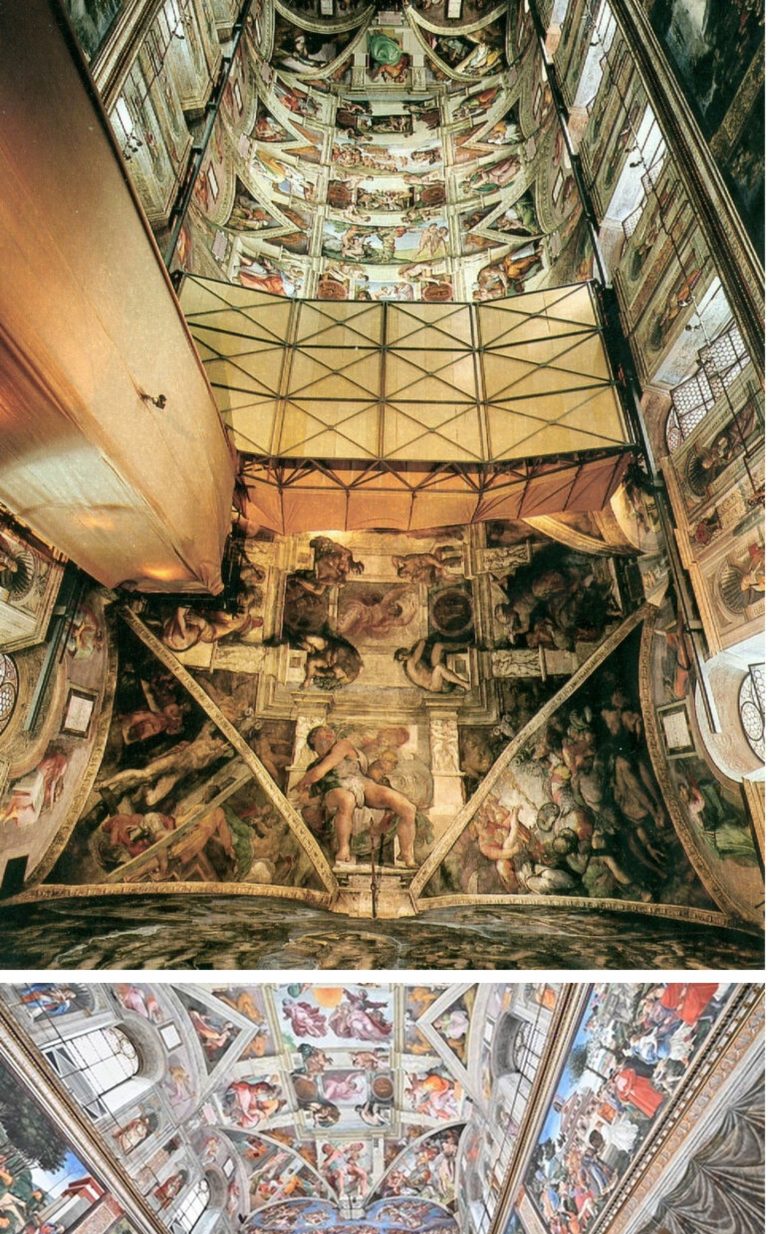
Above, Fig. 1, Top: National Geographic’s iconic photo-record of the Sistine Chapel ceiling which captured the last moments of the most acclaimed late stage of Michelangelo’s painting, including his The Crucifixion of Haman, the Prophet Jonah, and the Libyan Sibyl. Above, the post-cleaning, LED-lit chapel. When unveiled in 1512, the then brilliantly lit and shaded figures set in deep architectural spaces were eulogised for having made surfaces which physically advanced towards the viewer recede optically through Michelangelo’s powers of design and unprecedented deployment of lights and shades. At the time, no one spoke of Michelangelo’s colour – “brilliant” or otherwise.
TWIN AND CROSS-LINKED ASSAULTS ON A CRITIC
On 8 October 1987, halfway through the cleaning of the Sistine Chapel Ceiling, the restoration’s leading scholarly critic, Professor James Beck, Chairman of Columbia University’s Art History and Archaeology Department, was branded the “most culpable of the critics” by Sir John Pope-Hennessy in the New York Review of Books (“Storm Over the Sistine Ceiling”). Two months later, that attack was followed by another in the December Apollo magazine by Kathleen Weil-Garris Brandt (“Twenty-five Questions about Michelangelo’s Sistine Ceiling”). Like Pope-Hennessy, Brandt was a professor of Renaissance art at New York University’s post-graduate art history school, The Institute of Fine Arts (which incorporates a Samuel H. Kress Program-sponsored conservation department), and she was considered a long-standing friend by him.
Brandt characterised the restoration’s critics as “a tiny, heterogenous and vociferous cadre”. She likened their arguments to “the wild cries of some ferocious mutant of Chicken Little” and added “Many believe that the critics, like that benighted bird, were misunderstanding insufficient evidence, to draw mistaken conclusions to the alarm and detriment of the neighbours.” She conceded the issue “is a serious one” but only the better to sting: “Are the critics merely opportunists, bodysurfing in a wave of publicity they would never otherwise have enjoyed?” In his 2016 memoir, Michelangelo and I, Gianluigi Colalucci, the restorer/co-director of the Sistine Chapel restorations, described Brandt as “sweet and gentle in appearance but with a character of steel” who, having “obtained her own office in the museum complex”, had “put just about everybody under pressure with her inflexible activity”.
“THINGS ARE NOT AS YOU THINK”
There were degrees of hypocrisy in both attacks. Pope-Hennessy’s charge of professional culpability had followed his invitation to Beck to serve on a Metropolitan Museum Advisory Committee. As Colalucci would later disclose, Brandt’s denigration was not made as the self-effacing and disinterested scholar she had implied in Apollo – “Like many Renaissance scholars, I have held a kind of informal watching brief for the cleaning operation since its inception in 1981 [sic] and I talk on the subject with groups and individuals of all kinds.” Formally speaking, Brandt had two dogs in this fight. First, she had obtained her Vatican office as the official spokesman on “Scholarly and General information” for Arts and Communications Counsellors, a division of the New York Public Relations firm Ruder and Finn Inc. which had been retained by the Vatican to handle the restoration crisis. Second, she was a member of a shadowy, secretive scientific advisory committee the Vatican had set up, ostensibly, to monitor the controversial restoration. On learning of that committee, Colalucci threatened to resign but was dissuaded by his restoration co-director, Fabrizio Mancinelli, who urged him to calm down because: “You’ll see that things are not as you think…” In due course, Colalucci recalled, “we were given to understand that the findings were positive”.
As will be shown in Part III, the ploy of an institutionally self-appointed, supposedly invigilating but intended exonerating body, had been honed at the National Gallery in 1947 and 1967. Given the importance of the greatest art, whenever major restorations are started, they must, of political necessity, be defended unequivocally for the duration and at length thereafter, for fear of triggering institutional melt-downs. When a restoration of sacred art in a sacred place is funded in advance by a foreign corporation in a commercial exchange for film and photography rights, any admission of error becomes doubly inconceivable. Little surprise therefore that, as Colalucci disclosed, the Vatican’s own scientific advisory committee remained in place as a supportive “working group” throughout the entire restoration of Michelangelo’s Sistine Chapel frescoes. Headed by André Chastel, this group’s members, in addition to Brandt, were:
“Carlo Bertelli of Lausanne University, initiator of the restoration of Leonardo’s Last Supper executed by Pinin Brambilla [See: The Perpetual Restoration of Leonardo’s Last Supper, Part I: The Law of Diminishing Returns]; Pierluigi De Vecchi, an expert on Michelangelo; Sydney J. Freedburg from Washington; Giovanni Urban[i] former director ICR [the Istituto Centrale di Restauro]; Luitpold Frommell and Matthias Winner, directors of the Bibliotecca Hertziana in Rome; Umberto Baldini, director of the ICR [and head of the Brancacci Chapel restoration]; Michael Hirst, an expert on Michelangelo’s drawings; John Shearman, an expert on Raphael and the Sistine Chapel…The restorers were Alfio Del Serra from Florence…and Paul Schwartzbaum from New York, head of the ICCROM school and projects in Rome. Norbert Baer from New York University was the only chemist.”
THE SAMUEL H. KRESS FOUNDATION INTERVENTION
Colalucci aired a secondary grievance concerning the advisory committee in 2016: “By express desire of Chastel and the other members, we were not allowed to inform the press of the work of this group of experts, even though it would have been of great benefit to us because” [the quasi-invigilators] “wished to keep a low profile and avoid the attention of the already overly excited public opinion”. However, “Shortly afterwards, Marilyn Perry, the pleasant and dynamic president of the Kress Foundation, set up another working group, this time consisting almost exclusively of restorers on her own initiative.”
“The members were Mario Modestini, the foremost restorer in America; John Brealey, director of the restoration department of the Metropolitan Museum of Art in New York; the young Dianne Dwyer, then assistant to John Brealey [see Fig. 11 below]; Andrea Rothe, director of the restoration department of the J. P. Getty Museum in Malibu; David Bull, director of the restoration department of the National Gallery in Washington [see Figs. 2 and 3 below]; and Leonetto Tintori, a highly skilled restorer from Florence [see Fig. 3 below].
“The group’s task was to monitor our work, give advice and put forward criticisms. The [single] meeting was very fruitful and ended positively with a report drawn up [by] the members of the group aimed in particular at public opinion in the United States.”
The resulting open letter from this committee to the American press executed its expressly intended effect to perfection. In April 1987, Time’s art critic, Robert Hughes, claimed:
“…most experts on Renaissance art, and on Michelangelo in particular, strongly endorse it and reject out of hand the anti’s allegation of haste or insufficient study…Last week a further vote of confidence came from the Samuel H. Kress Foundation, a long-established non-profit organisation concerned with the care and preservation of Italian art. Six of the world’s leading conservators… reported in an open letter that the ‘new freshness of the colours and the clarity of the forms on the Sistine Ceiling, totally in keeping with 16th century Italian painting, affirm the full majesty and splendor of Michelangelo’s creation’”
John Russell reported in the New York Times:
“An international Group of leading conservators of Italian paintings has given its unanimous and strongly enthusiastic approval to the current restoration of Michelangelo’s frescoes in the Sistine Chapel in Rome…Though not intended as a riposte to recent criticism of the restoration the report could be said to rebut the attacks that have been made upon it. Among those who have opposed the restoration are Prof. James Beck of Columbia, Alexander Eliot, formerly of Time Inc. and a group of 14 American artists who asked the Pope to halt the work…”
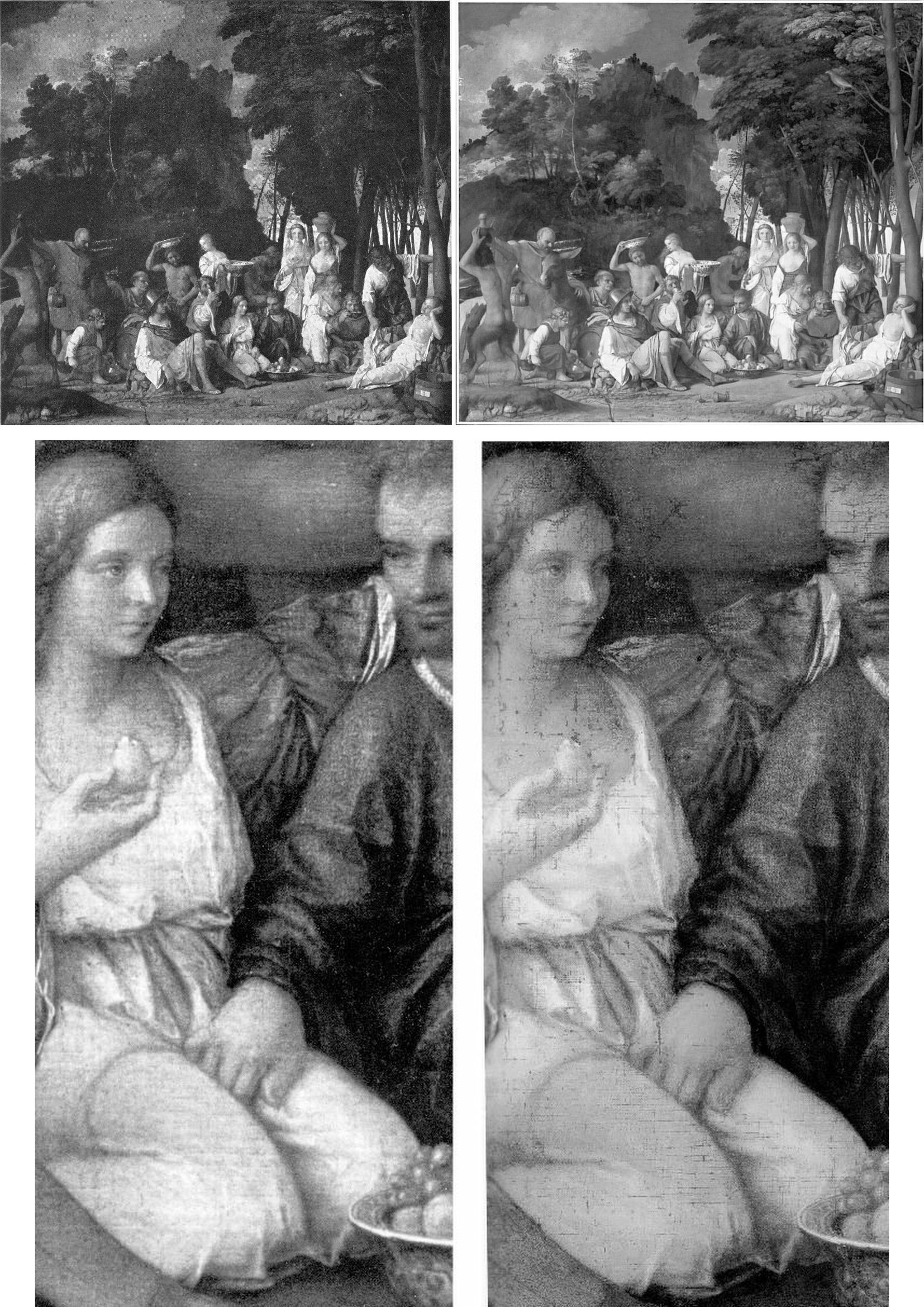
Above, Fig. 2: Top, the David Bull-restored Bellini/Titian Feast of the Gods, (before cleaning, left; after cleaning, right); below, a detail before cleaning, left, and immediately after cleaning, right. If Bull had simply removed a discoloured film of varnish, the previously discernible tonal values would have emerged enhanced – and not, as seen, diminished, compressed, and with a flattening of previously tangible forms. Such losses were Bull’s forte: when he restored Turner’s Rockets and Blue Lights (Fig. 3, below), one of the picture’s two distressed steamboats disappeared and its plume of once-black smoke was painted into a waterspout. (When that restorations-wrecked picture was sent to the UK on a tour, credulous British art critics took their lead from a Tate Gallery press release and gushingly proclaimed it “One of the stars of the show”.)
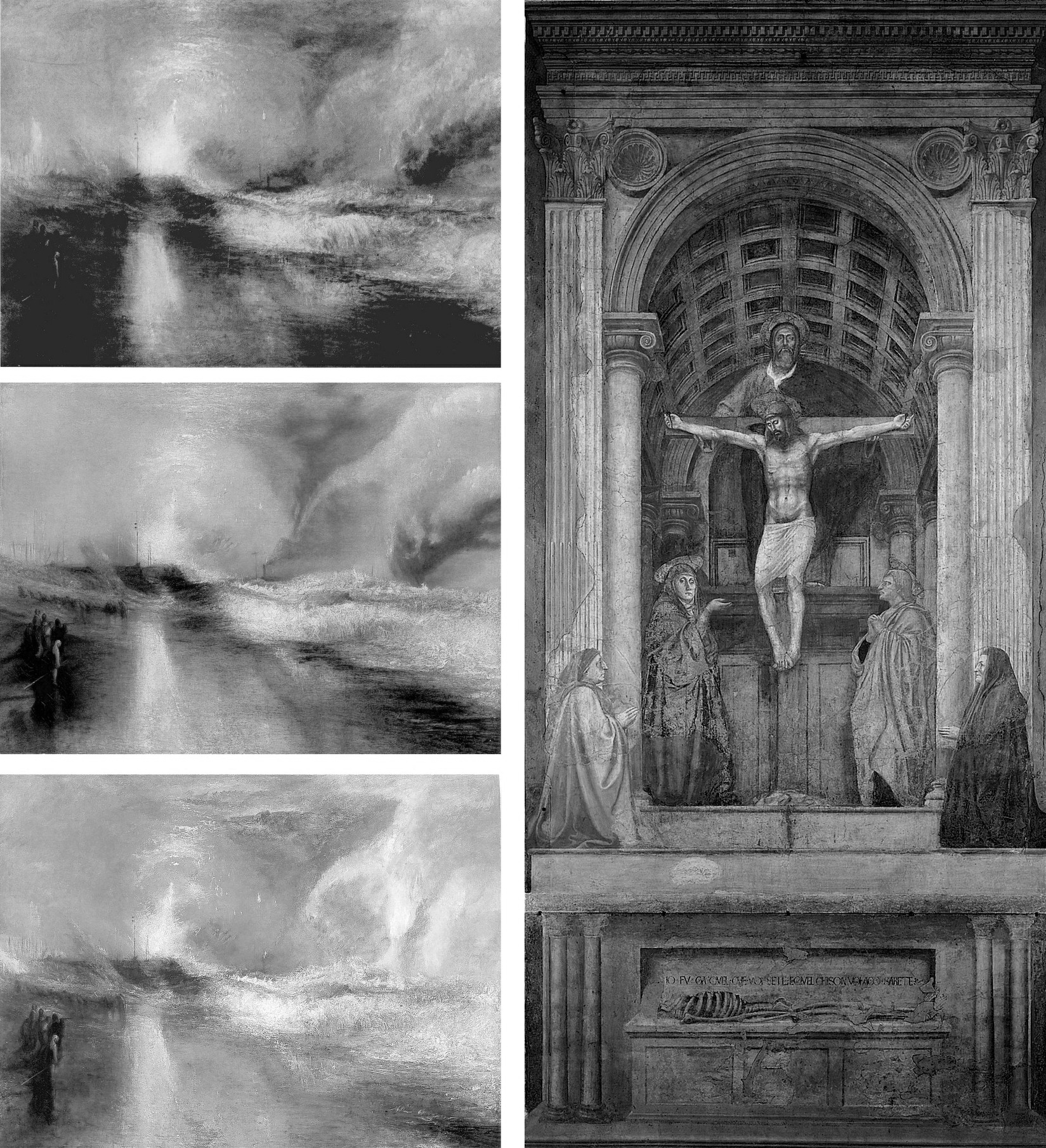
Above, Fig. 3: Left, Turner’s painting of two steamboats in distress, “Rockets and Blue Lights…” as seen in: 1896 (top); 1934 after restoration by William Suhr (centre); 2003 after restoration by David Bull (above). Right, Massacio’s Holy Trinity in the Santa Maria Novella, Florence, after restoration by Leonetto Tintori.
SUCKERED ART CRITICS
Where the Kress Committee’s open letter achieved immediate propagandistic effect, it took time for the claimed unanimity of its expert endorsement to dissolve. In a 28 April 2012 post we made the following (uncontested) disclosures:
“ArtWatch has been haunted for two decades by a nearly-but-not-made restoration disclosure. In the 1993 Beck/Daley account of the Nippon TV sponsored Sistine Chapel restoration (Art Restoration: The Culture, the Business and the Scandal), we reported that in the late 1980s Leonetto Tintori, the restorer of Masaccio’s Holy Trinity in the Santa Maria Novella, Florence [Fig. 3, above] and a member of the international committee that investigated the controversial cleaning, had urged the Sistine team privately to preserve what he termed ‘Michelangelo’s auxiliary techniques’ which in his view included oil painting as well as glue-based secco. What we had not been able to say was that Tintori (who died in 2000, aged 92) had prepared a dissenting minority report expressly opposing the radical and experimental cleaning method.
“Shortly before the press conference called to announce the committee’s findings, Tintori was persuaded by a (now-deceased) member [Fabrizio Mancinelli] of the Vatican not to go public with his views. He was assured that his judgement had been accepted and that what remained on the Sistine Chapel ceiling of Michelangelo’s finishing auxiliary secco painting would be protected during the cleaning. With a catastrophically embarrassing professional schism averted, the restoration continued and the rest of what Tintori judged to be Michelangelo’s own auxiliary and finishing stages of painting was eliminated. Without knowledge of Tintori’s highly expert dissenting professional testimony, the public was assured that despite intense and widespread opposition the cleaning had received unanimous expert endorsement. Critics of the restoration were left prey to disparagement and even vilification.”
Our 1993/2012 claims on the dissent within the international committee had been double-sourced by James Beck and the Florence-based art historian Richard Fremantle in conversations with Tintori (a member of ArtWatch). They became triple-sourced and document-backed on 8 June 2011 when the Titian expert and former director of the Warburg Institute, Professor Charles Hope, gave the following account when delivering the third James Beck Memorial Lecture (“The National Gallery Cleaning Controversy”) at the Society of Antiquaries, London:
“It would be unrealistic to suppose that those directly involved in the restoration would willingly concede that large areas of Michelangelo’s own work were removed. But even those who believe that the restorers did a good job ought to recognise that much of the controversy could have been avoided if a more careful assessment of the art-historical evidence had been carried out before the restoration began. But no serious investigation was made of the records of earlier restorations, the issues raised by Wilson were not addressed, and Vasari’s testimony was accepted as conclusive evidence that Michelangelo only used buon fresco, without any recognition of its problematic character (which was well understood in the nineteenth century) and without any discussion of the evidence of Armenini. In this context, one might also mention an article in the 1995 Revue de l’art by Leonetto Tintori, the most experienced restorer of Tuscan frescoes of his generation, who died in 2000 at the age of 92. Tintori was consulted about the desirability of restoring the ceiling, and I understand that he opposed it. The most important point in his article is that the technique supposedly used by Michelangelo on the ceiling, buon fresco alone, with only very small additions in secco, was entirely inconsistent with the practice of other painters in Tuscany, from Buffalmacco to Lippi and Sarto; and the same point was made by Eve Borsook [art historian and author of the 1960 and 1980 The Mural Painters of Italy] in the same journal. Tintori ended his article by deploring the modern practice of ever deeper cleaning, concluding, ‘This new orientation aimed at the total restitution of the original paint has had the paradoxical effect that the appearance of pure authenticity has become increasingly rare.’ Given his membership of the [Kress-assembled] committee that recommended, apparently against his own advice, the restoration of the ceiling, he could hardly have attacked the results explicitly, but it cannot be by chance that he chose to say what he did, a year after the publication of the [Vatican’s] final restoration report.
WHO HAD KNOWN OF TINTORI’S DISSENT?
In his 2016 memoir, Colalucci made no mention of Tintori’s opposition or his 1995 Revue de l’art views on the destructiveness of the Sistine Chapel restorations – his sole reference to the opposing restorer came in his above-cited composition of the Kress committee. Presumably, all other members of the working group – Modestini; Brealey; Dwyer [-Modestini]; Rothe and Bull had known of his opposition, as had Mancinelli. Perhaps Marilyn Perry and Colalucci had not known, but, certainly, Robert Hughes, John Russell, and very many other journalists were duped. Brandt gave no hint of Tintori’s opposition in Apollo but she stopped fractionally short of claiming unanimity:
“Everyone agrees with David Bull, Head of Paintings Conservation at Washington’s National Gallery of Art, that ‘the work being done on the frescoes should be meticulously watched, examined and questioned… (Fresco conservators seem not to be disturbed by the cleaning.)”
POPE-HENNESSY’S ATTACK ON BECK
When dubbing Beck the most culpable scholar/critic, Pope-Hennessy detached himself from his professional obligations:
“If you are an art historian, it is essential to free yourself from the fetters of your profession. The Sistine Ceiling is no more the property of art historians than the Ninth Symphony is the property of musicologists.”
The analogy was perversely inapt: in the Sistine Chapel, two recently appointed young officials – an art historian/curator and a quasi-scientific restorer – were rewriting a score they had ignorantly/wilfully misread in defiance of their predecessors’ views and reports and they were demanding that musical history be re-written to sanctify their systematic adulterations.
Pope-Hennessy was not alone in standing on such treacherous ground – he was running with a pack. His denunciation of Beck was made in a review of the 1986 book The Sistine Chapel: The Art, the History, and the Restoration (- published in the UK as The Sistine Chapel: Michelangelo Rediscovered). The book carried accounts from the three principal Vatican agents of the restoration: Professor Carlo Pietrangeli (Director General of the Vatican Museums); Dr Fabrizio Mancinelli (Curator of the Vatican Museums’ Byzantine, Medieval and Modern collections); and Gianluigi Colalucci (the Vatican’s Chief Restorer) – the latter two being the restoration’s co-directors. Their views were implicitly endorsed by accompanying scholarly essays from André Chastel, Pierluigi de Vecchi, Michael Hirst, John O’Malley, and John Shearman. The book was co-published by the Nippon Television Network Corporation which had sponsored the 1980-1994 restoration for $3million in exchange for all film and photography rights throughout each of the restoration’s three stages (the upper wall lunettes; the ceiling; and the Last Judgement altar wall) and for three years afterwards on each part.
INDEFENSIBLE METHODS
Pope-Hennessy appreciated that the restoration breached fundamental protocols by being conducted piecemeal on a narrow, enclosed platform when under intense film-set lighting that denied the restorers any means of appraising the actions and artistic effects of their radical, oven cleaner-like gelled cocktail of soda, ammonia, and detergents. (See Figs. 1 and 4.)
The cleaning paste, AB57, had been formulated to strip all historic organic materials from the plaster surface in two three-minute applications set twenty-four hours apart and removed each time with copious amounts of sponged water. The solvents-contaminated rinse water saturated the fresco plaster so completely that underdrawings on a lower plaster layer became visible. Empty assurances were given that a new air-conditioning system would protect the newly exposed bare plaster surfaces from the Chapel’s notoriously high levels of dirt, humidity, and fluctuating temperatures. Reports later emerged of secret night-time removals of white powder accumulations on the ceiling frescoes. By 2013 the ceiling had been lit to brighter and more colourful effect with powerful LED lights, when the chief defence of the restorers had been their supposed recovery of originally brilliant colours. See “The Twilight of a God: Virtual Reality in the Vatican” where we asked:
“Given this recent history, might Prof. Brandt – or any of the restoration’s supporters at that time – ever have imagined that within a couple of decades the Vatican would conclude that the chromatically brilliant ‘New Michelangelo’ would require artificial lighting ten times more powerful than that installed at the time of the restoration?”
In 2016, Colalucci blamed the chapel’s initially too-powerful levels of artificial lighting for the cleaning controversy itself:
“None of us had realized that after cleaning, these frescoes needed minimal lighting in order to be seen correctly. We should have considered the fact that, having been painted to be seen solely in light from the windows or candles and torches, they would look wrong in very brights lights such as television crews use.”
Despite the claim that the restoration had recovered an original intense chromaticism in Michelangelo’s painting that required low levels of lighting, the apparently natural light entering through the chapel’s windows was subsequently turbo-charged:
“…in the end the entire lighting system was revolutionized and moved outside with quartz lamps behind the window panes in accordance with a project devised by the technical department for a combination of natural and artificial light. Today with the new [LED] technologies, the Vatican Museums have installed a new lighting system with good results.”
THE STILL-UNSOLVED ATMOSPHERIC POLLUTION PROBLEM
On 10 January 2013 we reported:
“It is now clear that having first engineered a needless artistic calamity, the Vatican authorities have additionally contrived a situation in which the already adulterated remains of Michelangelo’s Sistine Chapel frescoes are presently in grave physical peril. On January 2nd 2012 Art Daily carried an Agence France-Presse report on the panic that has beset the Vatican authorities over the present and worsening environmental threat to the Chapel’s frescoes:
“The Vatican Museums’ chief warned that dust and polluting agents brought into the Sistine Chapel by thousands of tourists every-day risk one day endangering its priceless artworks. Antonio Paolucci told the newspaper La Repubblica in comments published last Thursday that in order to preserve Michelangelo’s Last Judgment and the other treasures in the Sistine Chapel, new tools to control temperature and humidity must be studied and implemented. Between 15,000 and 20,000 people a day, or over 4 million a year, visit the chapel where popes get elected, to admire its frescoes, floor mosaics and paintings. ‘In this chapel people often invoke the Holy Spirit. But the people who fill this room every day aren’t pure spirits,’ Paolucci told the newspaper. ‘Such a crowd… emanates sweat, breath, carbon dioxide, all sorts of dust,’ he said. ‘This deadly combination is moved around by winds and ends up on the walls, meaning on the artwork.’ Paolucci said better tools were necessary to avoid ‘serious damage’ to the chapel… The Sistine Chapel, featuring works by Michelangelo, Botticelli and Perugino, underwent a massive restoration that ended in the late 1990s. The restoration was controversial because some critics said the refurbishing made the colours brighter than originally intended.”
POPE-HENNESSY’S MANIFEST AMBIVALENCE
Without addressing the invasive actions of AB57 – the use of which had been condemned by restorers, scientists, artists, and art historians – or the abnormal film lighting – Pope-Hennessy did acknowledge some of their artistically disruptive consequences:
“On the other hand, it must be recognised that the effect made by any section of the fresco is contingent on the cleaning not only of that section but of the areas contiguous to it. The figure of God the Father in the Creation of the World could be cleaned faultlessly, but it would appear less dominant if the equation between the figure and the fictive moulding around it were disturbed. This has occurred in the first half of the ceiling…where the upper strip of the [fictive architectural] framing is now too light. If this happened in the second half of the ceiling, there would be protests that the Genesis scenes had been diminished or spoiled. The present width of the scaffolding is the equivalent roughly of one bay of the ceiling, and it is extremely difficult when standing on it to judge the relationship of the part of the ceiling that is within touching distance to the cleaned part beyond. I have repeatedly wondered whether it would not be prudent in the second half of the ceiling to employ a platform of double width, even at the cost of denying a larger area of the fresco to current visitors.” (Emphases added.)
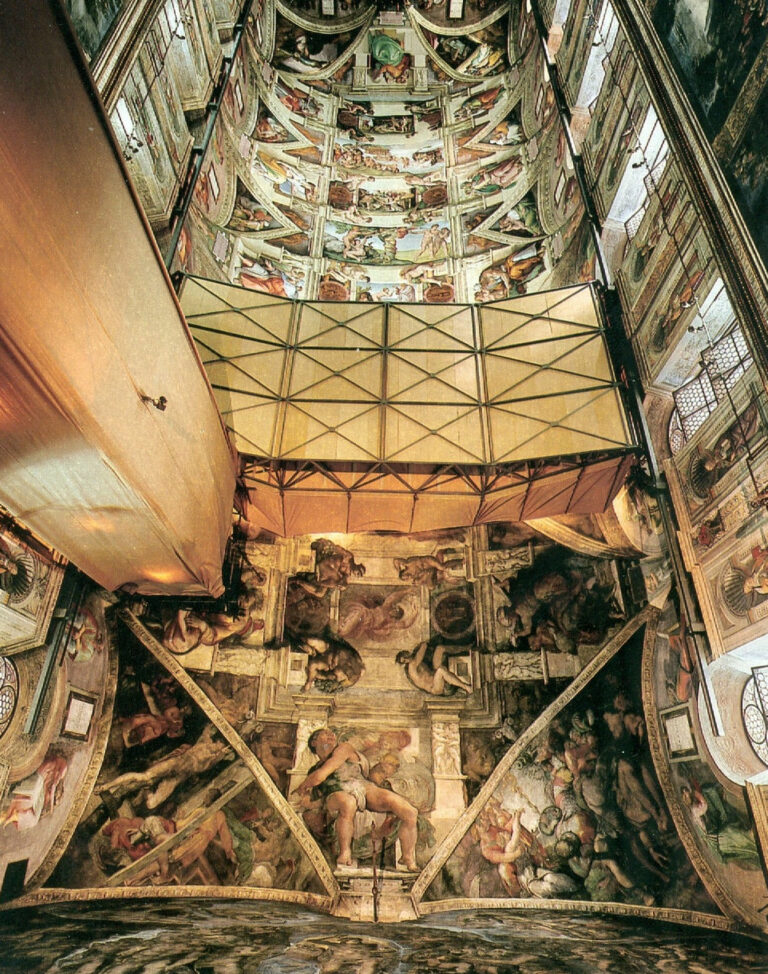
Above, Fig. 4: The Sistine Chapel ceiling showing the restorers and film-makers’ platform approaching the most brilliant, deep-space final stages of Michelangelo’s painting.
“TO RESTORE OR NOT TO RESTORE” – COLALUCCI’S BREACH OF PROTOCOLS
Had Pope-Hennessy’s suggestion been made and accepted (thereby tacitly acknowledging an unsound seven-year long procedure) it would have had no effect. Colalucci had stipulated the pre-set, no variations, two three-minute AB57 applications precisely to prevent his restorers from making individual appraisals for fear of undermining his desired aesthetic homogeneity. As he put it in 2016: “I wanted to have every square centimetre under my control and was reluctant to expose others to the risk of failure or controversy.” We can now be clear that this restoration truly was one man’s folly. On his unwarranted and unfounded insistence that Michelangelo had not painted on the fresco surface, the restoration was reduced to the brutally simplistic and non-artistic goal of executing the most technically expeditious removal of all historic materials from the plaster surface – which, in truth, was to say, primarily, the last stages of Michelangelo’s own work. For this reason, even if the restorers had been able to compare the already cleaned fresco sections with the one being cleaned, they had no authority to depart from Colalucci’s twin, three-minutes AB57 applications procedure. Later, in self-exculpation at a Kress-organised conference in New York, Colalucci claimed that the heat and the brilliant film-set lighting had “fatigued the eyes” and made aesthetic appraisals impossible – when the decision to clean with AB57 had been taken before the deal with the Japanese film-makers had been struck.
On his own admission, Colalucci had sanctioned a procedure that breached the most fundamental restoration protocol of all – and one that had recently been stated by Professors Paolo and Laura Mora, the inventors of AB57 – that, at all times, the restorer and not the cleaning agent itself must assume responsibility for all the resulting changes of appearance in the work of art. The absence of declared support for the Sistine restorations by the Moras themselves is conspicuous. My (Leonardist) colleague, Jacques Franck, recalls – and may still possess – a 1980s Italian newspaper report in which it was claimed that the Moras had resigned from a Vatican committee because they had judged AB57 (which had been developed to remove traffic pollution from Rome’s marble buildings) unsuitable for Michelangelo’s frescoes. Had they been invited to serve on the Kress-assembled committee, along with Tintori – and if not, why not? Or on the Vatican’s own committee? Our researches had found a single enigmatic comment on the subject. In the Summer 1987 Art News (“Michelangelo Rediscovered”), M. Kirby Talley, Jr. wrote: “The decision to restore the Sistine frescoes was not taken lightly. ‘To restore, or not to restore, that’s the question you have to ask yourself every time you are confronted with a problem.’ cautioned Professor Laura Mora, restorer at the Istituto Centrale del Restauro and a leading authority on fresco conservation.” Talley continued: “This question was posed by the Vatican authorities, and the pros and cons were scrupulously weighed before the final go ahead was given”. No doubt they were, but the fact remains that contrary to the Kress-driven propaganda coup that may have turned Pope-Hennessy, three – and arguably, the top three – leading fresco authorities had not been on the scales. Brandt brought no clarification on the matter in Apollo with her gnomic observation “Fresco conservators seem not to be disturbed by the cleaning”.
SACRIFICING MICHELANGELO’S “COMMUNICATIVE POWER”
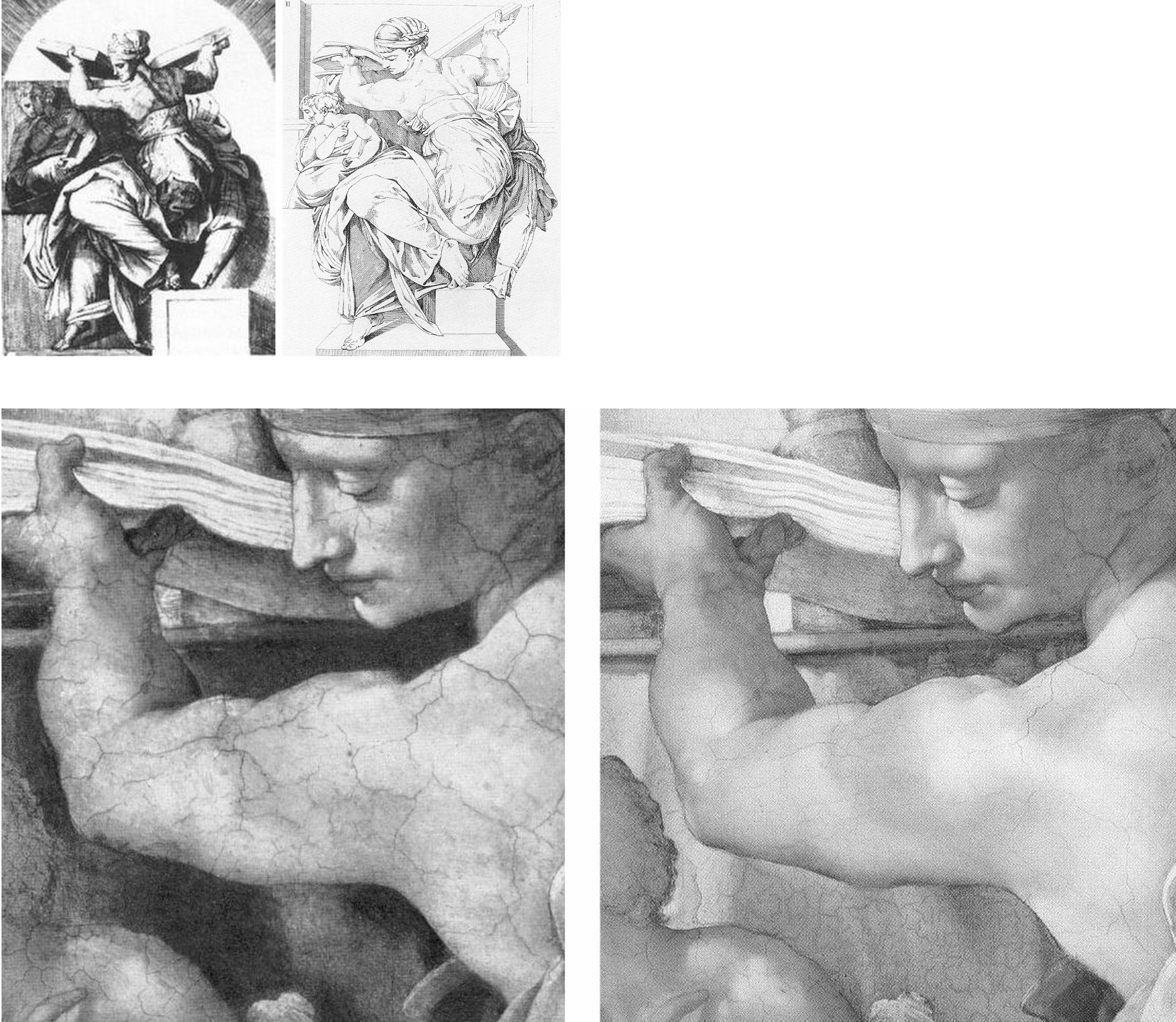
Above, Fig. 5, top: two engraved copies of the Libyan Sibyl, both of which showed the Sibyl’s left arm relieved by a tonally dark background; above, a detail of Michelangelo’s Libyan Sibyl before (left) and after (right) Colalucci’s cleaning and showing the profound and systematic losses of Michelangelo’s secco-extended tonal range of shading and aerial placements. As well as making broad-brush tonal adjustments, Michelangelo had – as Charles Heath Wilson had testified in the late nineteenth century (when very closely examining the ceiling from a special scaffolding) – also drawn secco revisions to contours and to many details such as hair and eyes. In the above photo-comparison, it can be seen that many lines which had clarified and reinforced details like the Sibyl’s thumb, lower jaw, the hair band, and the edges of the giant book, had all perished in Colalucci’s soda/ammonia/detergent double-washing. Further, Wilson had supplied an incontrovertible material/scientific proof that the secco painting was Michelangelo’s own: the secco painting had cracked as the plaster had cracked. The ceiling had begun cracking in Michelangelo’s own lifetime. Had the painting been applied centuries later by subsequent restorers, as the Vatican claimed on no evidence, it would have run into the cracks. It had not run into the cracks – but the world heard nothing of this: Wilson’s crucial, utterly subverting testimony on the secco painting had been air-brushed out by all players at the Vatican and, wittingly or unwittingly, by all of their art historical supporter/apologists.
For his part, Pope-Hennessy harboured and instanced futher (well-founded) aesthetic and historical anxieties:
“…you come in, as you have always done, through the little door under the Last Judgement and look up, speechless at the rebellious Jonah, the melancholy Jeremiah, and the Libyan Sibyl heroically supporting her colossal book [Fig. 5, above]. But about halfway down the chapel is a scaffolding resting on rails along the walls, covered with mustard-coloured fabric on which appear the shadows of ordinary mortals busily at work. [Fig. 4, above.] Beyond it you look towards the Zechariah, the Joel, and the Delphic Sibyl, suffused with light and seemingly the work of another, more lively, more decorative artist…Inevitably, judgement contains a strong subjective element, the more so as two kinds of verdict are involved, short-term judgement dominated by pleasure at the unwonted freshness of paint surface and long-term judgement in which one asks oneself whether the image has the same communicative power that it possessed before… Each time I go back to the chapel and sit, as I have so often sat, before the pitted surface of the Jeremiah, I feel concern that future generations may be denied an experience that raised the minds and formed the standards of so many earlier visitors. This is the basis of the claim of Beck and many others that the cleaning should be suspended at this point.” (Emphases added.)
Against all of which, he baldly insisted: “If there were the least reason to believe that the late frescoes would be overcleaned, this would be a valid view. But there is no evidence of overcleaning in the restored section of the chapel and there is no reason to suppose that the later frescoes will be treated less judiciously.”
THE WILFULLY DISREGARDED HISTORICAL VISUAL RECORD
On Pope-Hennesy’s own – albeit limited – admissions, there was every reason not to take the Vatican restorers’ methods on trust, not the least of these being the fact that, as any visually alert scholar should have appreciated, the many copies of the Ceiling made from Michelangelo’s day to our own, had all testified to his secco overpainting:
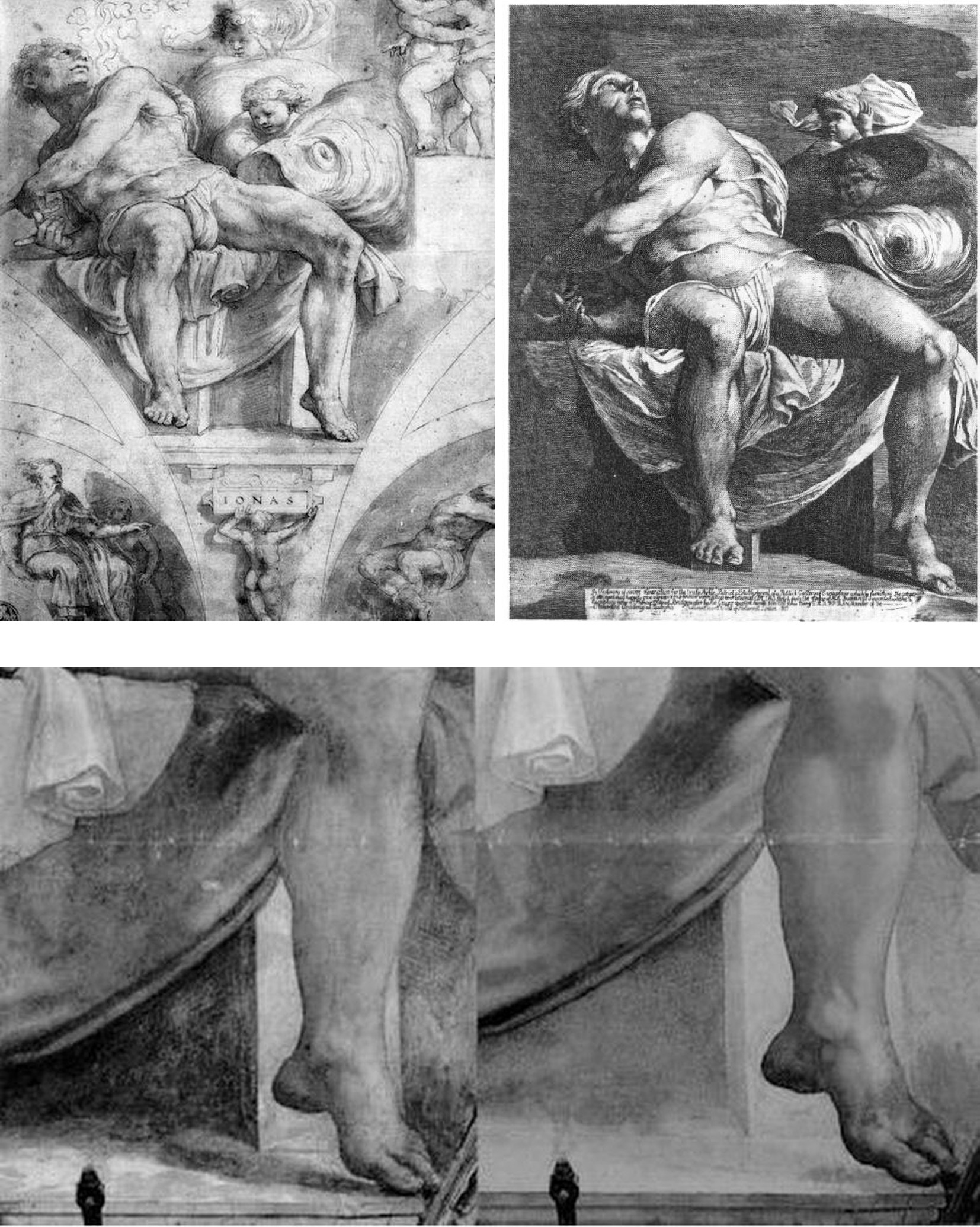
Above, Fig. 6: Top, left, the ink and wash copy of Michelangelo’s Sistine Ceiling figure Jonah, made between 1524 and 1534 by Giulio Clovio; top, right, a c. 1800 etched copy of Michelangelo’s Jonah by the Irish painter James Barry, R. A.; above, left, a detail of Michelangelo’s Jonah before Colalucci’s cleaning and showing the then surviving secco remains of the Clovio-copied dramatic shadow cast from the Prophet’s left foot; above, right, Jonah’s left foot after Colalucci’s elimination of the secco-enhanced shadows.
Disregarding all such historical visual testimony, the Vatican insisted that what had been understood since the 1512 unveiling to be Michelangelo’s own shadows, were arbitrary accumulations of soot trapped in “glue-varnishes” applied centuries later by successive restorers with sponges tied to thirty-feet long poles – poles of which, we established, no record existed and which, had they existed, would have stopped thirty-feet short of the ceiling. The phantom poles were summoned by Vatican officials in the absence – which we also established – of Vatican records of ceiling-high restoration scaffolding.
THE BOOK THAT WOULD HAVE BLOCKED THE SISTINE CHAPEL RESTORATION:
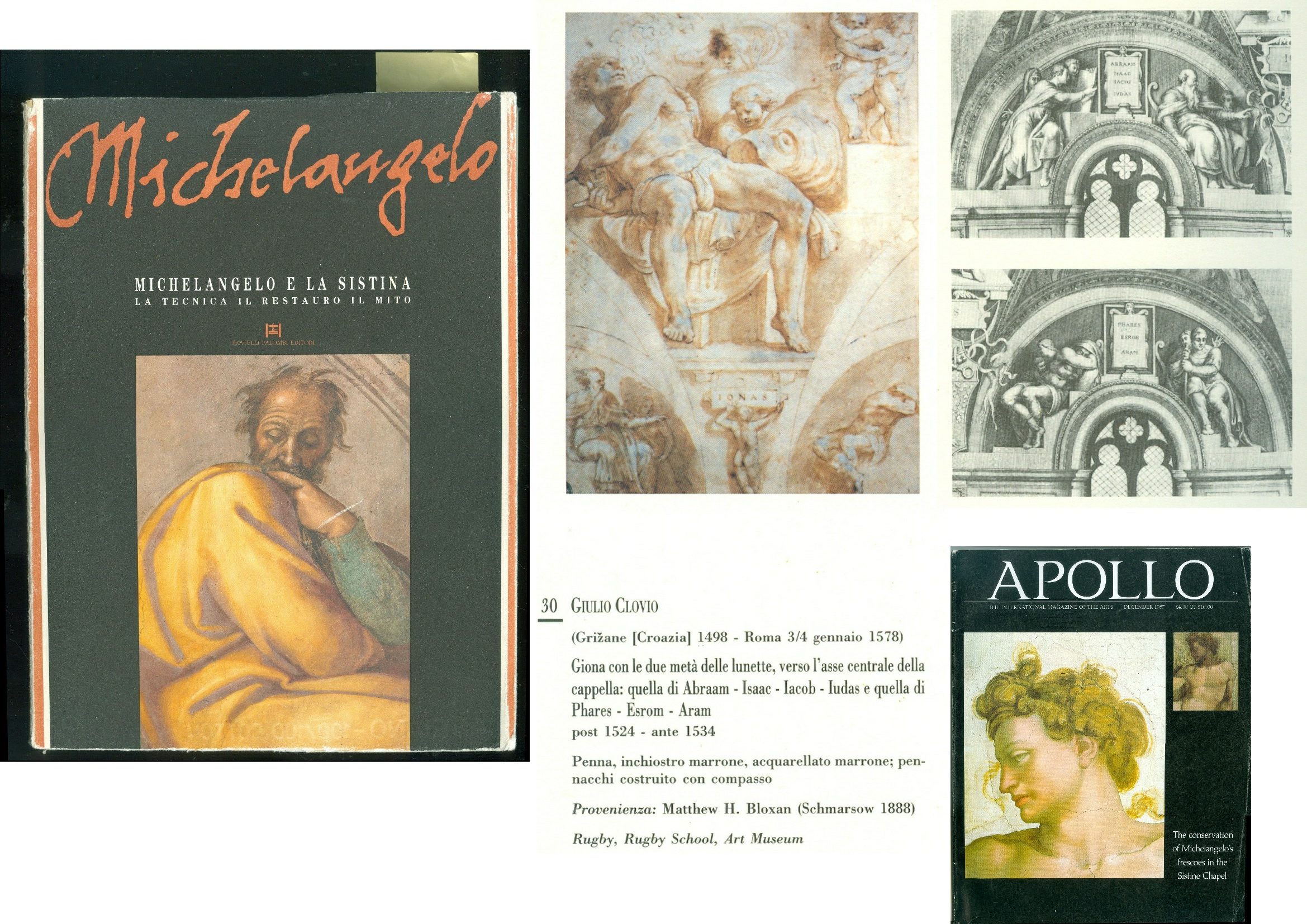
Above, Fig. 7: Left, the compendious 1990 book of historic copies of Michelangelo’s Sistine Chapel frescoes; centre, the book’s reproduction of Giulio Clovio’s Jonah drawing; right, the book’s reproduction of 19th century engravings (after lost copies) of the two lunettes Michelangelo had painted on the Chapel’s altar wall and would later destroy when preparing that wall for his Last Judgement.
Had the above book been published before 1980 and due consideration been given to Wilson’s account, a cleaning of the ceiling would have been stopped dead by the testimony of the above two images. The Clovio drawing alone constituted a proof positive that Michelangelo’s instantly-acclaimed lights and shadows had not only been present on the Ceiling but were also present on Michelangelo’s upper wall lunette frescoes – just as Colalucci’s Vatican restorer predecessors had reported. It did so because the two lunettes part-shown in its lower corners, were the very ones that Michelangelo destroyed to paint his Last Judgement. Thus, the sharply pronounced shadow that had been cast along the ground by Jonah’s left foot had been painted before any restorer had been near the frescoes. It could not, therefore, have been a freakishly artistic by-product of soot trapped within successive “glue varnishes” applied by restorers. Moreover, the glimpses of the shadows cast by Michelangelo’s lunette figures in Clovio were in turn confirmed by the etched copies of the two destroyed lunettes on the altar wall. Even the Clovio-recorded nude boy supporting Jonah’s name tablet had originally cast his own shadow on the wall before Michelangelo painted his Last Judgement.
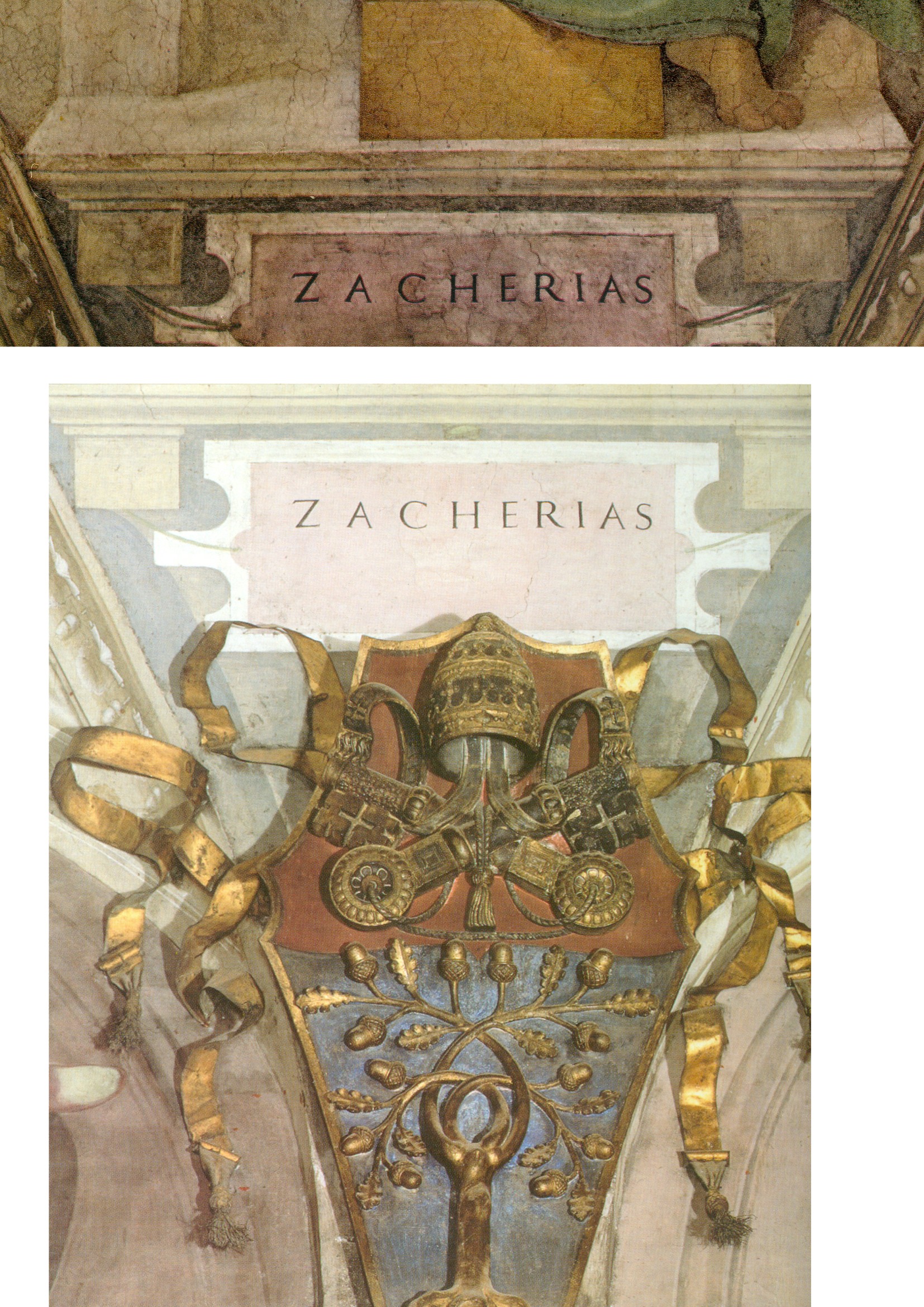
Above, Fig. 8: The name tablet for the Prophet Zacherias – top, before cleaning: above, after cleaning.
THE ELEPHANT ON THE CEILING
Michelangelo had not been the first artist to depict cast shadows. What stunned his contemporaries had been the thunderous force of spatial illusionism within which his figures had realised an unprecedentedly vivid sculptural presence-in-space. It was precisely in the wake of the illusionistic shading’s evisceration that Pope-Hennessy had (correctly) noted that where the name tablets had previously been “firmly integrated in the [real and fictive] architecture of the chapel…they [now] read like supertitles in an opera house” – see Fig. 8, above. To repeat: that tragically late-published book had shown beyond any dispute that there had been no break in the visual record of Michelangelo’s shadows from his day to ours – and, therefore, that the Vatican’s restorers had destroyed the finishing stages of Michelangelo’s own painting throughout the ceiling. In retrospect – and after all the account/demonstrations we have published (see, for example, Cutting Michelangelo Down to Size) – it might increasingly seem that this visually self-evident truth was a truth too big and too inconvenient in its implications ever to be ceded by the Vatican and the compliantly supportive art historical establishment it had garnered.
UNDERSTANDING POPE-HENNESSY’S SCHOLARLY BLANK CHEQUE
As a former director of both the Victoria and Albert Museum and the British Museum; a professor of art history at New York University’s post-graduate Institute of Fine Arts; and the very recently retired Chairman of European Paintings at the Metropolitan Museum of Art, Pope-Hennessy’s essay had effortless clout despite his self-subverting acknowledgements of both disturbing artistic results and – even – a wide distrust of the restoration among professionally sound peers. He opted to berate the critics while lauding the restorers, not on what they had done (on some of which he was critical) but on what he expected them to do next. Perhaps he had been privy to Mancinelli’s assurance to Tintori? He had certainly registered concern over of a group of cleaned Prophets and Sibyls:
“Optically, seen from the altar end of the chapel, they look a little smaller and less weighty than they did before. In the heads, a gain in definition is accompanied by a loss of ambiguity.”
Given that the visual arts work on and through their optical reception, how could Pope-Hennessy discount his own art historically informed, optically received, reading of diminished volumes and weights in Michelangelo’s figures? Perhaps he, like the art critics Hughes and Russell, had been swayed (or cowed) by the sheer authority of the supposedly unanimous Kress Foundation report? In any event, he wrote:
“…a gulf opened between those who adhered to the old concept of the ceiling and those who embraced the ceiling as it seemed originally to have been. The dispute was taken up in the American press, in largely polemical terms. There were demonstrations; and vociferous protests were made by both academic and non-figurative artists. The Vatican authorities went so far as to explain publicly, in two days of conferences in New York, the restoration program and the data on which it was based. Not unnaturally American criticism was reported throughout Italy, and had a disturbing, though not demoralizing, effect on the restorers involved. Arrangements, however, were made for a number of restorers of acknowledged excellence (three of them specialists in fresco decoration) to visit Rome, and they one and all endorsed the wisdom of what was being done.” (Emphases added.)
LEARNING TO LOOK
Aside from this explicit professional deference to a Higher Technical Authority in matters of aesthetic appraisal, other possible explanations for Pope-Hennessy’s stance emerged in his 1991 memoir, Learning to Look. This most distinguished scholar had a visual Achilles Heel – of time spent in an art school, he recalled “I disliked this too, and to this day I cannot draw.” Moreover, he had developed aversions to fellow art historians – and even (like Colalucci) to subjective judgements:
“One of the things about art history that I found puzzling from the first was that clever art historians (there were stupid ones too, of course, but a lot of them were really clever) should reach diametrically opposite conclusions on the basis of a tiny nucleus of evidence. The reason, so far as one could judge, was that the subjective element in art history was disproportionately large. If this were so, it was not only works of art that needed to be looked at in the original but art historians too, since their results were a projection of their personalities. So for some years, I made meeting art historians a secondary avocation.”
From the first, Pope-Hennessy had indeed made it his business to meet as many art historians as possible. When he left Balliol College, Oxford, with a second-class degree in history and an alumnus’s legendary “tranquil consciousness of an effortless superiority” (- in his case, specifically: “in the form of a self-confidence that sometimes verged on arrogance and a clear understanding of the difference between success and a succès d’estime”) he sold some inherited coconut islands off Borneo as income to be devoted “to travelling and to the preparation of a book” – and all this when, like Max Beerbohm’s Young Arnold Bennet, already having “a life plan in my mind.” During the Second World War he “found himself” in the Intelligence Department of the Air Ministry and there, for the first time, “met ordinary people” whom he considered “congenial and interesting”. In later life he expressed a preference for works of art over people of any kind:
“Objects mean more to me than people. It is not that I am frigid or reclusive, but that object-based relationships are more constant than human ones (they never change their nature and they do not pall).”
THE CHURNING “RAW MATERIAL” OF SCHOLARSHIP – AND A NEW SPECTATOR SPORT?
However, and despite his avowed attraction to the constancy of objects, as a self-made art historian, Pope-Hennessy came to welcome their radical alteration by restorers:
“People sometimes complain that there is nothing new to be said about Italian painting. They mean by this there are now monographs on many minor painters and that the works of great artists have been discussed in a large number of books. But the truth is that the raw material of Italian painting is in a constant state of flux. When paintings change through cleaning, our view of the artist who produced them changes as well.”
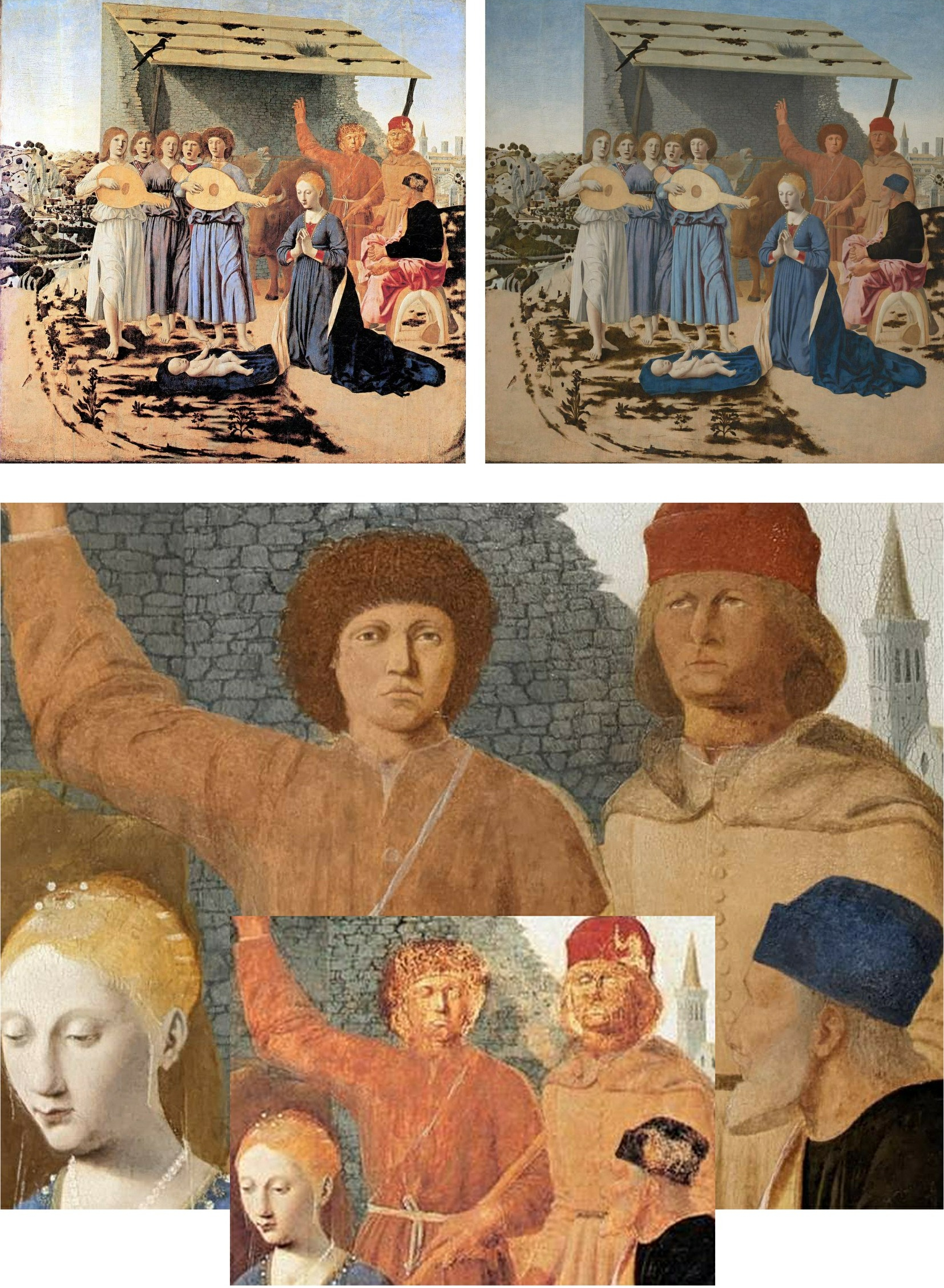
Above, Fig. 9: Top, the National Galley’s Piero della Francesca The Nativity before its latest restoration (left), and afterwards (right); above, a comparative detail showing the recently repainted shepherds and wall, with (inset) their previous state.
Like many of their scholarly peers, newspaper art critics have come to welcome the easy copy-generating potential of restorers’ alterations. In December 2022, Waldemar Januszczak of the Sunday Times, extolled the National Gallery’s controversially reconstructed Piero della Francesca Nativity (Fig. 9, above) and claimed that museums themselves now welcome “the inevitable brouhaha that follows any big restoration” because it “provokes interest and gets people through the door.” However, the art historian Giorgio Bonsanti deplored the intervention in IL GIORNALE DELL’ARTE and fears that such “controversies are destined not to subside but to remain and grow in future years, because the problem exists, and will remain evident to the millions of visitors to the National Gallery”. Scarcely less alarming to the Gallery must have been the Guardian critic, Jonathan Jones’, (earlier) assault on the repainted Nativity.
Jones had been the newspaper art critic of choice who was embedded within the Gallery’s conservation department during the restoration of its version of the Leonardo Virgin of the Rocks. The Evening Standard art critic, Brian Sewell, a student of Anthony Blunt at the Courtauld Institute, and a long-time scourge of National Gallery restorations, had been similarly co-opted within the restoration of Holbein’s The Ambassadors (Fig. 10, below). When so embedded, Jones predicted (wrongly) that “ArtWatch will attack the restoration”. On the Nativity, Januszczak similarly predicted: “There will be those, of course, who will howl at the changes – there always are.” In this case, at least three have now done so on the record – in addition to Jones and Bonsanti, in the March/April 2023 issue of the Jackdaw, its editor, David Lee (“Abbronzatura Solaire”), complained that aside from imposing complexions on the shepherds that are “more appropriate to Love Island than Bethlehem”, the Gallery has confounded a manifestly un-finished painting with a damaged finished painting.
Having previously studied the Nativity’s historic and restoration dossiers, we would add that this panel painting has likely suffered more accumulated restoration blunders than any other in the collection – with the possible exception, perhaps, of Giovanni Bellini’s Madonna of the Meadow. Both of those two pictures received disastrous “structural surgery” from a restorer (Richard D. Buck) who had been hired and brought over from America in 1948 by the National Gallery’s Director, Sir Philip Hendy, to introduce supposedly advanced conservation methods. Januszczak, who defends the Nativity’s recent repainting make-over on the grounds that “an active artwork that is doing what it is supposed to be doing must always trump a charming ruin”, begs the crucial question – “What is an historic picture supposed to do?” – and he clearly fails to appreciate that it is not Time and Neglect but, rather, restorers who, through their ceaseless Un-doing and Re-doing of pictures, create ruins. Where no auction house or dealer would dream of boasting that a picture on offer has had multiple restorations, museum pictures are treated today like so many bags on an airport carousel waiting to be picked up and done over on the whims and fancies of the next available restorer.
(Incidentally, Jones, Bonsanti, and Lee have by no means exhausted the many due criticisms of the Nativity’s latest restoration makeover. The ruined stone wall behind the repainted Shepherds, for example, has itself been repainted in a manner that robbed it of thickness and perspectival placement and left it running flatly across the picture plane, like so much stone-patterned wallpaper, to serve as a backdrop foil to the hypothetically reconstructed heads, as seen at Fig. 9.)
PROCLAIMED RESTORATION TRANSFORMATIONS – AND THINGS THAT CRITICS OVERLOOK
Where Pope-Hennessy had likened the Sistine Ceiling to Beethoven’s Ninth and noted that “another, more lively, more decorative artist” was emerging, Januszczak whooped at the spectacle of the transformation:
“The thin and neat scaffolding bridge moved elegantly along the ceiling like a very slow windscreen wiper. In front of it lay the old Michelangelo, the great tragedian, all basso profundo and crescendo. Behind it the colourful new one, a lighter touch, a more inventive mind, a higher pitch, alto and diminuendo. It was being able to see both of them at once – Beethoven turning into Mozart before your eyes – that made this restoration such a memorable piece of theatre.”
Unlike Januszczak, Pope-Hennessy had not always welcomed restoration-induced changes. In his 1970 book, Raphael, he observed: “But Raphael restored is Raphael interpreted; it is different from the real thing” – and in 1987 he would likely have known that a recent “Raphael restored” at the Vatican had proved disastrously different from the real thing. In 1982, Mancinelli had said of a bungled, chemically experimental restoration that required extensive repainting by Colalucci in Raphael’s Loggia, “It is the best demonstration that a restoration can also not go along well.” In 2016, Colalucci recalled that the Vatican had faced “a serious problem” when “a new inorganic substance that had not been sufficiently tried and tested” was used.
In 1991, as the Sistine Chapel restorations neared completion, Pope Hennessy reverted to his younger self’s restoration-critical stance and noted:
“In London since 1945 the National Gallery had been the target of ceaseless criticism. There had been intermittent controversies in the press over the cleaning of paintings, but successive directors had enjoyed the support of a passive, compliant board. The policy of Radical Cleaning had been espoused by Philip Hendy (who must have suffered from some retinal defect which made him see pictures as flat areas of colour) and had continued under his successors for so long that proof of the damage done to the collection over thirty years could be seen in almost every room.”
That judgement on National Gallery cleanings was sound and it constituted an international commonplace. Mario Modestini wept for half an hour at the sight the Gallery’s “flayed” restorations; in 1970 Pietro Annigoni painted “MURDERERS” on the National Gallery’s doors in protest; in March 1999 when I visited the Gallery with Professor Anatoly Alyoshin, head of the Repin Institute, St. Petersburg (Russia’s leading institute for the training of picture restorers), he was shocked by the paintings’ uniform brightness and seeming newness. Stopping between galleries, he swept his arm around and said “See! Everything in every school looks as if it was painted in the same studio at the same time.” In a sense, everything had been – after stripping paintings of all they judge extraneous, National Gallery restorers are permitted to this day to paint onto them whatever they take to have been an artist’s original intentions, even with pictures as old and venerated as Holbein’s The Ambassadors and Piero’s Nativity. Old masters are being treated like neglected scores awaiting the life-restoring interpretation of a would-be pictorial Furtwängler, von Karajan or Barenboim – but with the difference that where musical scores outlive their successive interpreters, a painting is its own score.
PURISM AND FAKISM: FALSE AGE CRACKS AND RE-INTERPRETATIONS ON RESTORED PAINTINGS
In the 1990s the National Gallery’s then head of restoration, Martin Wyld, contended: “The ‘Good Restorer’ is the one who ‘does the minimum necessary but not too little… we remove everything not put on by the artist and then use our judgement to get back to the original.” On 8 April 2023, the Financial Times (“Behind the seams at the museum”) reported that the present head of restoration, Larry Keith, said of his restoration of Parmigianino’s Saint Jerome’s vision of John the Baptist revealing the Virgin and Jesus, “We are editing, in a way. The work is informed by science and objective criteria, but there are decisions you take, which on some level are interpretive”. In an Esso-sponsored, BBC-filmed restoration of the Ambassadors (which has ceased to be available), Wyld was seen to have repainted much of the carpet to a new design on the authority of a “carpet expert”, and to have repainted much of Holbein’s famous anamorphic skull to a new and elongated design derived from a computer-distorted photograph of another skull. The Gallery’s defence of Wyld’s first-ever insertion of a Virtual Reality image into an old master painting was its claim that “modern imaging techniques” offered more “scope for exploring possible reconstructions” than the perspectival and optical conventions by which the skull had been produced. The pronounced differences between the Ambassadors’s old original paint and Wyld’s newly redesigned and presumptuously repainted parts of the skull, were concealed by his painting fake lines of cracking onto his own newly painted hypothetical reconstructions to match the real cracks on the real old paint.
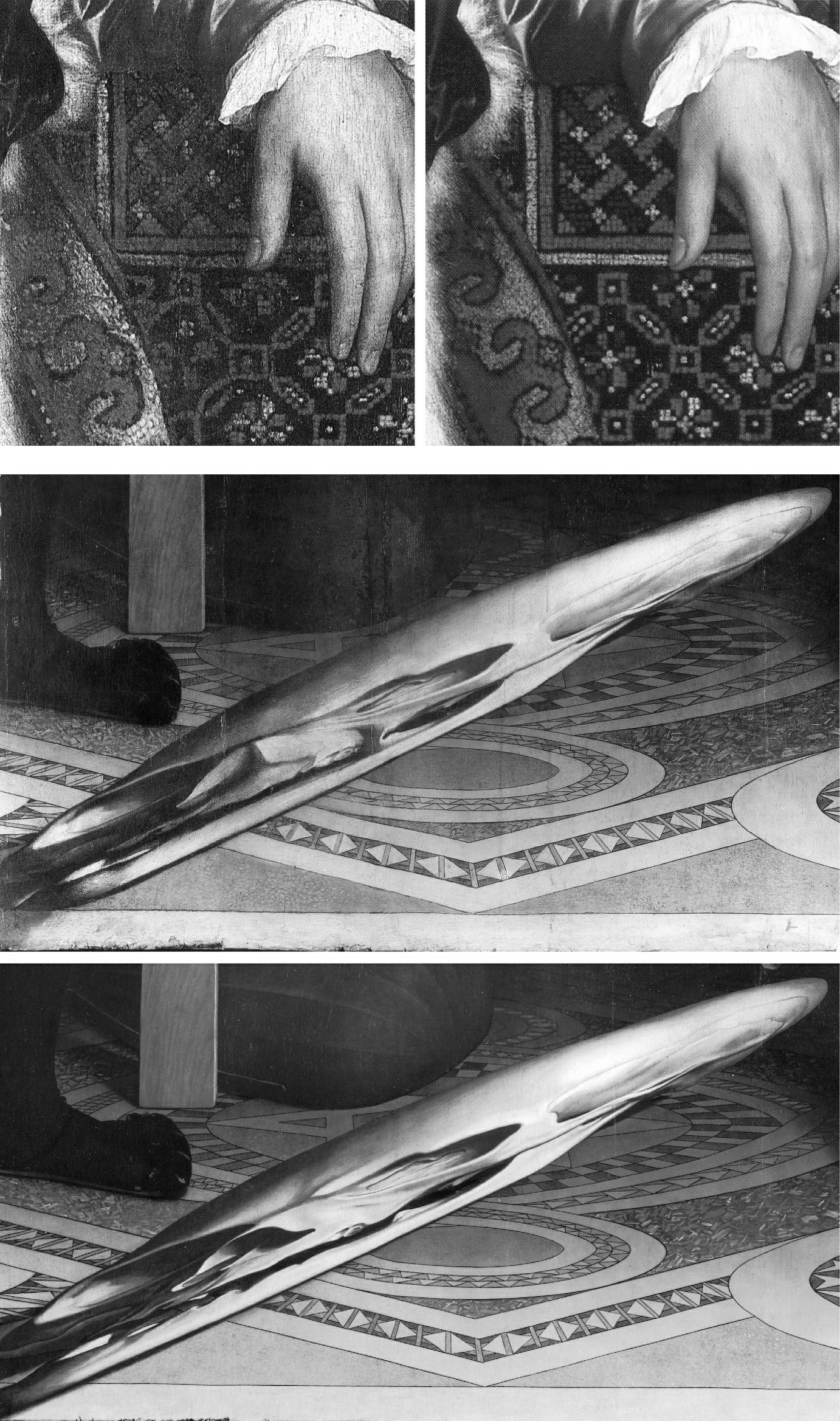
Above, Fig. 10: Top, a detail of Holbein’s The Ambassadors, showing a section of redesigned and repainted carpet, before treatment (left) and after treatment (right); centre, the pre-restoration anamorphic skull in Holbein’s Ambassadors; above, the Wyld-extended, computer-generated skull in the Ambassadors.
PRODUCING “DIFFERENT, MORE POWERFUL” IMAGES
The New York restorer and Kress-appointed Sistine Chapel invigilator, Dianne Dwyer Modestini (formerly Clinical Professor, Kress Program in Paintings Conservation at NYU’s Institute of Fine Arts) – very extensively repainted and artificially distressed the much-damaged Leonardo School Salvator Mundi that fetched a world record $450 million in 2017 at Christie’s, New York – prompting Thomas Campbell, a former director of the Metropolitan Museum of Art, to ask: “450 million dollars?! Hope the buyer understands conservation issues – #readthesmallprint”. Dwyer Modestini had published this small-print report of an early intervention in her decade long undoing and redoing of the picture:
“The initial cleaning was promising especially where the verdigris had preserved the original layers. Unfortunately, in the upper parts of the background, the paint had been scraped down to the ground and in some cases to the wood itself. Whether or not I would have begun had I known, is a moot point. Since the putty and overpaint were quite thick I had no choice but to remove them completely. I repainted the large missing areas in the upper part of the painting with ivory black and a little cadmium red light, followed by a glaze of rich warm brown, then more black and vermilion. Between stages I distressed and then retouched the new paint to make it look antique. The new colour freed the head, which had been trapped in the muddy background, so close in tone to the hair, and made a different, altogether more powerful image. At close range and under a strong light the new background is obvious, but at only a slight remove, it closely mimics the original [paint work] … Most of the retouching was done with dry pigments bound with PVA AYAB. Translucent watercolours, mainly ivory black and raw siena, were used for final glazes and to draw [false age-] cracks…” (Emphasis added.)
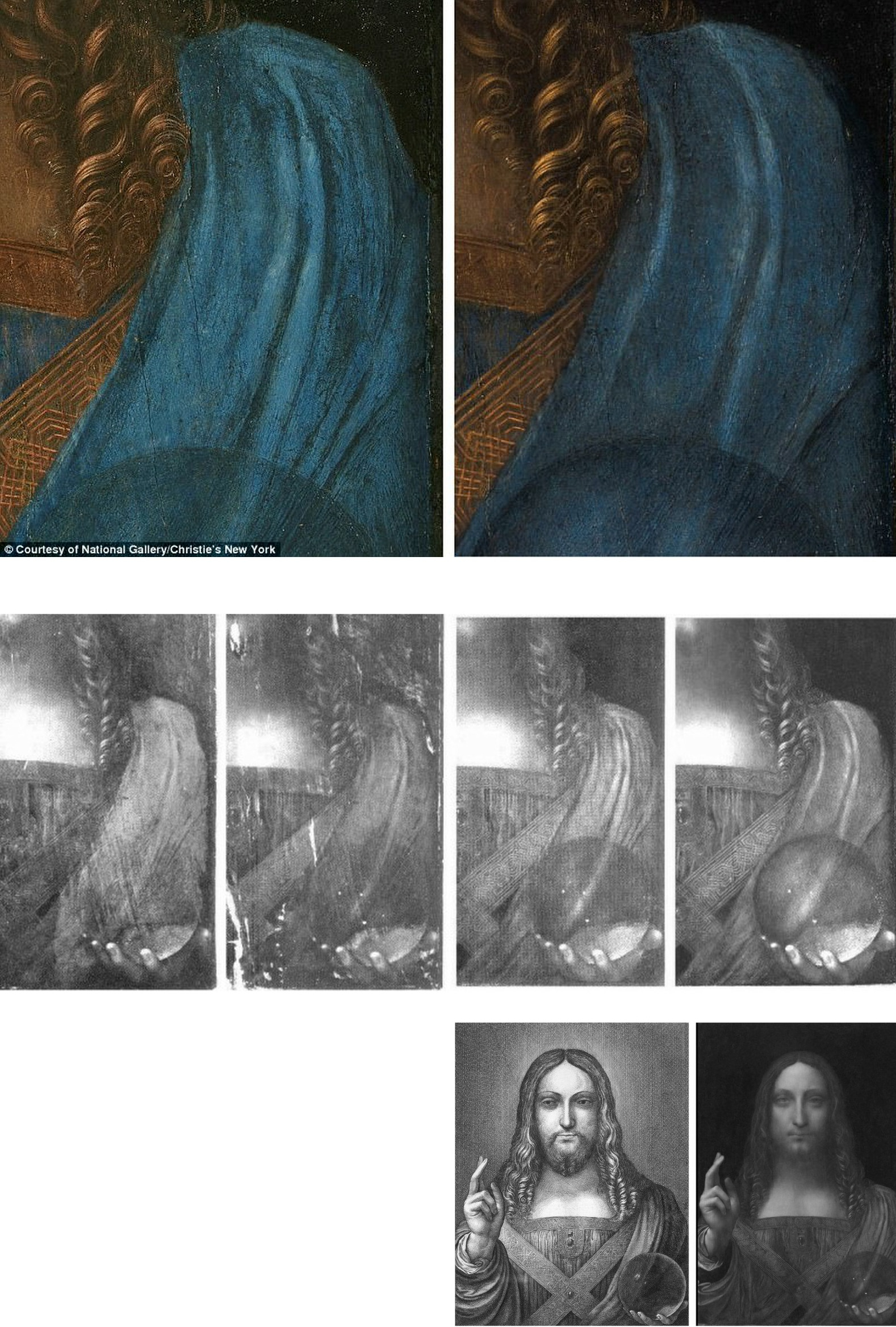
Above, Fig. 11: Top, a section of drapery on the $450million Leonardo school Salvator Mundi, as seen in 2011-12 at the National Gallery (left), and (right) as when sold in October 2017 at Christie’s, New York; centre row, showing left, and second left, the picture detail, as when acquired in 2005 and taken to Modestini for restoration; third left, the Modestini-restored picture detail when shown as an autograph Leonardo in 2011-12 at the National Gallery; and, right, the Modestini re-modified feature, as sold in 2017 as an autograph Leonardo, at Christie’s, New York; bottom row, left, the Wenceslaus Hollar engraving that was said by the National Gallery to have been copied from the National Gallery-exhibited Salvator Mundi picture (bottom right) when in the collection of Charles I. That claim was subsequently disproved when the lost Charles I Salvator Mundi emerged in Moscow and was seen to be of an entirely different composition – at which point, the previous resemblance of the painting’s complex shoulder drapery folds to those in the Hollar etching had become more of a disqualification than a potential corroboration.
CHRISTIE’S RESPONSE
In December 2017, Christie’s was presented with photographic evidence (Fig. 11, above, top) assembled by Dr Martin Pracher, a lecturer in technical art history, that showed the changed states of the Salvator Mundi’s (true left) shoulder drapery between 2012, when exhibited at the National Gallery as an autograph Leonardo prototype painting, and 2017, immediately before the $450million October 2017 sale at Christie’s, New York, in which the picture was offered as a then different but supposedly still-autograph Leonardo prototype that enjoyed “an unusually strong consensus” of scholarly support. Under Press questioning (see Dalya Alberge in the Daily Mail) a Christie’s spokeswoman said Modestini had “partially cleaned the passage of paint in the shoulder and the dark streaks disappeared… To imply something incorrect has taken place would itself be incorrect”. Thus, it was insisted that the recently “disappeared” multiple folds, were not folds but mere “dark streaks” that had appeared during Modestini’s 2005-2010 restorations only to disappear under her 2017 ministrations.
INSTITUTIONALLY SEALED LIPS
Of whatever it consisted, Modestini’s last-minute intervention had been made under sworn secrecy at NYU’s Institute of Fine Arts conservation studios, as she disclosed in her 2018 memoir, Masterpieces: Based on a manuscript by Mario Modestini. That is, when the Salvator Mundi returned to New York in July 2017 ahead of Christie’s November sale, Modestini, was instructed “not to inform anyone” when the painting was “delivered to the Conservation Center under guard and in great secrecy”. Modestini further disclosed that a deal brokered by Christie’s ahead of the sale whereby the vendor would receive at least $100million had also been “successfully kept under wraps.”
THE NATIONAL GALLERY’S ABIDING INFLUENCE ON RESTORATION “REVELATIONS”
When Pope-Hennessy deviated in 1987 from his earlier soundness on transformative restorations, he bought into the National Gallery’s longstanding picture cleaning rationale by endorsing two of the 20th century’s most spectacularly controversial restorations:
“In its cleaned form the [Sistine] ceiling has become again what Michelangelo’s contemporaries considered it, one of the supreme achievements of mankind. With Titian, the revelation started in the National Gallery in London, when the Bacchus and Ariadne was freed of centuries of dirt and proved to be painted in an altogether different tonality from any that had previously been supposed.”
That there had been no “centuries of dirt” to remove from the Titian will be shown in Part III. A fuller understanding of Pope-Hennessy’s late-life restorations lapse and an appreciation of the methodological and promotional similarities between the two most controversially transformative restorations in the second half of the twentieth century will be tracked through the records of the two successive National Gallery directors from 1934 to 1967, Sir Kenneth [later Lord] Clark, and Sir Philip Hendy. By the 1980s, that pair’s polished formulations had come to serve as an internationally infectious template for the unbridled techno-experimentalism seen in the Brancacci and Sistine chapels during what, for Colalucci, had constituted the terminus of “the golden age of restoration in Italy, the halcyon era from the late 1940s to the mid-1990s.”
In Part III, we correlate the false scholarship that flowed from the Titian Bacchus and Ariadne and Michelangelo Sistine Chapel restorations, along with the artfully engineered professional endorsements both restorations received from the then highest authorities.
Michael Daley, Director; 15 April 2023
An Appliance of Science in Art Historical Studies
A slim but eloquent and persuasive study of the assorted depictions of rock in Leonardo’s The Virgin and Child with St. Anne examines the pictorial means of the most perplexing figural invention in the artist’s oeuvre.
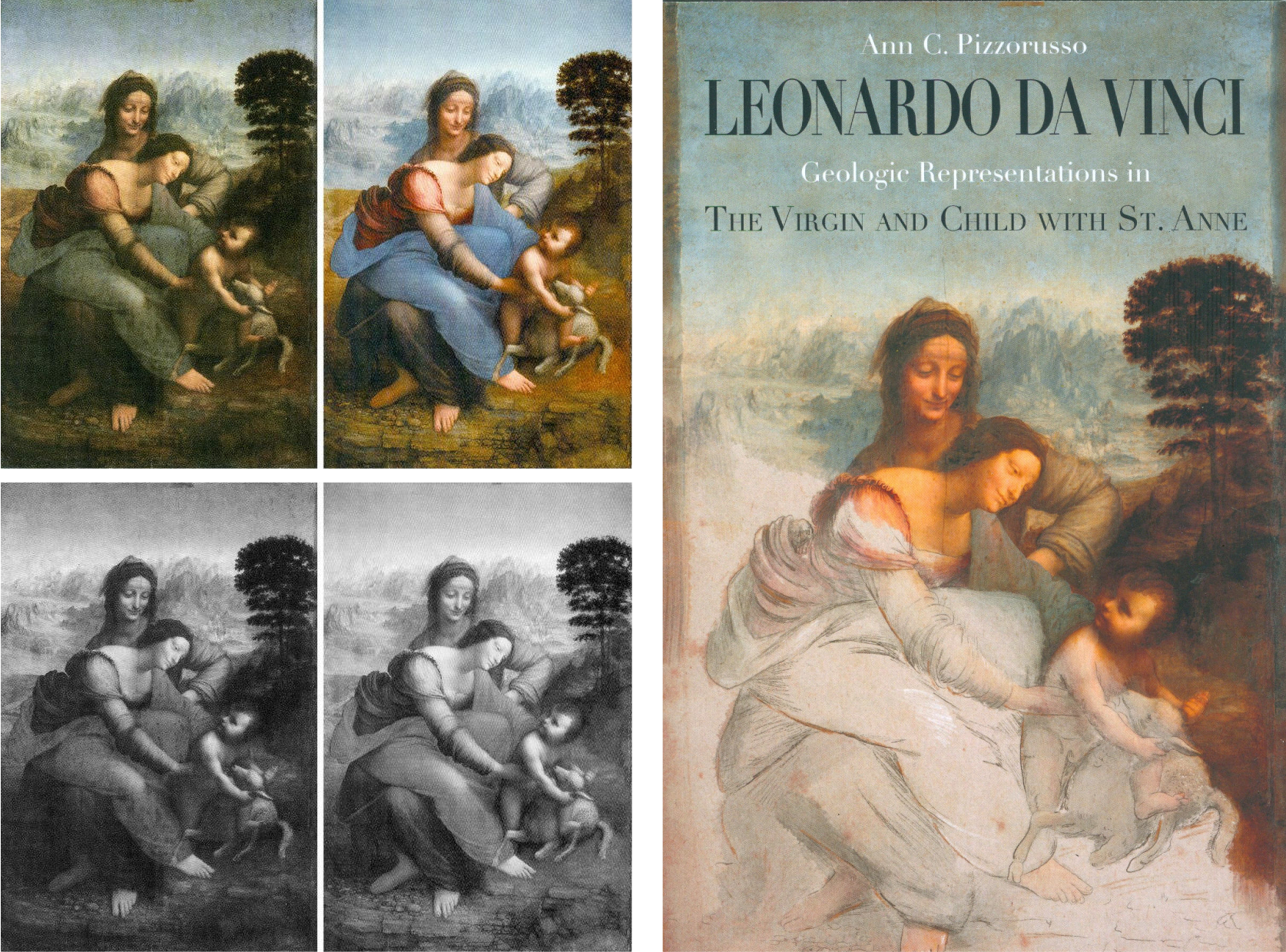
Above, Fig. 1: Left, Leonardo’s The Virgin and Child with St. Anne as seen before after its recent controversial cleaning at the Louvre; right, Ann Pizzorusso’s latest book – Cover design: Francesco Filippini.
This volume is slim because its material is handled with deft and engaging concision. Whether a bright child, a lay adult, or a professional art historian, the reader will enjoy and profit from this vivid journey through time and Italy – its geography; its mountains; its fauna, and, its most famous, multi-talented artist. As one Leonardo specialist puts it:
“The thrilling focus put by Ann Pizzorusso’s researches on the geology of Leonardo’s landscapes in works such as the Virgin of the Rocks and the Louvre’s The Virgin and Child with St. Anne is of foremost importance. Pizzorusso’s analyses and synthetic, clear explanations, help us better to understand Leonardo’s amazing attachment to a truthful, scientific-like, investigation into the world in which we live. Retrospectively, it also helps to see the Master at work concretely in his quest for perfection.” – Jacques Franck
(Ann Pizzorusso‘s work was cited extensively in the geology sections of Walter Isaacson’s biography of Leonardo, Leonardo da Vinci – see Fig. 5, below.)


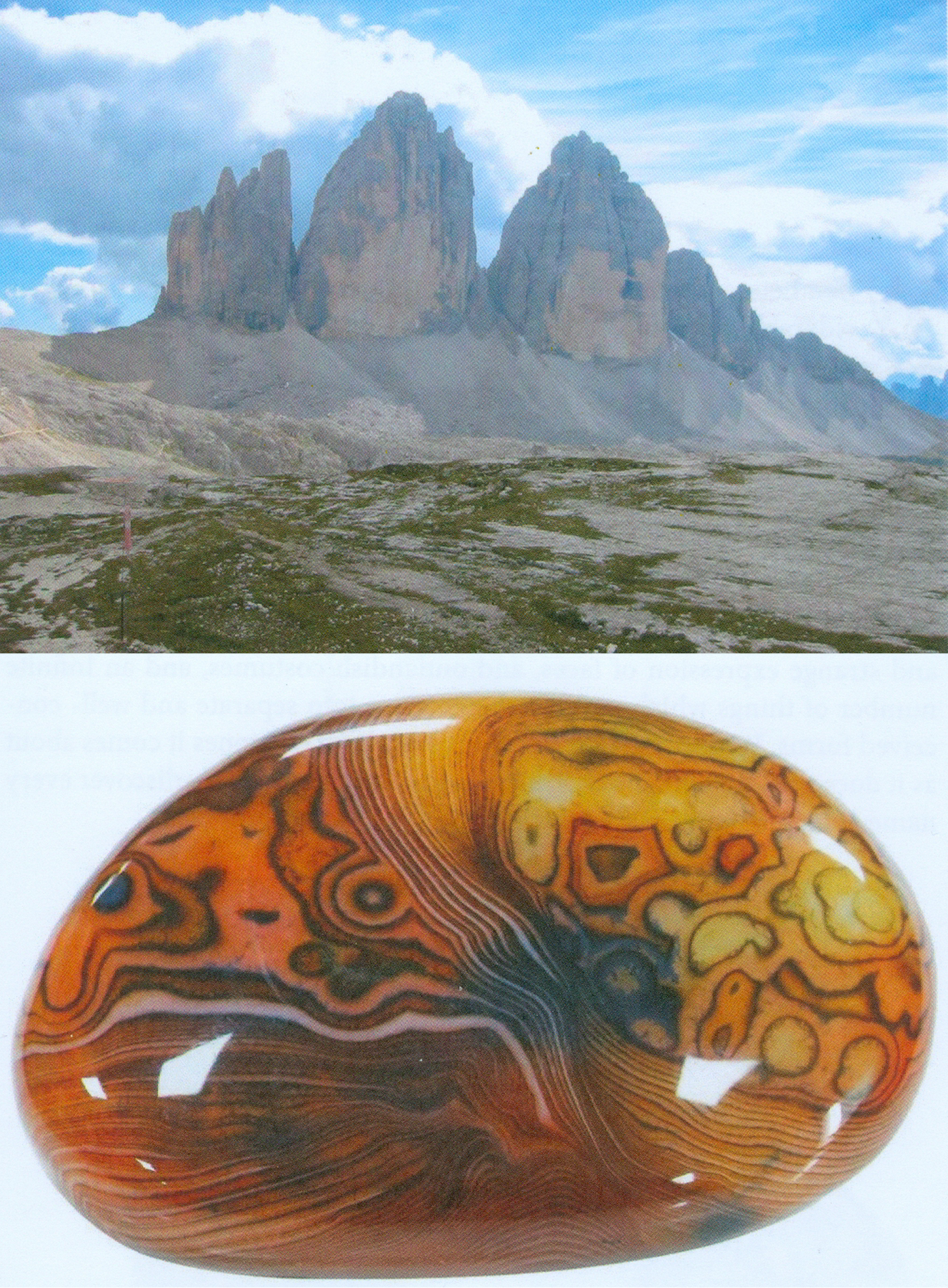
Above, Figs. 2, 3 and 4: A section of Pizzorusso’s focussed geological and botanical illustrations that run from the general to the very particular.
In current Leonardo art scholarship there are two practitioners who lay claim to direct scientific expertise. The first, Professor Martin Kemp, studied natural science at Downing College, Cambridge, with the aim of becoming a biologist but then, as he put it in his 2018 memoir Living with Leonardo, “steadily lost impetus in my studies of science” and “was drawn” into film, the visual arts and music. The second, Ann C. Pizzorusso, trained all the way through to qualifying and practicing as a geologist – but then, in the mid-1990s, “After many years of doing virtually everything in the world of geology – drilling for oil, hunting for gems, cleaning up pollution in soil and groundwater…” turned her skills towards Leonardo. Her debut article, “Leonardo’s Geology: The Authenticity of the Virgin of the Rocks” (Leonardo Magazine, Vol. 29, No, 1996, pp. 197-200 – Leonardo is a peer-reviewed academic journal published by the MIT Press) was a bomb that still reverberates.
THE TWO VIRGIN OF THE ROCKS PAINTINGS

Pizzorusso’s game-changing contention that shortcomings of scientific understanding evident in the geological and botanical descriptions in the National Gallery version of the Virgin of the Rocks were disqualifying, was well summarized and illustrated in the Guardian in 2014 (“The daffodil code: doubts revived over Leonardo’s Virgin of the Rocks in London”).
In her essay, Pizzorusso said of the National Gallery version:
“An observer with some knowledge of geology would find that the rock formations…do not correspond to nature; most of Leonardo’s drawings and paintings do. It seems unlikely that Leonardo would have violated his knowledge of geology in favour of abstract representation, considering that he executed an even more geologically complex picture – the “Virgin and St. Anne” (1510) – after he had completed the National Gallery painting.”
In so claiming, Pizzorusso lent belated technical support to Kenneth Clark, whose aesthetically appraised views on the authorship of the National Gallery’s second and later version of the Virgin of the Rocks had been carried in the 1938 book One Hundred details of Pictures in the National Gallery when Clark was the gallery’s director. His views on the picture’s (contested) authenticity were expressed as follows:
“There is no longer any doubt that the National Gallery’s Virgin of the Rocks is a second version of the subject undertaken by Leonardo some twenty years after the picture in the Louvre… It is uncertain how much of this replica he executed with his own hand, and this head of the Virgin is the most difficult part of the problem. It is too heavy and lifeless for Leonardo and the actual type is un-Leonardoesque [see Fig. 6 below, top left]; yet it seems to be painted in exactly the same technique as the angel’s head in the same picture [Fig. 6 bottom, centre]; and that is so perfect that surely Leonardo must have had a hand in it. Both show curious marks of palm and thumb (they are visible in this detail on the bridge of the Virgin’s nose) made when the paint was wet and no doubt covered by glazes long since removed [by restorers]. This perhaps is a clue to the problem. A pupil did the main work of drawing and modelling, and before his paint was dry Leonardo put in the finishing touches. Most of these have been removed from the Virgin’s face but remain in the angel’s, where perhaps they were always more numerous”
In 1990 the National Gallery republished Clark’s book with new photographs. The then director, Neil MacGregor, made two memorable comments in his foreword. The first concerned the testimony of photographs. Clark, MacGregor acknowledged, had been “fearful of what might be found if the golden veils of dirt and varnish were ever to be removed. In the years since, many have been…The reader who can compare the earlier edition with this one will decide how much is gain, how much loss.” (Emphasis added – that was the last time National Gallery staff admitted the indispensable value of photo-testimony in appraisals of restorations.) In a 1990 edition footnote, it was further conceded on the differences Clark had described between the Virgin’s and the angel’s head that: “As a result of the cleaning of the altarpiece in 1949 the differences between the heads are perhaps less apparent.” That tacit confession that such work as had recently testified to Leonardo’s partial/minimal involvement in the picture had perished in the restoration, did nothing to dissuade the gallery from further restoring the painting just eighteen years later.
Clark had seen no evidence whatsoever of Leonardo’s hand in the handling of the rocks and the plants, and Pizzorusso’s (above) charge highlights the fact that the handling of those subjects in this painting was markedly sloppier than in both Leonardo’s earlier and later outputs, as seen, respectively, in the Paris Virgin of the Rocks and the Paris Virgin and Child with St. Anne. For its part, the National Gallery perseveres with a conviction that its second (2008-9) restoration in barely more than half a century had dug sufficiently deep to uncover an entirely autograph Leonardo painting.
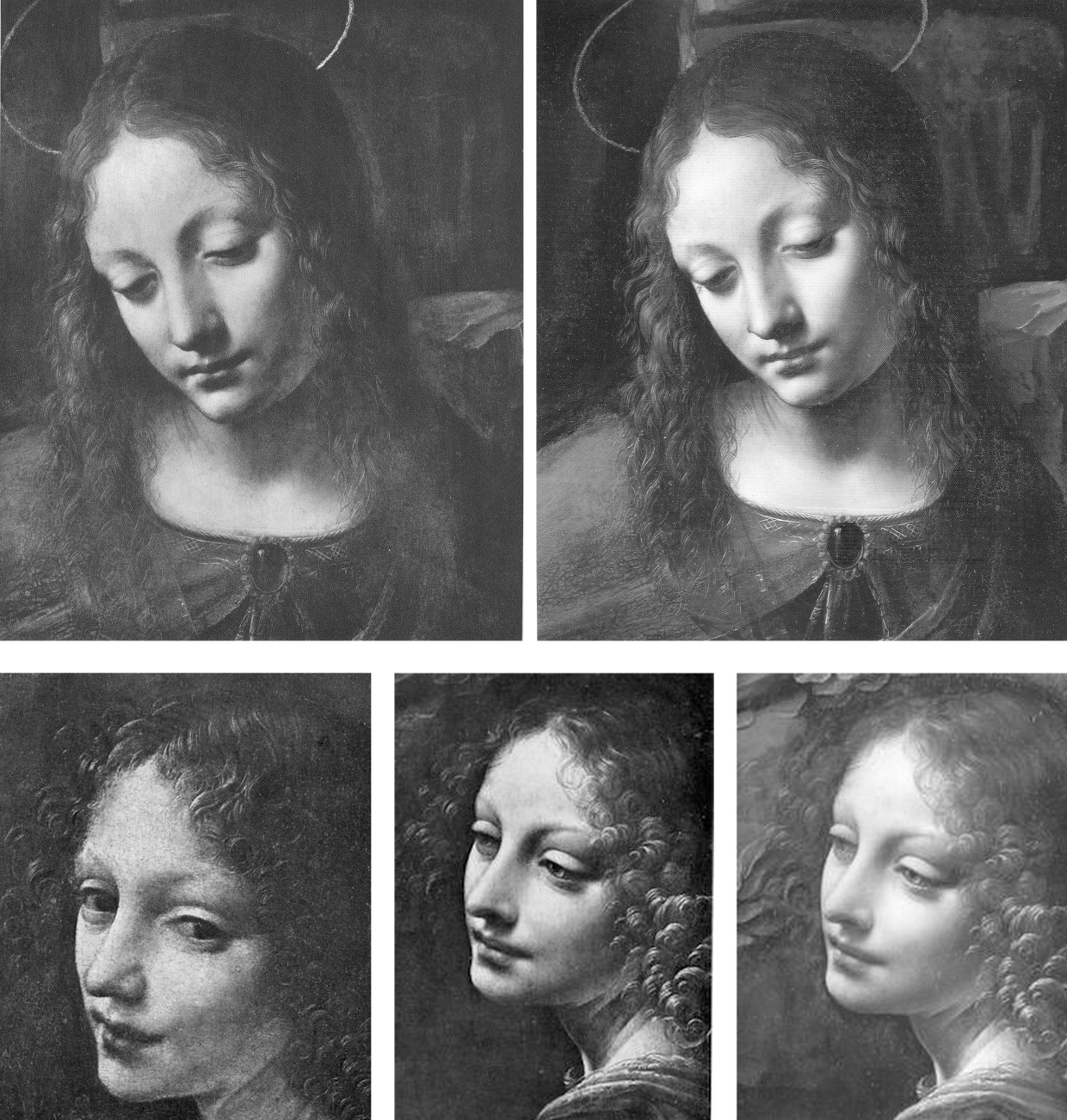
Above, Fig. 6: Top, the Virgin in the London Virgin of the Rocks as seen (left) in 1938 and (right) in 1990; above, left, the angel in Leonardo’s Virgin of the Rocks in the Louvre; centre and right, the angel in the National Gallery’s version, as seen in 1938 (centre) and (right) in 1990 and after its 1949 restoration.
MAPPING THE WORLD
In her Leonardo da Vinci cartographer and Inventor of the Google Map, Pizzorusso holds that:
“We can access any location on Earth with a simple click on our computer or cell phone. This wasn’t always the case, but it was always a desire, for man has continually sought to understand the extent of the Earth and his place on it. While this is not a treatise on the history of cartography, it will serve to show the vital importance of maps and the little known, but extraordinary accomplishments of Leonardo da Vinci as a Renaissance cartographer. Since many examples of his maps survive today, (with an extensive collection in the Royal Collection Library at Windsor Castle), we can appreciate not only his skill, but the instruments he invented to achieve nearly perfect accuracy in his measurements. He melded his knowledge of geology, engineering, surveying, hydrology, and of course art to revolutionize cartography. We can see his innovations on every map we use today and can even name him the inventor of the Google Map.”
A NOTORIOUSLY PRECARIOUS GROUPING
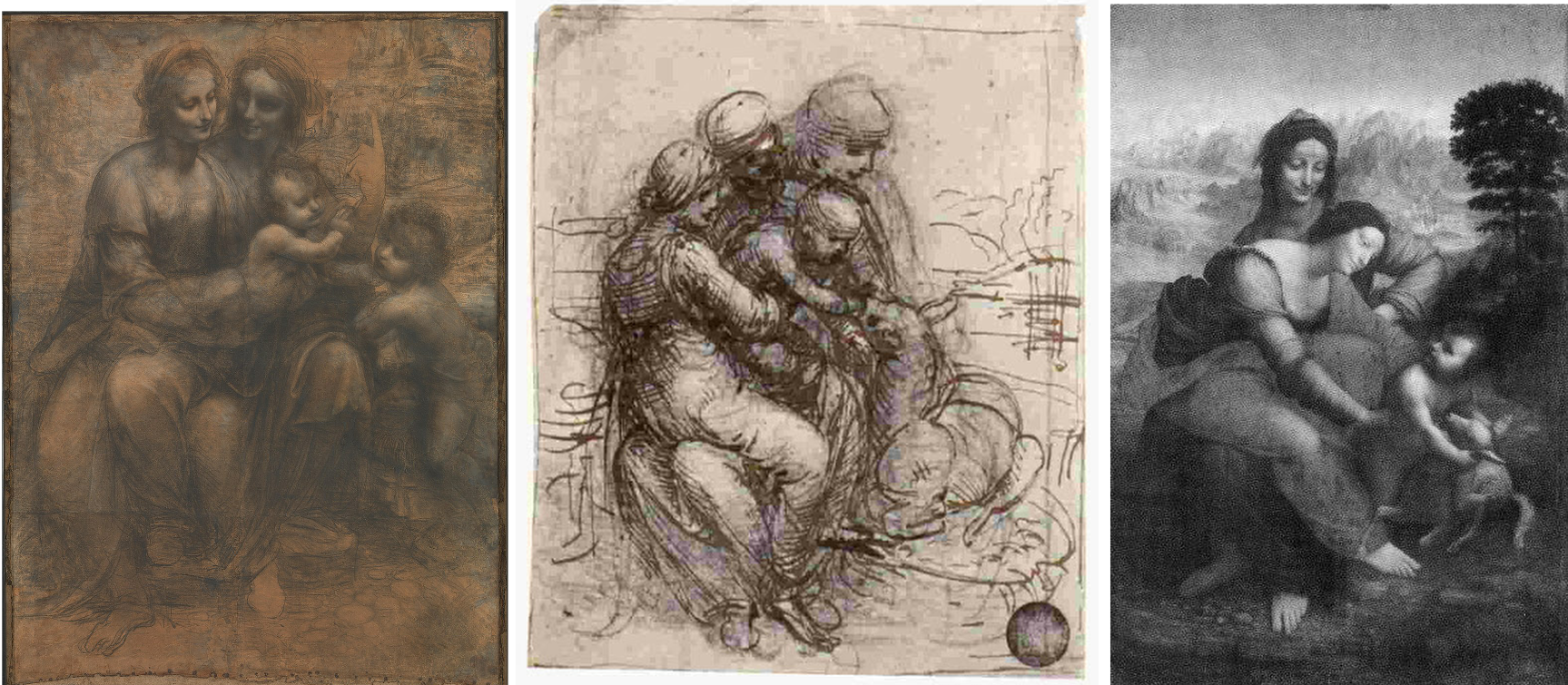
Above, Fig. 7: Left, Leonardo’s The Virgin and Child with St Anne drawing (the Burlington House Cartoon); centre, Leonardo’s (Venice – Gallerie dell’Accademia) study for The Virgin and Child with St Anne,;right, the Louvre’s Virgin and Child with St Anne before its recent restoration – see Pizzorusso’s 12 June 2012 “Could the Louvre’s ‘Virgin and St. Anne’ provide the proof that the (London) National Gallery’s ‘Virgin of the Rocks’ is not by Leonardo da Vinci?
In her latest book, Leonardo da Vinci – Geologic Representations in The Virgin and Child with St. Anne, Pizzorusso presses an appreciation of Leonardo’s understanding of geology and botany into an examination of the vexing figural complexities of Leonardo’s Virgin and St. Anne:
“In discussing the figure of the Virgin, Carlo Pedretti states that ‘Critics have often wondered why Leonardo should have abandoned the most satisfactory Classical sense of balance achieved in the London Burlington House Cartoon in favour of a pose that has always been taken as conveying a sense of uneasiness’. Bernard Berenson summarized his dismay with Leonardo’s treatment of St Anne as follows; ‘Seated on no visible or inferable support, she (St. Anne) in turn on her left knee sustained the restless weight of a daughter as heavy as herself.’”
And the resolution of the conundrum? It begins: “Had Berenson known his geology, he would have seen that…” The that is for the reader to discover.
The book is available worldwide, both in Kindle ebook form and in Paperback at Amazon UK and Amazon US Pizzorusso’s website is: Ann Pizzorusso – annpizzorusso.com .
Michael Daley, 12 May 2021
The Disappeared Salvator Mundi’s endgame: Part I: Altered States and a Disappeared Book
Michael Daley writes: As the world reels from China’s latest plague, the fifteen-year Salvator Mundi Saga has slipped into never-never land. The famously disappeared picture has been likened to an opera by its instigators and is set to become a musical in 2022 in which “artistic liberties will be freely taken to make an enlightening and entertaining experience”. Amazon is offering T-Shirts that carry the Salvator Mundi not as it looked in 2017 when it disappeared but as it looked in 2011 when first presented as a Leonardo at the National Gallery (see below, Fig. 3). The restorer’s own paintbrushes (which had been used to produce three distinctly different states or appearances) were auctioned on eBay with a $1,000 reserve. No bid was received. Back in the real world, before considering the rise and demise of a perpetually morphing disappeared picture’s attribution upgrade that netted $80 million, $127 million and $450 million in two restoration guises over four years on a $1,000 purchase that was overstated tenfold by its owners, we note three further bizarre developments, including a disappeared book of technical analysis and a disappeared Louvre catalogue.
1 – THE LOUVRE’S DISAPPEARED BOOK OF TECHNICAL DATA FOR A DISAPPEARED PAINTING
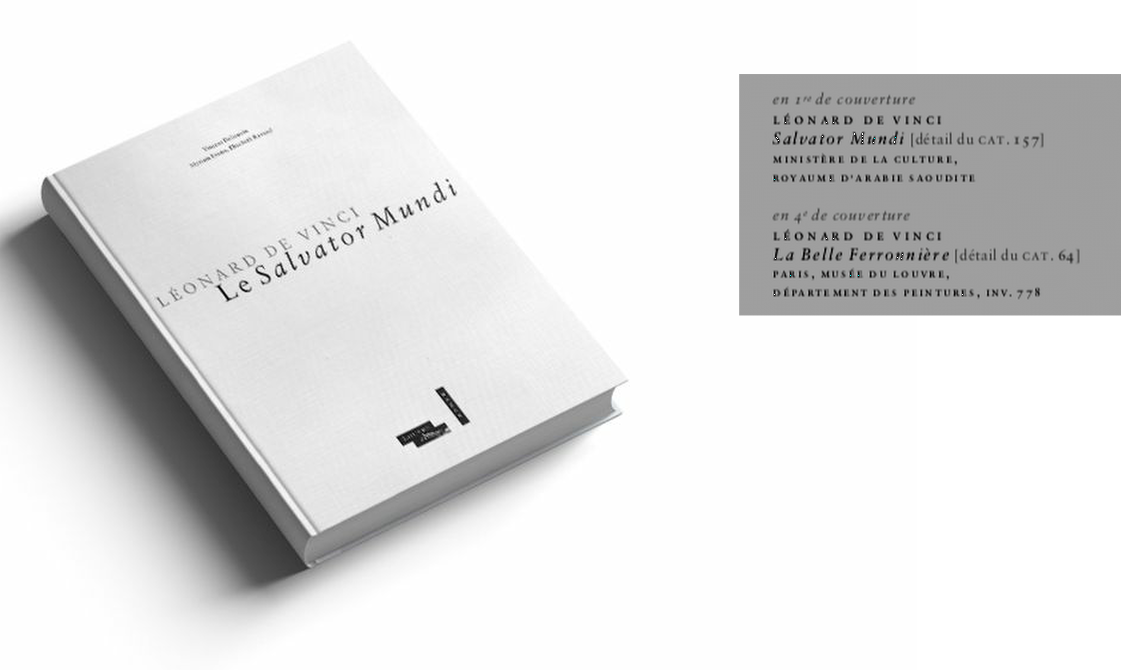
Above, Fig. 1: Left, a disappeared book; right, a disappeared ascription.
On 30 March, the Art Newspaper disclosed that last year the Louvre vaporised a 45-page book of technical examinations made in 2018 on the disappeared Salvator Mundi painting by C2RMF (Centre for Research and Restorations of the Museums of France). The Editions Hazan book, Léonard de Vinci: Le Salvator Mundi (Fig. 1, above, left), had been produced for the October 2019 opening of Léonard de Vinci, the Louvre’s major exhibition marking the 500th anniversary of Leonardo’s death, but it was withdrawn shortly before the opening even though the authors reportedly considered their examinations “to have demonstrated that the work was executed by Leonardo”. (The claim, of course, is implausible: technical examinations can sometimes disprove an attribution but can never establish artistic authorship.)
A Louvre spokesman said the book, written by the Louvre curator Vincent Delieuvin and C2RMF’s Myriam Eveno and Elisabeth Ravaud, had been “a project in case the Louvre got the chance to exhibit the painting” and that because this had not happened “it is not going to be published” – which seems tantamount to saying “If we can borrow it, it’s a technically-supported Leonardo; if we cannot, it’s not”. A copy of the disappeared book has been seen by Dianne Dwyer Modestini, who had restored the picture between 2005 and 2017. Modestini feels the conclusions confirm her own, earlier, judgements, even though they “do not reveal anything I did not already know about the materials and techniques…”
2 – THE LOUVRE’S DISAPPEARED CATALOGUE WITH A NON-APPEARING, NOW DISAPPEARED PAINTING
Second, to the embarrassment of a disappeared book of technical examinations, we disclose another disappeared Louvre publication: the catalogue for the museum’s 2019-20 Léonard de Vinci exhibition was also junked and replaced shortly before the opening. The two editions of the catalogue were identical except for one detail. In the first, the disappeared painting was splashed on the front cover as by Leonardo – “Front cover: Leonardo da Vinci, Salvator Mundi (detail of cat. 157), Ministry of Culture, Saudi Arabia Kingdom”. (See Fig. 1, above, right.) The author of that endorsing entry was Vincent Delieuvin, who co-curated the exhibition with Louis Frank. Delieuvin’s public commitment to the Leonardo attribution was made in the catalogue of a small 2016 Leonardo exhibition at the Italian Embassy titled: Léonard en France. Le maître et ses élèves 500 ans après la traversée des Alpes, 1516-2016 (Leonardo in France. The master and his pupils 500 years after the crossing of the Alps, 1516-2016). There, Delieuvin ventured of the now-disappeared picture “…Leonardo da Vinci’s Salvator Mundi whose autograph version seems to have reappeared very recently, unfortunately in very bad condition. The circumstances of the creation of this work are unfortunately not known.”
In the second printed catalogue, Delieuvin – with no explanation for the volte-face – correctly describes the Salvator Mundi as the Leonardo studio work that entered the Cook Collection in 1900 (on no provenance and that was later sold for £45) – namely: “Salvator Mundi, version Cook, vers 1505-1515″. A second Leonardo studio version, the de Ganay Salvator Mundi, was included in the Louvre exhibition as catalogue no. 158: “Salvator Mundi, version Ganay”. The choice of substitute may have been pointed: the Ganay picture had flopped when proposed in 1978 and 1982 as the supposedly lost autograph Leonardo prototype Salvator Mundi painting of which no record exists. Such notwithstanding, provenance claims made on behalf of that candidate were adopted and merged with those made on behalf of the Cook version. Because of the non-appearance of the disappeared Cook version, originally no. 157 in the catalogue, there is now a gap in the published catalogue between cat. 156 and cat. 158. That numerical lacuna testifies to the fateful loss of institutional support for the second would-be autograph Leonardo Salvator Mundi in forty years. (See Fig. 1, above, right.)
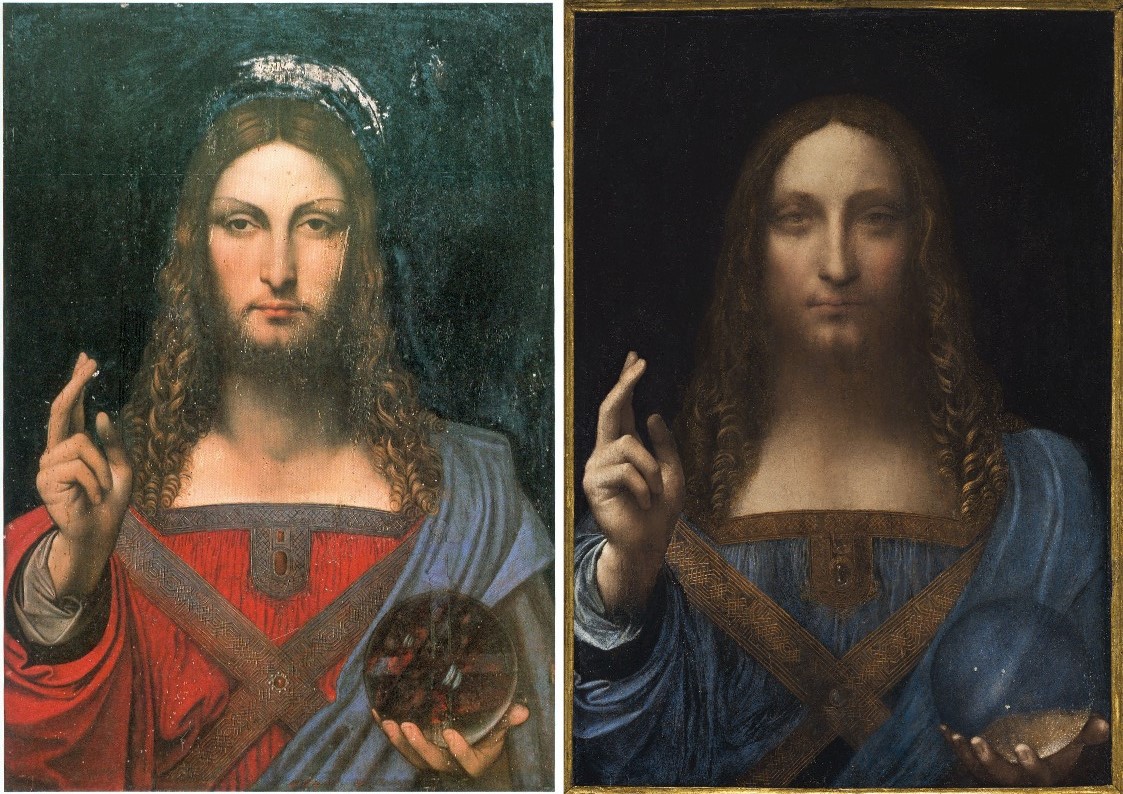
Above, Fig. 2: Left, the de Ganay Salvator Mundi which, in 1978 and 1982, had been proposed as a long-lost Leonardo prototype painting; right, the more heavily damaged and made-over ex-Cook Collection Salvator Mundi, which was presented as a long-lost Leonardo prototype painting at the National Gallery in November 2011.
3 – SOME DAY, MAYBE, NEVER…
After fetching $450 million in 2017 at Christie’s, New York, as Leonardo’s (supposedly) autograph, (supposedly) long-lost, (supposedly) iconic male equivalent of the Mona Lisa, the painting (really did) disappear without a trace, leaving the world bemused and the picture’s briefly “vindicated” advocates to play blame games. It was promised the painting would be launched as a Leonardo at the official opening of the United Arab Emirates spanking new Abu Dhabi Louvre Museum in 2018. That did not happen. It was said the painting would star as A Discovered Leonardo at the Paris Louvre’s grand 2019 Leonardo blockbuster. That did not happen either, just as we had predicted. The Wall Street Journal has reported that Saudi Arabia’s Ministry of Culture has possession of the disappeared painting and plans to store it while deciding whether or not to build an exclusively Western art museum to house this once again officially-deemed Leonardo school Christian image (“Saudi Arabia’s Secret Plans to Unveil Its Hidden da Vinci-and Become an Art-World Heavyweight”, 6 June 2020).
A MUSEUM FOR A PICTURE NO MUSEUM WANTED
It might seem unlikely that the disappeared former Leonardo Salvator Mundi will reappear in a purpose-built museum of Western art in Arabia when it is now well known (thanks to Ben Lewis’s 2019 lid-lifting book The Last Leonardo) that the picture had been offered to, and rejected by: the Getty Museum; the Hermitage; the Museum of Fine Arts, Boston; the Vatican; the Dallas Museum; a German auction house; Berlin’s Gemäldegalerie, and even, at a knock-down $80 million, to the Qatari royal family.
WHY DID THE BIG WESTERN MUSUMS BACK OFF?
The National Gallery launched the Leonardo attribution in its 2011-2012 Leonardo blockbuster, Leonardo da Vinci: Painter at the Court of Milan, after covertly helping to assemble its proclaimed “Unusually Uniform Scholarly Consensus”. The gallery made no attempt, however, to buy the Salvator Mundi. Similarly, and notwithstanding National Gallery claims of blanket endorsement by the Metropolitan Museum’s curators of pictures and drawings, the Met, too, did not buy what Christie’s dubbed “The Last Leonardo”. Despite publicly avowing support for the Leonardo ascription, the Met’s Chairman of European Paintings, Keith Christiansen, has (so far as we know) written nothing in its support – in marked contrast to his decisive role in the museum’s 2004 purchase of the tiny Madonna and Child that Christie’s offered as the “The Last Duccio”. Where the Met’s director, Philippe de Montebello, shuffled financial mountains to acquire the Duccio at Christiansen’s behest, Thomas Campbell, de Montebello’s successor from 2009 to 2017, tweeted after the 2017 $450 million Salvator Mundi sale that he hoped the mystery buyer “understands conservation issues” and had “read the small print”. Many were sickened by Christie’s globally-hyped removal of a sixteenth century painting from an old masters’ sale context to offer it (buttressed by cross-linked and mutually assured sale guarantees) among trophy modernist “icons” – and all on a picture Christie’s had passed over when it was offered in 2005.
“SALVATOR MUNDI IS A PAINTING OF THE MOST ICONIC FIGURE IN THE WORLD BY THE MOST IMPORTANT ARTIST OF ALL TIME” – LOÏC GOUZER
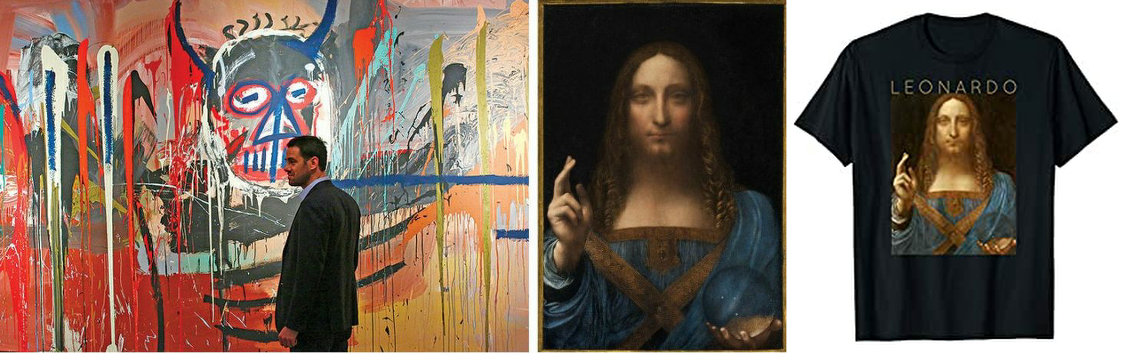
Above, Fig. 3: Left, Loïc Gouzer, Christie’s former co-chairman of Americas post-war and contemporary art, next to Jean-Michel Basquiat’s Untitled at a press preview; centre, the Salvator Mundi as when sold as a Leonardo at Christie’s, New York, on 15 November 2017; right, the Amazon T-Shirt sporting the Salvator Mundi as it appeared at the National Gallery in 2011 with many more folds visible in the drapery at Christ’s (true) left shoulder – see below, Figs. 8, 9 and 10.
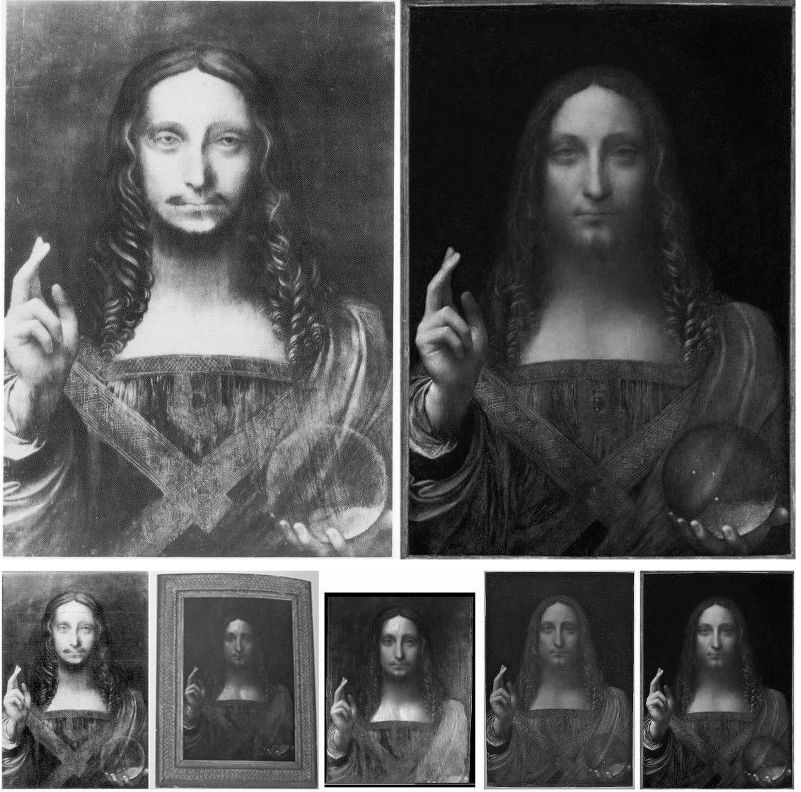
Above, Fig. 4, top row: Left, a c. 1913 photograph of the Salvator Mundi when in the Cook Collection, England; right, the Salvator Mundi as when sold at Christie’s in November 2017. Bottom row: the same time-line changes with three intermediary states from 2005; 2005; and 2011-2012 (when exhibited as a Leonardo at the National Gallery).
THE INTENSIFYING CRISIS OF ART MARKET CONNOISSEURSHIP
The epically long Salvator Debacle has put the abiding old masters’ connoisseurship crisis centre stage. To restate the intractable root problem: supply is finite – the old masters aren’t working any-more; most big-name works are already in museums; and infinite new global money craves art that bestows cachet and respectability. In February 2018, Guillame Cerutti, Christie’s CEO, purred: “our major clients are looking for trophies. They want quality and rarity in any field. This painting had both aspects, it ticked all the boxes”. Such a global trophy-hungry market can only be grown with dramatically upgraded art trade “sleepers” or outright forgeries. Both stand on restorers’ transforming skills which, along with claimed technical discoveries, licence scholars’ elevation of formerly nondescript works to revered Lost Masterpiece status.
MUSEUMS BEWARE
For Big-Name buyers, risks are high and can trip the grandest museums. The Metropolitan Museum’s David was one of its most popular paintings… until it wasn’t a “David” anymore. In 2004 the Met’s director, Philippe de Montebello, spoke of the “Stoclet Duccio” Madonna and Child as “Filling a gap in our Renaissance collection that even the Metropolitan had scant hopes of ever closing, the addition of a Duccio will enable visitors for the first time to follow the entire trajectory of European painting from its beginnings to the present. Moreover, the Duccio Madonna and Child is a work of sublime beauty. This was a unique opportunity to not only to add a masterpiece to the Museum’s holdings but to give its collections a new dimension.”
The institutional gush was infectious: “The Stoclet Duccio – we can now proudly call it ‘the Metropolitan Duccio’ – is an astonishing achievement”, wrote the New York restorer/some-time dealer, Marco Grassi, who likened the picture’s emergence to a discovered Mozart quartet. The disappeared Salvator Mundi is now likened by its original owners/supporters to the discovery of a new planet: “Paintings by the master are as significant culturally as the planets are celestially”. (It must seem cruel to have discovered and lost a planet in six short years.) Circumspection would have been prudent for Grassi and de Montebello: the Stoclet vendors had prepared a “four-inch thick” legal contract document and refused to allow the picture to be examined technically by the three big museums (the Met, the Getty and the Louvre) selected by Christie’s to bid in a private treaty sale. In 2003, the vendors had withdrawn the picture at the last moment from a big Duccio exhibition in Siena at which specialists would have had the first opportunity since 1935 to examine the picture – not one of the four Duccio scholars who had published monographic studies since 1951 had ever seen the picture which was known only by an old black and white photograph.
MARKETING “A LAST DUCCIO” AND “A LAST LEONARDO” AT CHRISTIE’S, NEW YORK
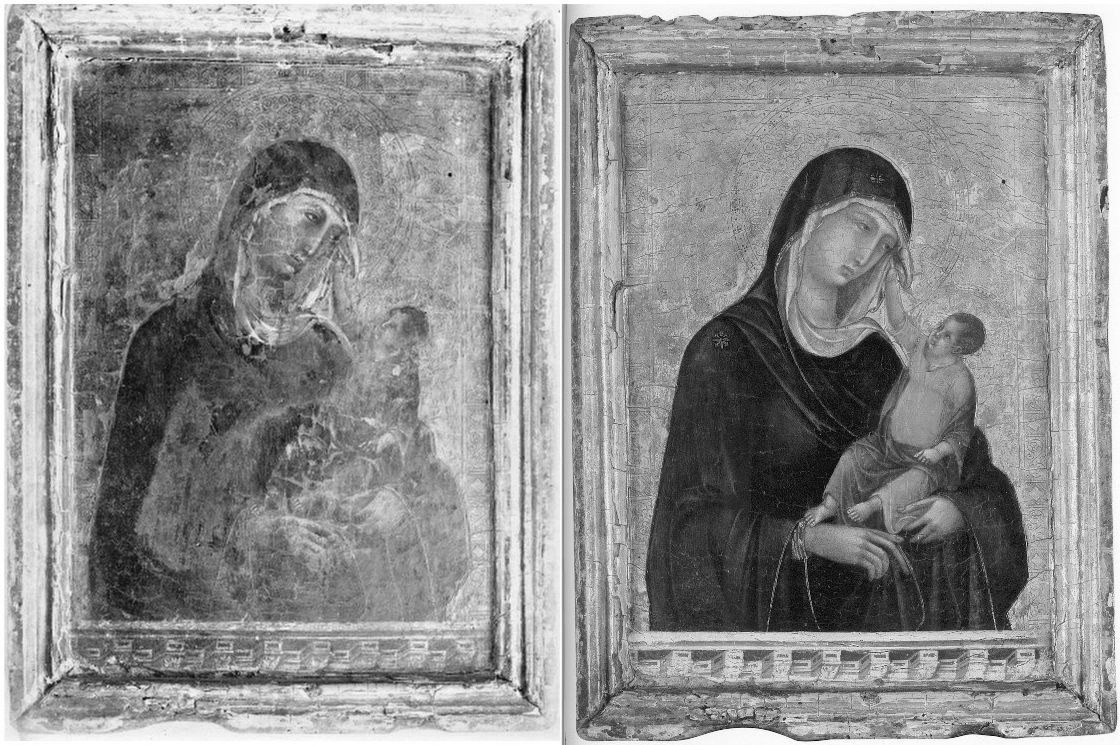
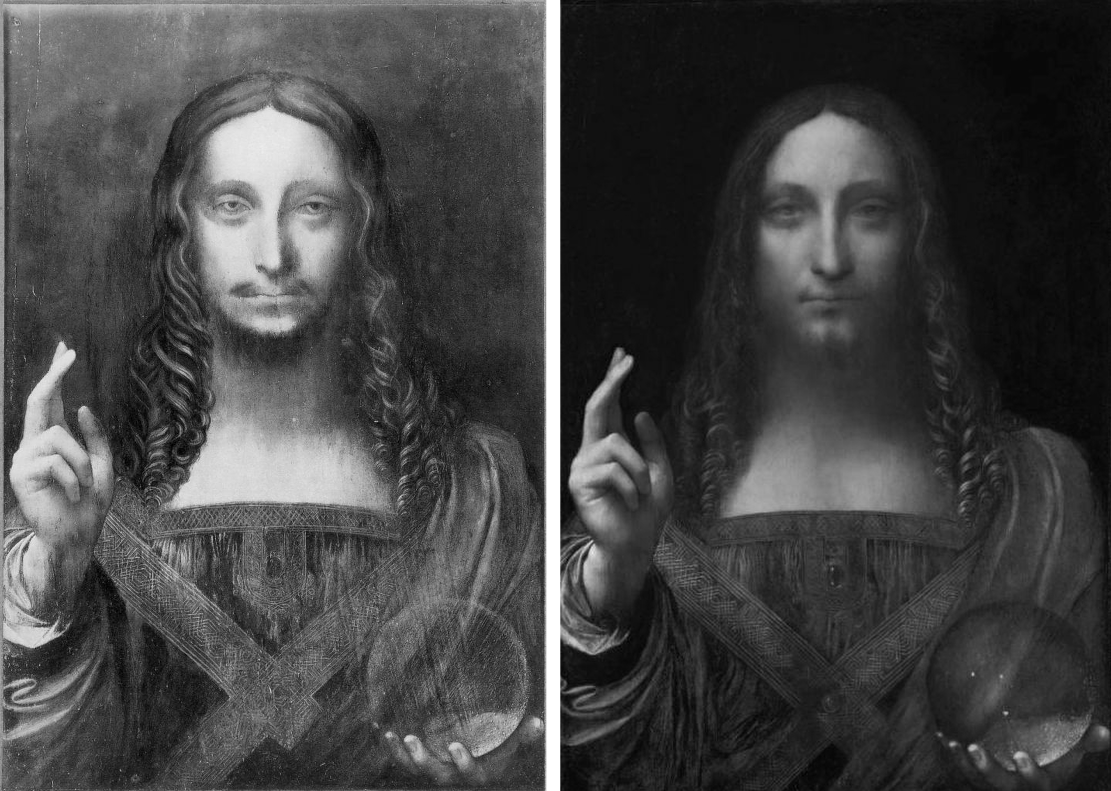
Above, top, Fig. 5: The Met Duccio as first photographed before 1904 (left); and as seen when sold in 2004.
Above, Fig.6: The disappeared $450 million Salvator Mundi as seen in c. 1913 (left); and as seen when sold at Christie’s, New York, in 2017.
In 1901 no one thought the tiny Madonna and Child (Fig. 5, above, left) a Duccio. Some thought it a Sano di Pietro. The picture had emerged after 1900 and, just like the Salvator Mundi (above, Fig. 6), it did so without provenance. It was said to have been found in a Tuscan antiques shop by Count Stroganoff, a Russian friend of Bernard Berenson and a big collector of “inediti” works that had not appeared in scholarly publications or exhibitions. Stroganoff had it restored and cradled. When, after buying it, Met conservators removed the cradle in 2005 (the year the Salvator Mundi was bought in a provincial U.S. sale for less than the low estimate of $1,200 – for $1,000 plus a $175 charge – it, as mentioned, having been turned down by Christie’s), they found that the panel’s originally gesso-ed back had been scraped down to the bare wood which bore a pencilled ascription to “Segna della Buoninsegna”, an apparent confusion between the Ducciesque painter Segna di Buonaventura and Duccio. In 1904 the head of the Uffizi Gallery judged it “in the manner of Duccio”. When an exhibition of early Sienese painting was held in 1904, a friend of Berenson’s, Carlo Placci, commended a late inclusion of Stroganoff’s recently restored picture which by then was incorporated within a larger frame bearing a metal plaque announcing a Duccio. Stroganoff had attributed his own antique shop purchase. Berenson’s circle would usher it into stardom at a time of considerable intellectual and financial crisis for the scholar – his principal source of income had dried; finding part-replacements for it were proving elusive; he had stopped writing. (Ironically, Berenson had held hopes until 1904 of finding employment as an advisor on Italian purchases at the Metropolitan Museum of Art.)
By 1904, as Frances Vieta discovered, Stroganoff had no fewer than eight similarly small gold background Sienese style panels, one of which was ascribed to Duccio’s follower Simone Martini and later bequeathed to the Hermitage in St. Petersburg. The “Simone Martini” had been dismissed in 1901 by the art historian Giorgio Bernardini as “so heavily restored in the skin tones, and in the red and blue robes, that it is not easy to attribute to anyone.” After seeing it at the Hermitage in 1929, George Martin Richter complained (Burlington Magazine): “Beneath this mantle there is concealed not an organically constructed body but a form rather suggestive of a bag full of washing.”
For all the Christie’s Hype, the Met had bought a Berenson Family-accredited pig in a poke. The museum came under challenge. In 1984 the now c. $50 million picture had been rejected by one of the Big Three Duccio Specialists, Florens Deuchler. ArtWatch International’s founder, Professor James Beck, wrote to the Met’s Chairman, calling for an inquiry and advising the museum to ask for its money back (see Beck’s, From Duccio to Raphael – Connoisseurship in Crisis, 2006, Italy, chapter 6 and Addendum). The Duccio pedigree, like that of the Salvator Mundi, is short, modern and precarious. The Salvator Mundi had no pre-20th century history. The Met’s official history of the Duccio begins not in 1901, when no-one considered it a Duccio, but in 1904 after it had been attributed by Bernard Berenson’s wife, Mary Logan (once), and (twice) by Berenson’s protégé, Frederick Mason Perkins, who trained in music, not art history. Christiansen elaborated: “from that point on the picture has held a central place in the Duccio literature”. Central, but with an unseen and unexamined work that had been dismissed by scholars on its six centuries-late emergence. The then 28-year old Perkins, is cast by Christiansen as a leading specialist in Sienese painting when Logan had written his first article and most of his first book.
Worse, as Vieta further established, Perkins was a fount of lucrative attributional errors. In 1923, he advised Helen Frick (then creating the incredible scholarly resource that is today’s Frick Research Library) to buy two huge marble sculptures from an antiques dealer for $150,000. He attributed these “wonderful” sculptural “masterpieces” to Duccio’s heir, Simone Martini. They had recently been made by the sculptor/forger, Alceo Dossena. Perkins’s fee was ten per cent. In 1933 he attributed an unpublished Madonna and Child surrounded by Angels to Duccio in an article carried in La Diana. The Belgian collector Adolphe Stoclet, the then owner of the now-Met Duccio, bought that second “Perkins Duccio”. In 1989 it was loaned to the Cleveland Museum of Art and there identified by Gianni Mazzoni, an Italian scholar of Sienese art and its forgers, as by the forger Icilio Federico Joni – which experience might have chilled the Stoclet family. Joni is known to have run a little factory of forgers whose works were put onto the market by middlemen, one of whom was Perkins himself. The lynchpin of Christiansen’s case for the “Met Duccio” is Berenson’s subsequent (private) hymning of the Stoclet picture as the loveliest and most characteristic thing Duccio ever did to the Duveen firm which paid him ten per cent on Italian purchases. Despite Berenson’s effusions, Duveen would not touch the “very small and ineffective” picture with a “nearly black” robe.
AN UNPUBLISHED TECHNICAL EXAMINATION AT THE MET
A top-secret post-purchase technical examination of the Duccio was carried out at the Metropolitan Museum. Staff were forbidden to talk to the press. No reports were published. The findings were discussed by Christiansen in the February 2007 Apollo. That article carried an x-ray of the painting showing modern, round-headed, wire nails underneath the picture’s ancient, badly distressed, “candles-burnt” gesso-ed frame. That hard, subversive material fact drew no comment (- other than ours in three consecutive issues of The Jackdaw, in 2008-09, as reprised in this post.) No comment was made, either, about the Met Duccio’s eccentric and pronounced craquelure. Scarcely less remiss than these “material” silences was the Met’s failure to acknowledge and address the uncharacteristically sloppy drawing of the figures, as revealed by infra-red imaging (see Fig. 7, below, centre).
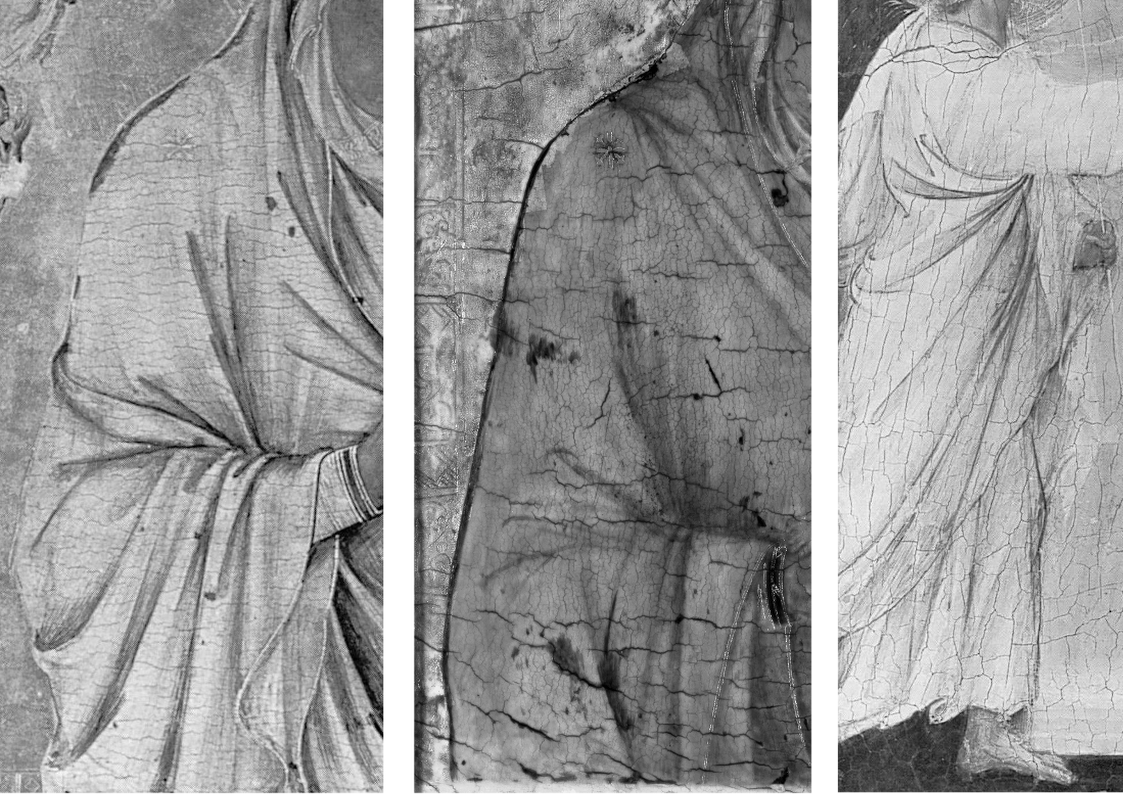
Above, Fig. 7: Left, an infra-red image of the National Gallery’s Duccio triptych (detail); centre, an infra-red image of the Met Duccio (detail); right, an infra-red image of the National Gallery’s indisputably Duccio panel, The Annunciation.
De Montebello, Christiansen and the Met picture restorer Dorothy Mahon travelled to London in autumn 2004 to view the Duccio at Christie’s. They were buying “blind” (unable to conduct technical examinations of the kind made on the other Stoclet/Perkins Duccio) and in knowledge that “the Louvre was working on trying to get the money together”. They spent an hour and a half at Christie’s where “The director made an offer for it on the spot”, and they all then went to see the National Gallery’s “rare and very beautiful Duccio triptych” – “a touchstone of Duccio’s work” (detail, above, left) so that the director “might assure himself that the two works were equivalent”. It would have been better to have gone to the National Gallery first, not only to see the triptych but to study its historical and technical dossiers, and those of the gallery’s absolutely secure Duccio Annunciation. Having bought the picture, all three “felt ‘ours’ was every bit as fine and in some respects more intimate and direct” than the triptych and was “a painting that represented the artist at the very height of his powers”. Two Duccio specialists, Deuchler and James Stubblebine, thought the NG triptych “Shop of Duccio: Simone Martini”.
Having thus bought very expensively without a trace of “buyer’s remorse”, other possible grounds for concern may have been overlooked. For example, Christie’s had won the right to conduct its private, three-museum sale by putting “a significantly higher valuation on the painting than anyone else – by multiples”, as Nicholas Hall, the international director of Christie’s Old Masters department, later told the New Yorker (Calvin Tomkins, “The Missing Madonna”, 11 July 2005). When Hall invited Christiansen (an old friend) to lunch to show him a recent transparency of the Stoclet Madonna, he was immediately smitten and proactive. As he later recalled: “‘Fantastic, how about the price?’ I asked. He told me. ‘OK,’ I said, ‘I will deal with that later,’ and then we finished our lunch.” (Danny Danziger, Museum – Behind the Scenes at the Metropolitan Museum of Art, New York, 2007.)
Had the Met officers opted to compare the under-drawing of the three works, as above, Fig. 7, before buying, they might have seen that on the quality of drawing one of the three was the other two’s inferior. If we think of the three images as a triptych, it is striking how much more fully and vividly realised the draperies and figures are as form in the two “wings”. Consider the left and centre under-drawing: in the outer image the drapery folds are not notionally indicated with lines that converge, as on the Met picture, but are realised, in anticipation, as autonomous three-dimensional folds and hollows that move over and around the implicit body within – one senses, for example, precisely where the unseen elbow is located, this being no “bag of washing”. The contour on the National Gallery Madonna’s outer edge is not depicted, as is the case in the Met picture, with a long un-lovely single continuous unbroken line of few deviations along which it is impossible to sense the elbow’s location. Rather, it is conceived and shown as a record of the points at which the forms and undulations of the cloth turn away from the viewer. Such differences of drawing speak of radically differing degrees of plastic/sculptural sensibility and comprehension. That on the left is greatly and decisively more sculptural, dynamically expressive, and plausible as a figure adjusting itself to support the weight of a child. Drawing has rightly been described as the probity of art and, as such, its study and evaluation must be considered one of the most pertinent and indispensable tools of critical analysis.
In the face of artistic weaknesses Christiansen blusters: “The drapery of the Virgin is astonishingly three-dimensional in the way it falls over the arm; it’s like a Roman sculpture.” All style judgements are relative: this is more, or less, or identical with, that. When drawing is weak, associated aspects often prove deficient. Viewing the triptych immediately after the Christie’s Duccio, Christiansen noted the former “struck a slightly different key than the picture we had been examining.” That difference, as the Met’s subsequent examinations disclosed, had a material basis. Ultramarine pigment was used in the triptych as opposed to the Met picture’s cheaper azurite. Moreover, the painted relief of the triptych’s ultramarine blue drapery was modelled not so much by progressive (and chromatically-debilitating – as Duveen had complained) dilution with white pigment, but by the addition of carbon black shading enriched by a red glaze – a tri-partite finish made with the best materials – and one that was emulated by Modestini on the background of the Salvator Mundi. Modestini has given two accounts of her actions. They both merit attention, because both are more detailed, and frank, than is commonly encountered in restoration reports.
REPLICATING HISTORICAL AUTHENTICITY TO PRODUCE A “DIFFERENT, ALTOGETHER MORE POWERFUL IMAGE”
Writing in a 2012 conservation report (see below), Modestini recalled:
“There were actually two stages of the current restoration. In 2008 when it went to London to be studied by several Leonardo experts, there was less retouching: I hadn’t replaced the glazes on the orb, finished the eyes, suppressed the pentimenti of the thumb and stole, and several other small details, but, chiefly the painting still had the mud-coloured modern background that was close in tone to the hair. Two years later I was troubled by the way the background encroached upon the head, trapping it in the same plane as the background. Having seen the richness of the well-preserved browns and blacks in the London Virgin of the Rocks”, and based on the fragments of black background which had not been covered up by the repainting, I suggested to the [then two] owners that it might be worthwhile to try to recover the original background and finish the incomplete restoration.
“I began to remove the overpaint mechanically under the microscope. Where it had been protected by the Verdigris [layer, that had been scraped off “at an unknown date and replaced by a mud-coloured background”], the original background was intact, and much of it survived under messily applied fill material. The difference between the original black and the modern brown was dramatic.
“The initial cleaning was promising especially where the Verdigris had preserved [because applied soon after?] the original layers. Unfortunately, in the upper parts of the background, the paint had been scraped down to the wood and in some cases to the wood itself. Whether or not I would have begun had I known, is a moot point. Since the putty and overpaint were quite thick I had no choice but to remove them completely. I repainted the large missing areas in the upper part of the painting with ivory black and a little cadmium light, followed by a glaze of rich warm brown, then more black and vermilion. Between stages I distressed and then retouched the new paint to make it look antique. The new colour freed the head, which had been trapped in the muddy background, so close in tone to the hair, and made a different, altogether more powerful image. At close range and under strong light the new background paint is obvious, but at only a slight remove it closely mimics the original.
“The retouching was done with time-tested materials.” Viz: “with dry pigments bound with PVA AYAB. Translucent water colours, mainly ivory black and raw siena, were used for final glazes and to draw [fake age] cracks. For the black background both AYAB and Maimeri Colori per restauro were used. Except for the background, I mainly used treble 0 sable watercolor brushes in a series of vertical passes until the area of loss matched the surrounding material.”
RESTORATIONS BEGET RESTORATIONS
In her 2018 memoir, Masterpieces, Modestini recalled:
“When the painting returned [in 2008 from London] to New York, I saw it on many occasions and became increasingly dissatisfied with my hastily concluded restoration. This is inevitable, especially when the painting is a damaged work by a great artist. Although I was aware of this, I itched to have it back. Leonardo’s [sic] Virgin of the Rocks in London had just been cleaned, and I made an appointment to see it. It is relatively well-preserved and, at that time, the only Leonardo that was not encumbered with centuries-old, thick, yellow, decayed coats of varnish like the Mona Lisa and the St John the Baptist in the Louvre. When I saw it, I was struck by the richness and depth of Leonardo’s blacks and realized that the principal problem of the Salvator Mundi was that the image was imprisoned by the nineteenth-century, sludge-colored repaint of the background. In a few areas, mostly around the contours of the figure, the original deep black was visible, and I knew from one [!] of the cross sections that Leonardo had paid great attention to it, building it up with four layers consisting of two different blacks, and black mixed with vermilion. I explained this to Robert [Simon], who immediately understood.
“For retouching [aka repainting] I use high-quality dry pigments, and I had a number of different blacks to work with – bone black, which Leonardo was known to favor, and a sixty-year-old tin of finely ground, pure ivory black that I had inherited from Mario [Modestini], which is no longer made. I had never used it but suddenly remembered Mario talking about how special it was…After I had polished and distressed my new paint, the result was reasonably satisfactory, at least when compared to the previous iteration. The difference it made to the painting was astounding: the great head surged forward and became much more powerful. I allowed myself to think that the decision I had taken was not so terrible after all. With the figure now more prominent and three-dimensional, some minor areas of loss and wear began to clamor for attention. This sequence is an essential part of the process of restoring a damaged painting.
“Luke Syson, the curator of the National Gallery’s Leonardo exhibition, asked to borrow the painting, notwithstanding some cavilling from colleagues about exhibiting a work that was on the market…”
Where Modestini was licensed by the owners to act as a painter-in-arms with Leonardo, Christiansen downplayed the triptych’s greater richness of effects and materials by deeming it “Obviously…a deluxe object” made for a rich client as opposed to “the first owner of the Metropolitan’s [who] was also someone of wealth or social standing”. If the force of that distinction is not immediately apparent, there are other, no less telling, differences where cost is immaterial: the triptych’s under-drawing was made with a quill pen – the instrument said to be Duccio’s favourite. That of the Met painting was made with brush… Making repeated allowances for atypical traits is never reassuring. Modestini has disclosed that although the all-blue draperies of the disappeared ex-Cook Collection Salvator Mundi are of ultramarine, it is of low grade – as was the panel on which it was painted. (In 2019 Simon reported that the ultramarine had not undergone full purification and had retained large particles of quartz.) It has been claimed, as described below, that by some technical quirk, whenever the restored Salvator Mundi is re-varnished, the forms of the true left shoulder draperies expand or contract in numbers (see Fig. 8, below) precisely as occurred between 2011 when the picture was at the National Gallery, and 2017, when it was on offer at Christie’s.
ART WORLD CLOAK AND DAGGER

Above, Fig. 8: Left, top, and detail below left, the Salvator Mundi when exhibited at the National Gallery in 2011-12 as a long-lost autograph Leonardo painted prototype Salvator Mundi; right, top, and detail below right, the (disappeared) Salvator Mundi when offered in 2017 at Christie’s, New York, as a long-lost autograph Leonardo painted prototype Salvator Mundi with “an unusually strong consensus”.
In her 2018 memoir, Masterpieces, Modestini describes how the painting was brought to her place of work at New York University’s Institute of Fine Arts’ Conservation Center in 2017:
“…I called [the Sandy Heller Group] immediately and was told the Salvator Mundi would be arriving in New York shortly and I was not to inform anyone. On Wednesday evening, July 19, the painting was delivered to the Conservation Center under guard and in great secrecy and was stored in the vault.”
Why? Does Christie’s lack safe storage facilities? Modestini seems to have made preparations for the picture to be sent on its whistle-stop global promotional tour even though she does not approve of such risks being taken: “I had some concerns…A museum would not have agreed to this but the painting was on the market, and I realized that it was essential that prospective buyers in far-flung locations could examine it in person.” With a colleague, she “supervised the reframing and packing at Christie’s.” Why, and on whose authority was it sent to an academic institution, under guard and in great secrecy before being dispatched on its global tour? And, what happened to the painting between being stored in the Conservation Center’s vault and its being prepared for that world tour by Modestini, at Christie’s, New York? For Christie’s explanation of this episode, see Dalya Alberge’s “Auctioneers Christie’s admit Leonardo Da Vinci painting which became world’s most expensive artwork when it sold for £340m has been retouched in last five years”. The Christie’s spokeswoman said to Alberge: “Prior to its presentation for sale at Christie’s, Modestini partially cleaned the passage of paint in the shoulder and the dark streaks disappeared”. So, to disappearing books and catalogues, and paintings, must be added disappearing features within a disappeared painting. It is a pity that Modestini, while describing the manner in which the Salvator Mundi painting returned to her safe-keeping in NYU’s Institute of Fine Arts, drew a veil over her own actions therein when writing her 2018 memoir Masterpieces. There are so many questions now dangling: “Why did a small painting that was cleaned in a day and had then undergone several campaigns of restoration over six-years between 2005 and 2011, receive further, covert, treatment just six years later? When Modestini first worked on the painting its varnish was “sticky”. Was it sticky once-more when sold for nearly half a billion dollars in 2017? The disappearances within the painting are one concern. Another is the differences between the picture’s appearance in 2011 when launched at the National Gallery as by Leonardo and its appearance in 2017 when offered to the world in a different guise at Christie’s, New York, as a National Gallery-endorsed miraculously discovered and recovered Leonardo. Those unexplained differences might seem encapsulated in our early split-halves composite image of Christ’s face (as shown below at Fig. 10) where there is a mismatch between the two halves. This Christ has had two faces in our times, the later one with more colour in the cheeks and more focussed eyes. Clearly, both cannot be taken as recovered authentic faces, so the real and urgent question is: Should either of them ever have been presented as Leonardo’s own work?
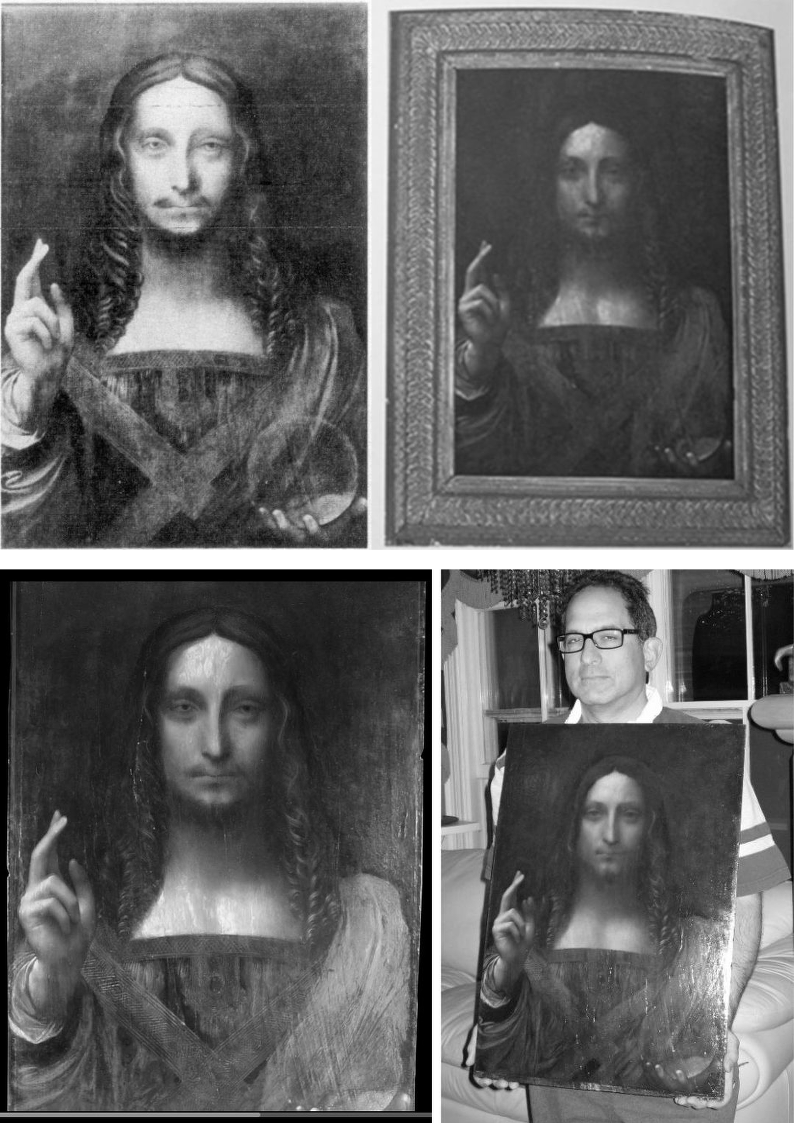
Above, Fig. 9: Top, left, the Salvator Mundi, c. 1913, when in the Cook Collection; top right, the Salvator Mundi as catalogued by the St Charles Gallery, New Orleans, as “After Leonardo da Vinci” for the April 9-10 2005 sale. Above, left, the Salvator Mundi as taken to the restorer, Dianne Modestini in April 2005 (with a still sticky varnish); right, the picture in May 2008 when about to be taken by Robert Simon (as above) to the National Gallery for a (confidential) examination by a small and select group of Leonardo scholars, after the first stage (as described above) of Modestini’s restorations .
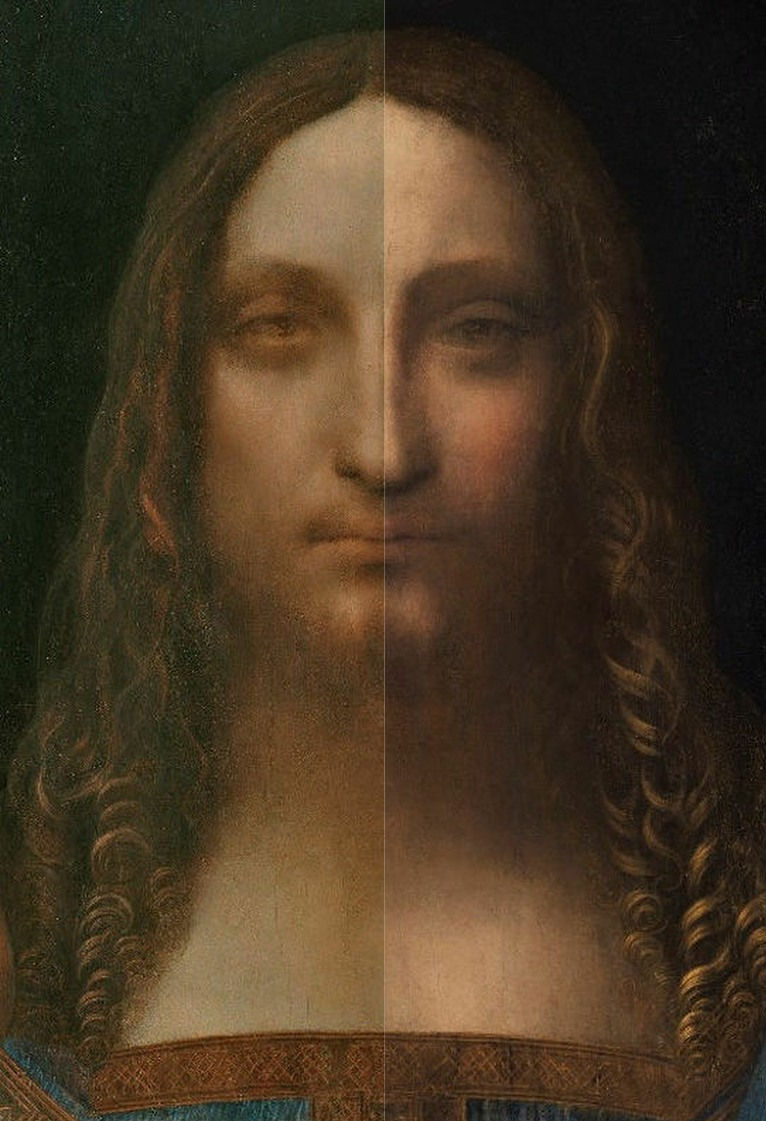
Above, Fig. 10: Left, the ex-Cook Collection Salvator Mundi face, as exhibited in 2011 at the National Gallery; right, the ex-Cook Collection Salvator Mundi face, as offered at Christie’s, New York, in 2017.
A POST HOC SALVATOR MUNDI LITERATURE
As will be examined in Part II, our challenges to the perpetually mutating and “improving” Salvator Mundi were made: a) within days of its November 2011 launch at the National Gallery; b) nearly a month before Christie’s November 2017 sale; c) five days before Christie’s 2017 sale; d) the day before Christie’s sale; and, subsequently, e) in nearly a score of posts – see Endnote below. The undisclosed identity of the original owners was only uncovered in September 2018 (by The Washington Post). Until that date and disclosure, the true purchase price in 2005 was exaggerated ten-fold by both the original owners and the painting’s advocates -and therefore in all press reports over a thirteen-year period. The publication of researches that had been promised in 2011 by the owners and by the National Gallery did not occur until 2019 and, even then, it was not in full.
Four recently published books now comprise a small, belated literature on the rise and demise of the long-unloved Leonardo School work that morphed into the world’s most expensive and least visible picture. They were: Living With Leonardo – Fifty Years of Sanity and Insanity in the Art World and Beyond, by Professor Martin Kemp, London, 2018; Masterpieces (“Based on a manuscript by Mario Modestini” and with informative chapters on: the Salvator Mundi; Cleaning Controversies; and, Misattributions, Studio Replicas and Repainted Originals) by Dianne Dwyer Modestini, Italy, 2018; The Last Leonardo – The Secret Lives of the World’s Most Expensive Painting, by Ben Lewis, London, 2019; and, Leonardo’s Salvator Mundi & The Collecting of Leonardo in the Stuart Courts, by Margaret Dalivalle, Martin Kemp, & Robert B. Simon, Oxford, 2019.
Until those four works appeared, the literature consisted of the catalogue entry “Christ as Salvator Mundi, about 1499 onwards” in the National Gallery’s 2011-12 Leonardo exhibition catalogue by its curator, Luke Syson; and, Dianne Modestini’s account of the Salvator Mundi’s restoration and art historical credentials that was delivered in January 2012 at a National Gallery conference and published in 2014 as “The Salvator Mundi by Leonardo da Vinci rediscovered History technique and condition” in Leonardo da Vinci’s Technical Practice, Paintings, Drawings and Influence, Ed. Michel Menu, Paris. Both Syson’s and Modestini’s accounts acknowledged indebtedness to the private researches of one of the picture’s owners, the New York dealer, Robert Simon.
Specifically, Syson declared in 2011: “This discussion anticipates the more detailed publication of this picture by Robert Simon and others. I am grateful to Robert Simon for making available his research and that of Dianne Dwyer Modestini, Nica Gutman Rieppi and, (for the picture’s provenance) Margaret Dalivalle, all to be published in a forthcoming book.” In 2014 Modestini acknowledged having benefited from “…the knowledge and good eyes of Robert Simon with whom I worked closely on the restoration for six years and who generously shared with me the results of his research for this paper. I am especially indebted to Nica Gutman Rieppi, Associate Conservator in the Kress Program at the Conservation Center of the Institute of Fine Arts, New York University, who took the samples, made the cross-sections and coordinated the analytic work which was carried out with great thoroughness, precision and dedication by Beth Price and Kenneth Sunderland, research scientists at the Philadelphia Museum of Art, with the help of Dr Thomas J. Tague of Broker, Billerica, Massachusetts who carried out the ATR FTIR analysis of the sizing.”
That research had still not been published in 2013 when the picture was sold privately and under (Simon has revealed) a non-disclosure agreement through Sotheby’s for $80 million. The research had not been published by 2017, when Alan Wintermute of Christie’s wrote (in “Leonardo’s Salvator Mundi”, one among other endorsing/bolstering essays by Frances Russell, Dianne Modestini, David Franklin and David Ekserdjian, in the auction house’s 2017 Salvator Mundi book/catalogue): “The reasons for the unusually uniform scholarly consensus that the painting is an autograph work by Leonardo are several… The present painting, although only recently discovered, has already been extensively studied, with a remarkable campaign of research lead by Dr. Robert Simon. The most insightful and broad-ranging examination of the painting was presented by Luke Syson in the 2011 catalogue of the Leonardo exhibition in London. The following discussion depends heavily on Dr. Syson’s entry, which itself drew on the unpublished research made available to him by Robert Simon, Dianne Dwyer Modestini, Nica Gutman Rieppi, Martin Kemp and, for the picture’s provenance, Margaret Dalivalle…” Having thus drawn the scholarly research wagons around the picture (and the auction house) Wintermute disclosed that the still-unpublished researches by Dalivalle, Kemp and Simon would not be published until 2018 – which was to say, a full seven years after the painting had been declared and exhibited as a Leonardo, at the National Gallery. In the event, and even with its pared-down authorship (see below), the book would be further delayed until 2019, by which date the mystery over the subsequently disappeared picture’s ownership and whereabouts had deepened yet further.
The Simon Researches had originally been earmarked for a book of essays to be published by Yale University Press and sold at the National Gallery’s “Leonardo da Vinci: Painter at the Court of Milan” exhibition. That book proved to be the first on this Salvator Mundi picture that failed to materialise. Reasons for its demise were volunteered by Professor Martin Kemp in his Living with Leonardo:
“Robert [Simon] thought it was a good idea to publish a book of essays by various authors, including Margaret Dalivalle and myself. Yale University Press, which does not normally publish monographs on single paintings, was signed up as publisher. I was happy to go along with this, while expressing reservations about a volume with multiple authors being finished on time. Academics are notably adept at missing deadlines, and I was unconvinced that all the authors actually had anything new to say… In the event the complete book was not delivered and, deprived of the rationale of selling a good number of books at the time of the show, Yale withdrew.”
A GOOD SHEPHERD, AN UTTERLY FANTASTIC CONSENSUS AND A DONE-DEAL
The long-promised book of essays emerged in 2019 (through Oxford University Press) as the Dalivalle/Kemp/Simon compilation – but without a proper technical account of the picture’s campaigns of restoration and technical examination. Simon presents the book as “the first to treat the subject monographically” and “the first complete analysis of this essential addition to Leonardo’s oeuvre”. The authors liken their authorially-trimmed exercise to a three-act opera with each act constituting an in-depth facet of the story while “necessarily bypassing many ancillary issues”. The first act is said to chronicle the painting’s “journey from anonymity in America, with no provenance and in severely compromised condition, to its public revelation as a work by Leonardo at the exhibition in London. The six-year process of research and conservation is related by Robert Simon, who shepherded the Salvator Mundi on this remarkable journey…” When Simon took the painting to London in May 2008 (Fig. 9, above) to show it to a select group of Leonardo scholars assembled at the National Gallery, he made a good and lasting impression on Martin Kemp who, in his 2018 memoir, underscored Simon’s decisive role in the institutionally and ethically problematic attribution upgrade:
“…A general discussion followed. Robert Simon, the custodian of the picture (whom I later learned was its co-owner), outlined something of its history and its restoration. He seemed sincere, straightforward and judiciously restrained, as proved to be the case in all our subsequent contacts. We looked, we talked and we looked again. It was a remarkable occasion. By the time I left, I was determined to research every aspect of the Salvator Mundi. It seemed at first sight to resonate deeply with key aspects of Leonardo’s science of art, and his views of the role of God in the cosmos.
“I remained in touch with Robert Simon who is strongly committed to scholarly research. I learned that the eloquent painting we had viewed was in fact one of the known versions of the Salvator Mundi, formerly in the Cook Collection – previously heavily overpainted, it had now been cleaned and retouched. It had never before received serious attention; we had paid only passing attention to the black and white photograph of it [Fig. 6] that had occasionally been used as an illustration…
“All of the witnesses in the gallery’s conservation studio were sworn to confidentiality [by whom?] and the painting travelled back to New York with Robert. It was becoming ‘a Leonardo’ […and later: ‘Robert quietly introduced the Salvator Mundi to a judicious selection of experts, who – remarkably, given the usual leakiness of the art world – kept their counsel for three years. By the time the painting emerged in public there was a critical mass of influential voices who would speak in the painting’s favour.’]
“…Was it on the market? Would exhibiting it mean that the National Gallery was tacitly involved in a huge act of commercial promotion? It seemed highly likely that it was also ‘in the trade’. All I knew at this stage was that it was being represented by Robert Simon. He told me that it was in the hands of a ‘good owner’ who intended to do the right thing by it, and I did not enquire further. I was keen to consider the painting in its own right, not in relation to ownership. I speculated, of course, that Robert might have a financial interest, perhaps a share in its ownership, and I assumed he was gaining some kind of legitimate income from his work on the picture’s behalf…
“It was, however, a great surprise to find that the Salvator was to be sold at Christie’s in New York on 15 November 2017 in a mega-auction of celebrity works of art from the modern era. The auctioneers sent the painting on a glamorous marketing tour of Hong Kong, San Francisco and London. I was approached by the auctioneers to confirm my research and agreed to record a video interview to combat the misinformation appearing in the press – providing I was not drawn into the actual sale process.”
TIGHT LIPS
The anonymity of which Simon spoke was a self-imposed, prolonged tactical ploy. In 2013, the three art dealing co-owners, Alexander Parish, Robert Simon and Warren Adelson (who in 2010 bought a one-third share for $10 million, thereby giving Simon and Parish a ten-thousand-fold return in five years on their $1,000 purchase), realised that because it was known within the opaque but gossipy art trade that the picture was being offered to museums, it would be too risky to put it to public auction: “there’s not a deader-in-the-water [thing] than a picture which you put up for auction and which then bombs”, Parish told Ben Lewis: “Supposing we had put a pretty reasonable price on the Salvator Mundi – let’s say we put a $100 million reserve on it – and it tanked, where do you go from there? Absolutely dead.”
The unidentified consortium of owners had other needs for opacity. Again, Parish to Lewis: “We’re a little opaque as to the date and location of acquisition. We purposefully have never corroborated Louisiana as the place where we bought it. And I’m not going to now. Why? Because some grandson of whoever these people are who sold it is going to decide, ‘Oh, that’s my $450 million picture. Who can I sue?’” Parish identified a third danger in professional transparency: “Part of the reason for the secrecy was the mechanics, if you will, that Bob [Simon] had to employ to get the utterly fantastic consensus that he compiled. Because in academic realms, if A says yes, B’s going to say no, just to be a dick. It’s not unheard of that certain experts are contrarian just because an opposing expert has said something else.” That last may sometimes occur but witnessing such spats enables the scholarly and art market communities to gauge the relative strengths of competing or conflicted argument and evidence. In art attributions and art restorations, as in law and in politics, things work better when propositions, expertise and evidence are subject to open appraisal and interrogation. Syson’s exclusion from the May 2008 National Gallery examination of the two leading Leonardo specialists most likely to respond negatively to the picture drew Lewis’s attention and is discussed below. The National Gallery’s preference for a select group of experts was disclosed by Kemp in 2018 when he published his March 2008 invitation to the event from the National Gallery’s new director, Nicholas Penny:
“I would like to invite you to examine a damaged old painting of Christ as Salvator Mundi which is in private hands in New York. Now it has been cleaned, Luke Syson and I, together with our colleagues in both painting and drawings in the Met, are convinced that it is Leonardo’s original version, although some of us consider that there may be [parts] which are by the workshop. We hope to have the painting in the National Gallery sometime later March or in April so that it can be examined next to our version of the Virgin of the Rocks. The best-preserved passages in the Salvator Mundi are very similar to parts of the latter painting. Would you be free to come to London at any time in this period? We are only inviting two or three scholars.”
TWO OF A KIND
Note: the claimed similarities between the two supposed autograph Leonardo pictures would once have weighed heavily against the Salvator Mundi. A former director of the National Gallery and a Leonardo specialist, Kenneth Clark, had said of the gallery’s version of the Virgin of the Rocks “A pupil did the main work of drawing and modelling, and before his paint was dry, Leonardo put in the finishing touches. Most of these have been removed from the Virgin’s face but remain in the angel’s, where perhaps they were always more numerous” – see “The National Gallery’s £1.5 Billion Leonardo Restoration”. As for claims of the Cook Salvator Mundi being a long-lost prototype-for-all-other-versions, Clark judged it “one of the versions ‘less close to the [presumed] original’”. He attended the 1958 sale at Sotheby’s where this very Salvator Mundi version limped away for £45 to the United States, and hence, eventually, to Louisiana in 2005, where it would draw just two bids and fetch its $1,000 plus $175 charges – thus, below the picture’s low estimate of $1,200. Even with the overheads of a castle to find, Clark had money to spend on art. As he reported to Bernard Berenson: “In a fit of madness I even bought some pictures at the sale of the remnants of the Cook Collection, including a very beautiful Alonso Cano of Tobias and the Angel, and a Giulio Romano; also a splendid Granet. They were sold for the price of a small Cézanne pencil drawing…” (Letter, 14 July 1958, in My dear B. B. The Letters of Bernard Berenson and Kenneth Clark, 1925-1959, ed. Robert Cumming, Yale University Press, New Haven and London.)
THE NATIONAL GALLERY’S SHOW-CASING WITH EXTRA OOMPH
Four months before its 2011-12 Leonardo exhibition the National Gallery defended its decision to include the undocumented privately-owned painting as “an important opportunity to test this new attribution”. Had the painting been included on precisely those terms and shown when cleaned and not-yet restored few would have complained at an opportunity to see a recently discovered version of the Leonardo school Salvator Mundi. That did not happen. It did not happen because Penny had become an instant partisan of the proposed upgrade and was advising Simon on building a necessary consensus of scholarly support for the picture when, all the while, the picture was undergoing transforming campaigns of restoration in accordance with Simon’s (anthropomorphising) conviction that the picture should be allowed to “live once again as a work of art”. Instead of a disinterested display of the work “as-was” after cleaning and before restoration, the Gallery exhibited it after multiple bouts of restoration, the second of which was made in declared emulation of the National Gallery’s own (questionable) version of The Virgin of the Rocks, as a miraculously recovered and, supposedly “long-lost” Leonardo. Begging a monumentally large question of attribution in this manner was a plain abuse of institutional authority and – given the picture’s fanciful and preposterously bloated provenance – a gross misrepresentation of the historical record to boot.
When Ben Lewis asked Luke Syson why the work had been catalogued unequivocally as a Leonardo, he replied: “I catalogued it more firmly in the exhibition as a Leonardo because my feeling at that point was that I was making a proposal and I could make it cautiously or with some degree of scholarly oomph. It is important not to float an idea without saying where you yourself stand on it.” Syson was standing on a house of (double-borrowed) cards. When the exhibition opened on 9 November 2011 our first objection was published within days – see Figs. 11 and 12 below.
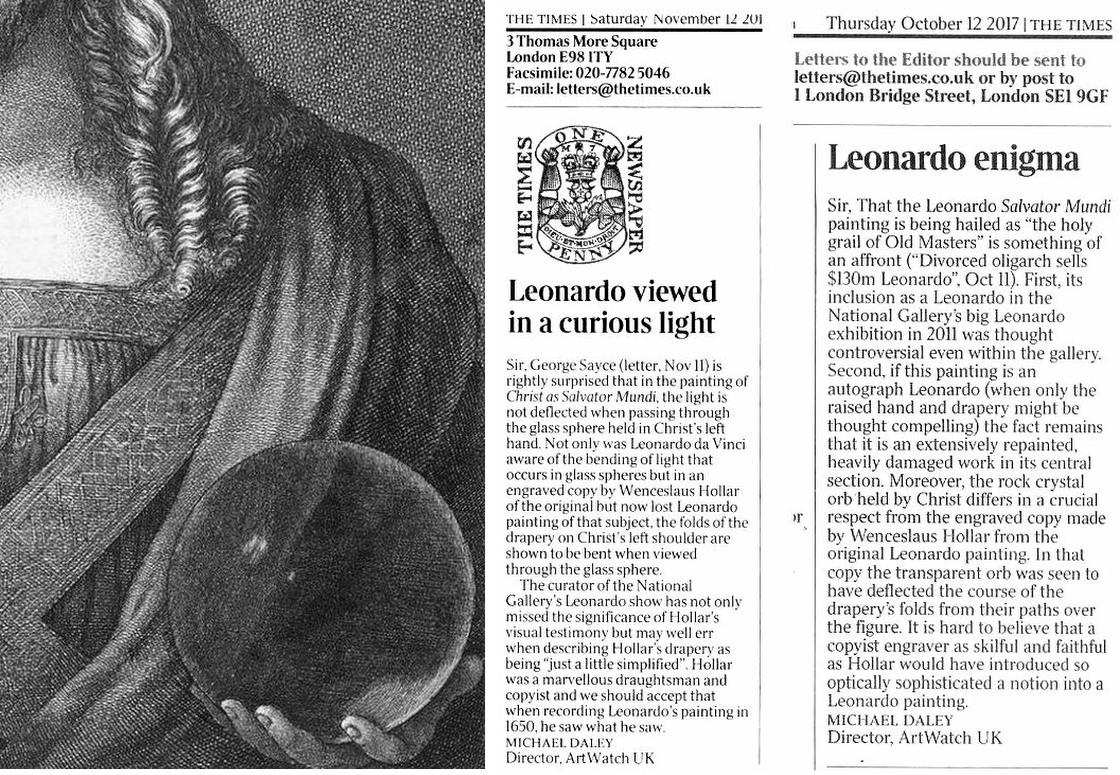
Above, Fig. 11: Left, a detail of 1650 etched copy by Wenceslaus Hollar of a painting then attributed to Leonardo that was being claimed to be a record of the Salvator Mundi version in the National Gallery; right, ArtWatch UK letters contesting the attribution on the absence within the painting of optical features recorded by Hollar.
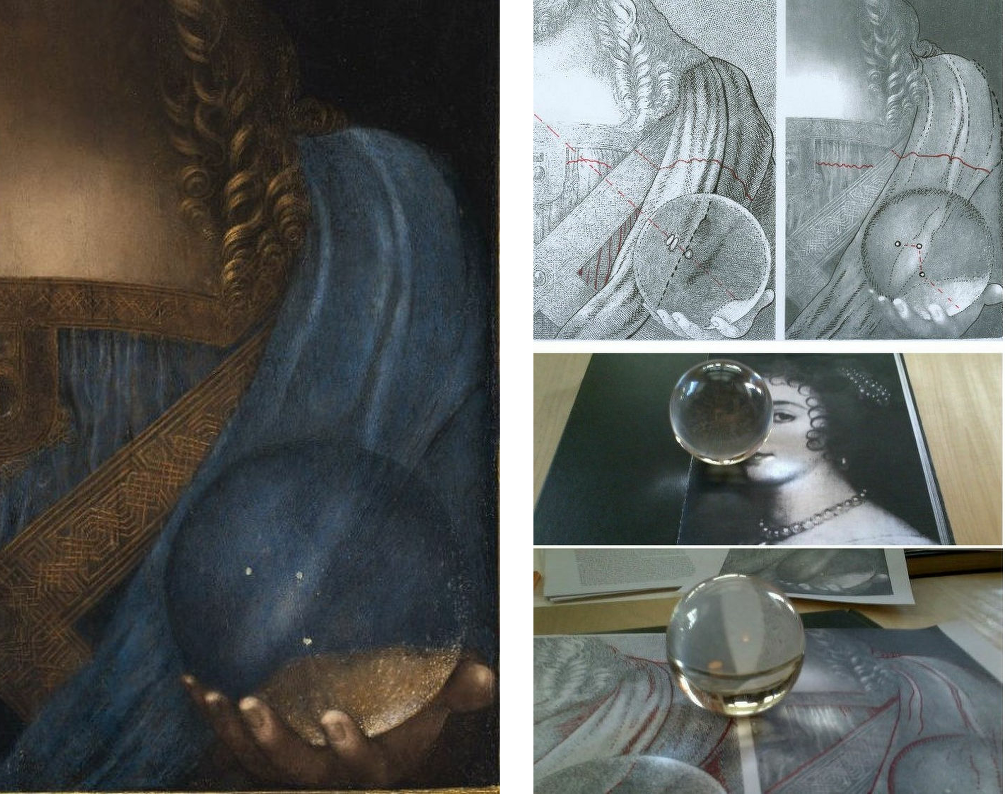
Above, Fig. 12: Left, a detail of the Salvator Mundi as it was immediately before its disappearance in 2017; right, top, AWUK diagrams highlighting many optical differences between the Hollar copy and the painting exhibited at the National Gallery.
SCHOLARLY RESPONSES TO THE NATIONAL GALLERY’S LEONARDO ATTRIBUTION
In the event, the Leonardo attribution was publicly challenged by at least four scholars in reviews of the 2011-12 National Gallery exhibition. Carmen Bambach, of the Metropolitan Museum and author of the major 2019 four-volumes Leonardo da Vinci Rediscovered, rejected the Leonardo attribution in a 2012 Apollo review of the National Gallery exhibition and gave the painting to Leonardo’s student Boltraffio (with possible modifying touches by Leonardo). Frank Zöllner of Leipzig University and author of the Leonardo catalogue raisonné, Leonardo da Vinci – The Complete Paintings (Bibliotheca Universalis) had said ahead of the exhibition that the proportions of the nose were “too long” for such a perfectionist as Leonardo and were more likely to have been painted by a talented follower. When the late husband of the restorer, Mario Modestini, first saw the Salvator Mundi he thought it by a very great artist a generation after Leonardo.
Later, in the revised 2017 edition of his book, Zöllner said of the ex-Cook Salvator Mundi that while it surpasses the other known versions in terms of quality, it: “also exhibits a number of weaknesses. The flesh tones of the blessing hand, for example, appear pallid and waxen, as in a number of workshop paintings. Christ’s ringlets also seem to me too schematic in their execution [Fig. 6, above], the larger drapery folds too undifferentiated, especially on the right-hand side [Fig. 8, above]. They do not begin to bear comparison with the Mona Lisa, for example. It is therefore not surprising that a number of reviewers of the London Leonardo exhibition initially adopted a sceptical stance (Bambach 2012; Hope 2012; Robertson 2012; Zöllner 2012). In view of the arguments put forward to date and the above-mentioned weaknesses, we might sooner see the Salvator Mundi as a high-quality product of Leonardo’s workshop, painted only after 1507, on whose execution Leonardo was substantially involved. It will probably only be possible to arrive at a more informed verdict on this question after the results of the painting’s technical analyses have been published in full (Dalivalle/Kemp/Simon 2017).”
As seen, the Dalivalle/Kemp/Simon account did not materialise until 2019. Recently, Professor Charles Hope, former director of the Warburg Institute, pinned the scholarly nub in the London Review of Books (“A Peece of Christ”):
“Many of those who specialise in making such attributions have great confidence in their own judgment, even when this has proved fallible, and they tend to discount or give a tendentious spin to documentary evidence and information about provenance that does not fit with their theories.”
In 2017, Christie’s, New York, cited fifteen scholars as supporters of the Salvator Mundi’s Leonardo ascription. They were:
Mina Gregori, Nicholas Penny, Dianne Dwyer Modestini, Carmen Bambach, Andrea Bayer, Keith Christiansen, Everett Fahy, Michael Gallagher – the Met’s head of picture restoration, David Allan Brown, Maria Teresa Fiorio, Martin Kemp, Pietro C. Marani, Luke Syson, David Ekserdjian and Vincent Delieuvin.
One, Carmen Bambach, as seen above, had rejected the ascription in 2011. As also seen above, another, Delieuvin, has now downgraded the picture to a school work. Crucially, none had supported the attribution in a scholarly publication or forum, and several would disavow their inclusion in this list. When Lewis spoke to the select and confidential group of five Leonardo scholars invited to see the Salvator Mundi at the National Gallery (Pietro Marani, Maria Teresa Fiorio, Carmen Bambach, David Alan Brown and Martin Kemp), he discovered that only two had committed to a Leonardo attribution; two had declined to express an opinion; and one had rejected it.
Moreover, Lewis noted two striking omissions from the event that would likely have tipped the balance. One was our colleague, Jacques Franck, a Leonardo expert who had advised Syson on the restoration of the National Gallery’s version of the Virgin of the Rocks – much as he had done at the Louvre with its Leonardo restorations. Like others, Franck identifies two authorial hands in the Salvator Mundi picture, but he sees no participation by Leonardo in the painting – see his “Further thoughts about the ex-Cook Collection Salvator Mundi” and our “The Louvre Museum’s bizarre charge of ‘fake information’ on the $450 million Salvator Mundi”.
The second was Frank Zöllner, who then had recently written within his catalogue raisonné of Leonardo’s paintings: “In conclusion, mention must be made of the increasing attempts, above all in recent years, to attribute second- and third-class paintings to Leonardo’s hand. In this context it should be noted that the catalogue of paintings presented here is definitive. While there may be works circulating in the fine art trade that stem from Leonardo’s pupils, the likelihood of an original by the master himself ever making a new appearance is extremely small.”
Syson admitted to Lewis that Zöllner’s omission had been a mistake but justified Franck’s exclusion on the grounds that as a trained painter he was “too far outside the world of academic and institutional art history to be invited in to this project”.
Michael Daley, Director, 12 (& 24) August 2020
In Part II, we outline reasons why it might sometimes be of assistance to scholars and curators to heed the views of artists.
Endnote: ArtWatch UK Posts on the Salvator Mundi:
14 November 2017, “Problems With the New York Leonardo Salvator Mundi, Part I: Provenance and Presentation”
1 January 2018, “The $450m New York Leonardo Salvator Mundi, Part II: It Restores, It Sells, Therefore It Is”
20 February 2018, “A Day in the Life of the New Louvre Abu Dhabi Annexe’s Pricey New Leonardo Salvator Mundi”
27 February 2018, “Nouveau Riche? Welcome to the Club!”
11 March 2018, “In Their Own Words: No. 3 – The Reception of the First Version of the Leonardo Salvator Mundi”
29 March 2018, “Startling Disclosures on the Re-re-restored Leonardo Salvator Mundi”
10 April 2018, “The Leonardo Salvator Mundi Saga: Three Developments”
9 August 2018, “Leonardo Scholar Challenges Attribution of $450m Painting”
18 September 2019, “How the Louvre Abu Dhabi Salvator Mundi became a Leonardo-from-Nowhere”
11 October 2018, “Two Developments in the No-Show Louvre Abu Dhabi Leonardo Salvator Mundi Saga”
12 November 2018, “The Pear-Shaped Salvator Mundi”
6 February 2019, “The Leonardo Salvator Mundi Part I: Not ‘Pear-Shaped’ – ‘Dead-in-the Water’”
22 February 2019, “The Louvre Museum’s Bizarre Charge of ‘Fake Information on the $450 million Salvator Mundi’”
4 July 2019, “Salvator Grumpi – updated”
20 September 2019, “Forthcoming events: The Ben Lewis Salvator Mundi Lecture and the new ArtWatch UK Journal”
28 October 2019, “The non-appearing, disappeared, $450million, now officially not-Leonardo, Salvator Mundi”
15 November 2019, “Books on No-Hope Art Attributions”
5 & 11 February 2020, “The Saviour and a Stealth-Attribution”
3 August 2020, “Further thoughts about the ex-Cook Collection Salvator Mundi”
The Leonardo Salvator Mundi Saga: Three Developments
“The more I read it, the more it looks probable.”
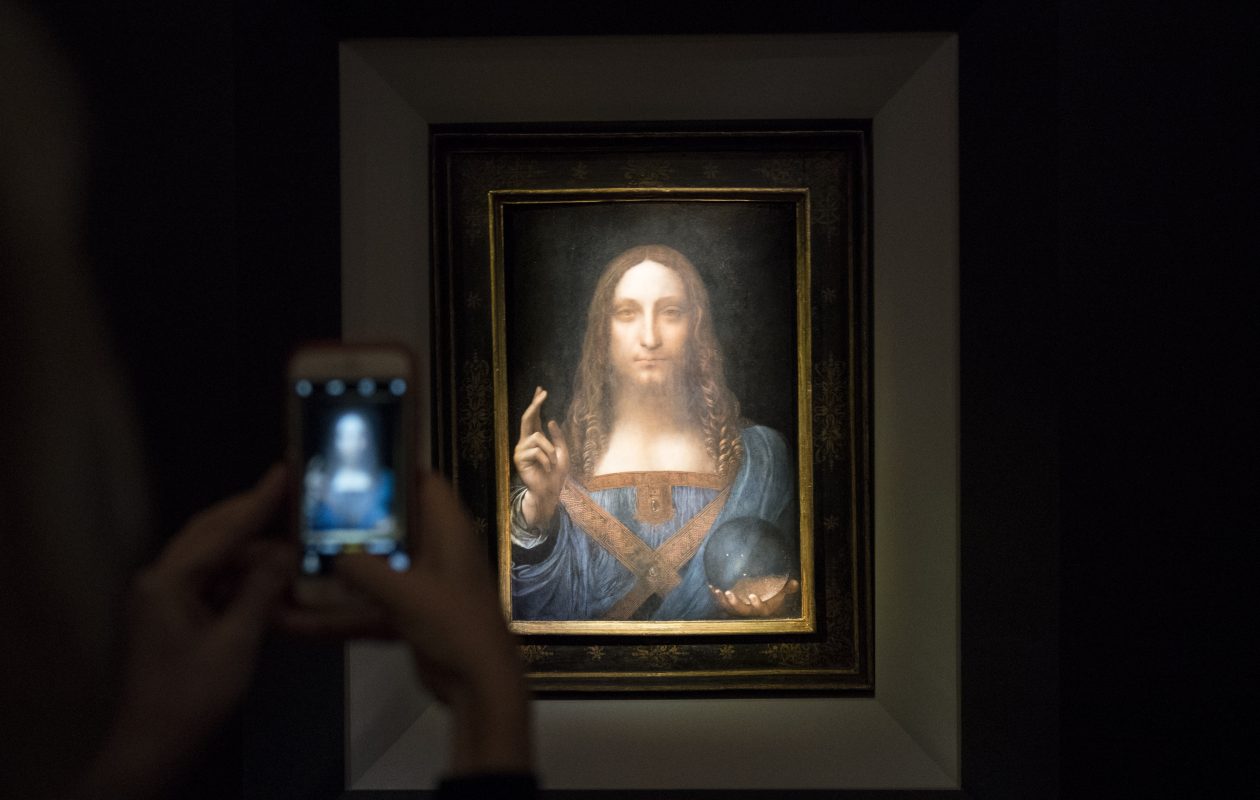
Above, Salvator Mundi, the painting attributed to Leonardo da Vinci and sold at auction in 2017 for $450 million. Photo: Drew Angerer/Getty Images – as published on 2 April 2018 in Buffalo News
The sensational Mail Online story (“EXCLUSIVE: The world’s most expensive painting cost $450 MILLION because two Arab princes bid against each other by mistake and wouldn’t back down (but settled by swapping it for a yacht”) discussed here in this News & Notices post, has been questioned or disparaged by a number of commentators but not directly challenged by Christie’s, so far as we know. On March 30 Bendor Grosvenor wrote (“Who underbid the Salvator Mundi?):
“I’m sceptical about this version of events. First, the source seems determined to prove mainly that the picture is somehow ‘not worth’ what it made – the figure of $80m is mentioned – when there were other underbidders up to the $200m level. Second, I’ve been told that the underbidder to $400m was not from the Middle East, from a source who would know.”
Had Grosvenor’s source been correct and the Mail’s story, thus, been seriously misleading, one would expect Christie’s’ lawyers to have demanded either changes to the online article or its removal. Grosvenor’s seeming partisanship on the Salvator Mundi case takes two forms. As well as knocking the knockers, he hypes his brother-auctioneers’ hype, as, on November 12 2017 (“Leonardo’s ‘Salvator Mundi’ to be sold at Christie’s”):
“I love this video of people seeing Leonardo’s Salvator Mundi. Christie’s say 20,000 have been to see the painting on its world tour. I’ve been impressed by how Christie’s have marketed the picture – in fact, I’d say that they’ve taken marketing Old Masters to a whole new level. A well deserved AHN pat on the back to all involved. The sale is on Wednesday 15th November. Anyone care to make a prediction?”
On November 16, the day after the $450m sale, Grosvenor was ecstatically supportive (“’Salvator Mundi’ – the most expensive artwork ever sold at auction”):
“Christie’s just did something that re-writes the history of auctioneering. They took a big gamble with their brand, their strategy to sell the picture, and not to mention the reputations of their leadership team, and they pulled it off. They marketed the picture brilliantly – the best piece of art marketing I’ve ever seen. Above all, they had absolute faith in the picture. AHN congratulates them all.”
Pace Grosvenor and his sources, questions on Christie’s marketing of the Salvator Mundi persist. The whispering campaign against the Mail’s disclosures has not worked. In this weekend’s Financial Times the author Melanie Gerlis closed her art market column with the item below:

As things stand, no one has disproved the Mail’s suggestion that the (disputed) Leonardo Salvator Mundi has been swapped for a luxury yacht. In her book Art as Investment, Gerlis noted that because the “worth and price are known to only a few” in an art market that is underpinned by a lack of “verifiable and meaningful data”, those looking to art purely as a secure investment “might first consider looking elsewhere.”
With the Salvator Mundi, some 13 years after its emergence, we still do not know when, where and by whom the painting was bought. There have been many conflicting accounts on the work’s ownership (see below). In the April 6 Antiques and Arts Weekly, the New York dealer Dr Robert Simon was asked: “Can you say where you found Leonardo’s ‘Salvator Mundi’?” He replied:
“Alex and I acquired the painting at an estate auction in the United States, but we’ve never divulged the location of the auction. We were not permitted to, according to the terms of the confidentiality agreement we signed at the time we sold the painting.”
The sale was conducted privately in 2013 through Sotheby’s when it was acquired by the “Freeport King”, Yves Bouvier, who was acting as an agent for the Russian oligarch Dmitry Rybolovlev. Did Sotheby’s insist that the origin of the picture not be disclosed? Or Bouvier? Whomever – the enforced confidentiality clause was made eight years after the claimed discovery/acquisition in 2005. However constricting the terms of the 2013 sale agreement might have been, they could hardly account for the non-disclosure of the owners’ identities for the previous eight years – including the time the picture spent in the National Gallery. When the Salvator Mundi was about to enter the Gallery’s big Leonardo show in 2011 as an autograph Leonardo, the Sunday Times reported:
“Its ownership is a closely guarded secret. Robert Simon, a New York art dealer, is representing the owner, or owners – the official line is it is a ‘consortium’.”
Why, then, did the National Gallery agree to participate in this secrecy on the ownership of a painting whose (contested) Leonardo ascription had been supported by the gallery’s own director; by one of its curators; and, by one of its trustees?
Another of the scholar-supporters of this upgraded Leonardo is Professor Martin Kemp. In 2011 Kemp told the Sunday Times how he had been invited to view the work by the National Gallery (“there’s something it’s worth you coming in to look at”, was how Kemp put it). Kemp described entering the National Gallery’s conservation studios and joining “a little group of people, including some Leonardo scholars from Italy and America, and Robert Simon.” Robert Simon had been accompanied on that trip by the Salvator Mundi’s restorer, Dianne Dwyer Modestini. In 2012 Modestini would deliver a paper on the picture’s (then) two restoration campaigns at a conference held in the National Gallery.
FRESH CLAIMS
On April 6 Buffalo News reported that Dianne Modestini was to speak on April 9 in the Burchfield Penney Art Center at SUNY Buffalo State and was about to make two new claims.
First, that she and her late husband, the restorer Mario Modestini, had entertained no doubts that this was an autograph Leonardo painting: “We were completely convinced and we felt that we could justify this to anyone without sounding like idiots.” This goes further than Modestini’s 2012 paper: “…when I first saw it I never imagined what would transpire with this lovely but damaged painting on panel…I wasn’t aware of a lost, much-copied Salvator Mundi by Leonardo and I was perplexed. I showed the painting to my then 98 year old husband, Mario…He looked at it for a long time and said, ‘It is by a very great artist, a generation after Leonardo’.”
Second, that no technical evidence had emerged to confirm authorship by Leonardo. Modestini reportedly said that what made her so sure was not “the discovery of any single clue attributable to the master’s style or any technical element of the painting that could be traced to his hand, but rather the quality of the painting”. There was “no under-drawing for example, that was Leonardo’s drawing style, or anything like that. The pigments are the pigments that any one of his contemporaries could have used, and did.” This attribution was entirely a matter of judgment: “the quality of the painting, the sort of old-fashioned connoisseurship and skills, which art historians have always used to make an attribution, were in the end the telling factor for us.”
Those present at her lecture might have learnt why a painting that had so soon revealed itself as an autograph Leonardo to two experienced restorers and in which “apart from the discrete losses, the flesh tones of the face retain their entire structure, including the final scumbles and glazes” had needed a third campaign of restoration with substantial repainting of the face, some time between 2016 (when the Qataris reportedly turned down a private offer of the painting for $80m) and the spectacular $450m sale at Christie’s on 15 November 2017 amidst modern works, not old masters.
A NEW BOOK – FURTHER COMPLICATIONS
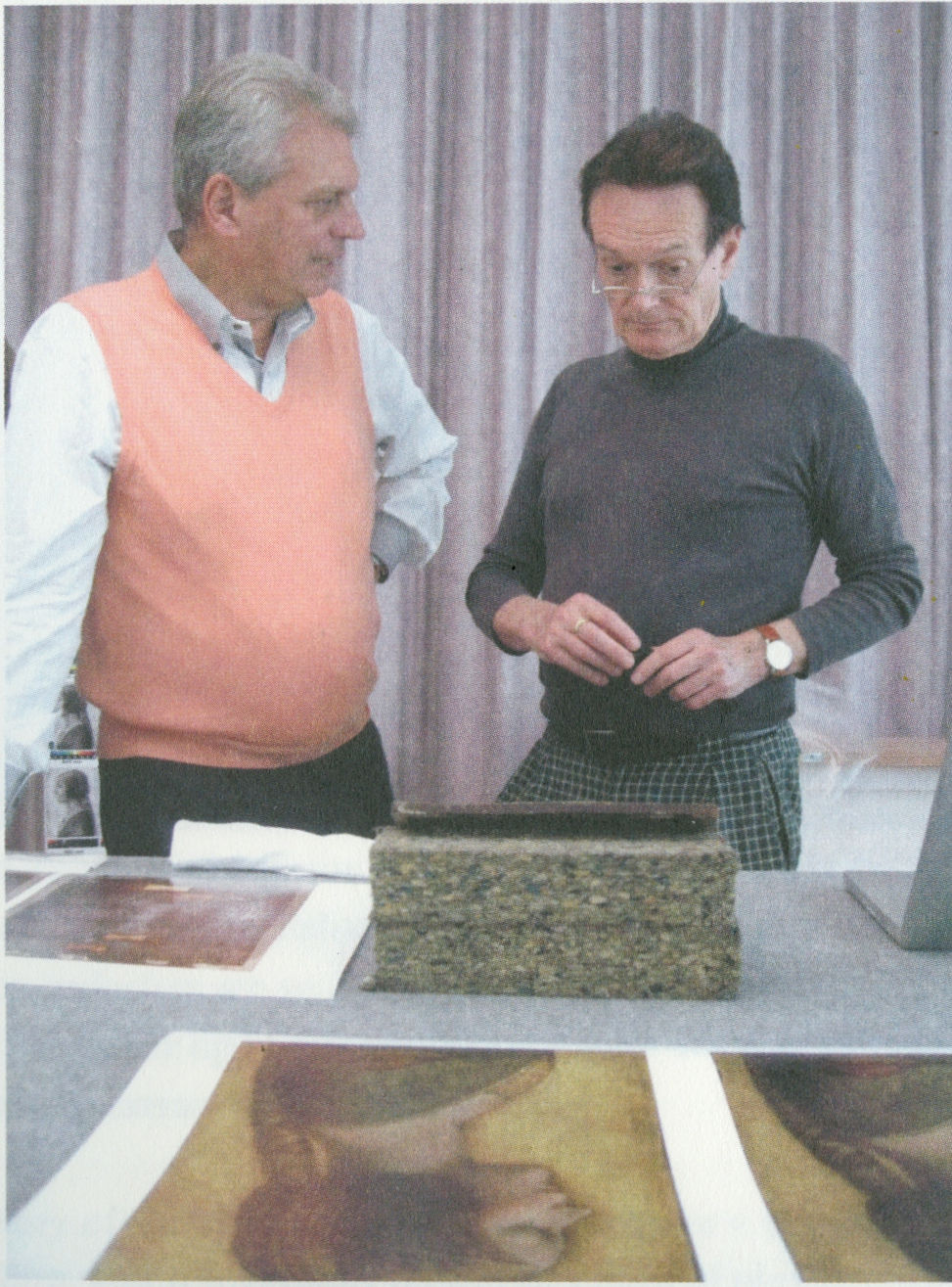
Above: left, Peter Silverman, the owner of the drawing “La Bella Principessa”; right, Professor Martin Kemp, author of the 2010 book “La Bella Principessa” – The Story of the New Masterpiece by Leonardo da Vinci. Photo: as published in Martin Kemp’s Living With Leonardo
Professor Martin Kemp has published a new book (Living with Leonardo – Fifty Years of Sanity and Insanity in the Art World and Beyond) in which he pays a back-handed compliment to ArtWatch in his second chapter: “Theirs has been the most sustained and fully researched of the hostile polemics”. Elsewhere he launches a series of slurs against three named ArtWatch UK contributors and officers in defence of his own support for two recently attributed Leonardos, the Salvator Mundi painting, and the mixed media drawing on vellum glued onto oak, that he dubbed “La Bella Principessa”. The slurs will be refuted, but we note here that Kemp has now provided a fuller, and apparently verbatim, account of the National Gallery’s invitation to him to view the Salvator Mundi:
“On 5 March 2008, my birthday, an email arrived, announcing the appearance of a new Leonardo – a painting rather than a drawing […It] came from a well known source: Nicholas Penny, then director of the National Gallery in London.
“I would like to invite you to examine a damaged old painting of Christ as Salvator Mundi which is in private hands in New York. Now it has been cleaned, Luke Syson and I, together with our colleagues in both paintings and drawings in the Met, are convinced that it is Leonardo’s original version, although some of us consider that there may be [parts? – Kemp’s parenthesis] which are by the workshop. We hope to have the painting in the National Gallery sometime later in March or in April so that it can be examined next to our version of the Virgin of the Rocks. The best preserved passages in the Salvator Mundi panel are very similar to parts of the latter painting. Would you be free to come to London at any time in this period? We are only inviting two or three scholars.”
The following observations on that stage of the Salvator Mundi’s Leonardo accreditation might be made:
1) The method of inviting successive select groups of scholars to see and appraise the painting in the prior knowledge of others’ support for the new attribution might be thought to have fallen short of the National Gallery’s own practices. When Nicholas Penny, as a curator at the National Gallery, proposed the Northumberland version of Raphael’s Madonna of the Pinks as the original painted prototype of the very many versions, he first published a thorough and well-received scholarly article in the Burlington Magazine, and later invited a group of some thirty Raphael scholars to discuss the matter during a day-long symposium at the National Gallery.
2) With this Salvator Mundi upgrade, none of the fifteen or so invited experts has published a case for the attribution. Robert Simon has yet to publish the researches to which both Modestini’s restoration report and Luke Syson’s exhibition catalogue entry were indebted. It is not clear whether Modestini was present when the painting was examined at the National Gallery. Kemp writes in his new book:
“No one in this assembly was openly expressing doubt that Leonardo was responsible for the painting, although the possibility of participation by an assistant or two was generally acknowledged. I sensed that Carmen [Bambach, of the Metropolitan Museum drawings] was the most reserved about the painting’s overall quality. A general discussion followed. Robert Simon, the custodian of the picture (whom I later learnt was its co-owner), outlined something of its history and its restoration. He seemed sincere, straightforward and judiciously restrained, as proved to be the case in all our subsequent contacts…”
Carmen Bambach rejected the Leonardo attribution in a 2012 Apollo review of the National Gallery exhibition and gave the painting to Leonardo’s student Boltraffio. Ironically, the Times reported on 9 April 2017 that Kemp has now demoted the Hermitage Museum’s Litta Madonna (which was included as a Leonardo in the National Gallery’s 2011-12 exhibition) from Leonardo to Boltraffio.
3) After seeing the Salvator Mundi next to the National Gallery’s version of Leonardo’s Virgin of the Rocks (which is to say, its second version), Dianne Modestini was inspired to change the appearance of the former:
“There were actually two stages of the current restoration. In 2008 when it went to London to be studied by several Leonardo experts, there was less retouching. I hadn’t replaced the glazes on the orb, finished the eyes, suppressed the pentimenti on the thumb and stole, and several other small details but, chiefly, the painting still had the mud-coloured modern background that was close in tone to the hair. Two years later I was troubled by the way the background encroached upon the head, trapping it in the same plane as the background. Having seen the richness of the well-preserved browns and blacks in the London Virgin of the Rocks and based on fragments of the black background which had not been covered up by the repainting, I suggested to the owners that it might be worthwhile to try to recover the original background and finish the complete restoration.”
Thus, Modestini had intervened radically on the painting shortly before it was included in the National Gallery’s major 2011-12 Leonardo exhibition and two years after it was appraised by selected Leonardo scholars at the National Gallery.
4) Restoration campaigns, like wars, are easy to start. In 2012 Modestini acknowledged an ambition to finish a “complete restoration”, after seeing the National Gallery’s restored Virgin of the Rocks. Permission, she recalled, was granted to strip and repaint the entire background:
“The initial cleaning [i. e. paint and varnish removal] was promising especially where the verdigris had preserved the original layers. Unfortunately, in the upper parts of the background, the paint had been scraped down to the ground and in some cases the wood itself. Whether or not I would have begun had I known, is a moot point. Since the putty and overpaint were quite thick I had no choice but to remove them completely. I repainted the large missing areas in the upper part of the painting with ivory black and a little cadmium light red, followed by a glaze of rich warm brown, then more black and vermilion. Between stages I distressed and then retouched the new paint to make it look antique. The new colour then freed the head, which had been trapped in the muddy background, so close in tone to the hair, and made a different, altogether more powerful image.”
5) “Restorations”, which might more accurately be described as “stripped and painted re-presentations commissioned by owners”, are rarely straightforward and unproblematic. Modestini made her decisions in the sincere belief that the London Virgin of the Rocks is an entirely autograph Leonardo painting and therefore a reliable guide to her own interventions on the Salvator Mundi. However, that Leonardo attribution has only been widely thought to be the case since the painting’s recent restoration. Kenneth Clark, when director of the National Gallery thought otherwise. In 1944 he said of the head of the picture’s angel: “This is one part of our Virgin of the Rocks where the evidence of Leonardo’s hand seems undeniable, not only in the full, simple modelling, but in the drawing of the hair. The curls around the shoulder have exactly the same movement as Leonardo’s drawings of swirling water. Beautiful as it is, this angel lacks the enchantment of the lighter, more Gothic angel in the Paris version…” Of the head of the Virgin, Clark wrote:
“…It is uncertain how much of this replica [of the first, Louvre, Virgin of the Rocks] he [Leonardo] executed with his own hand, and this head of the Virgin is the most difficult part of the problem. It is too heavy and lifeless for Leonardo and the actual type is un-Leonardesque; yet it is painted in exactly the same technique as the angel’s head in the same picture; and that is so perfect that Leonardo must surely have had a hand in it. Both show curious marks of palm and thumb…made when the paint was wet, and no doubt covered by glazes long since removed. This perhaps is a clue to the problem. A pupil did the main work of drawing and modelling, and before the paint was dry Leonardo put in the finishing touches. Most of these have been removed from the Virgin’s face but remain in the angel’s, where perhaps they were always more numerous.”
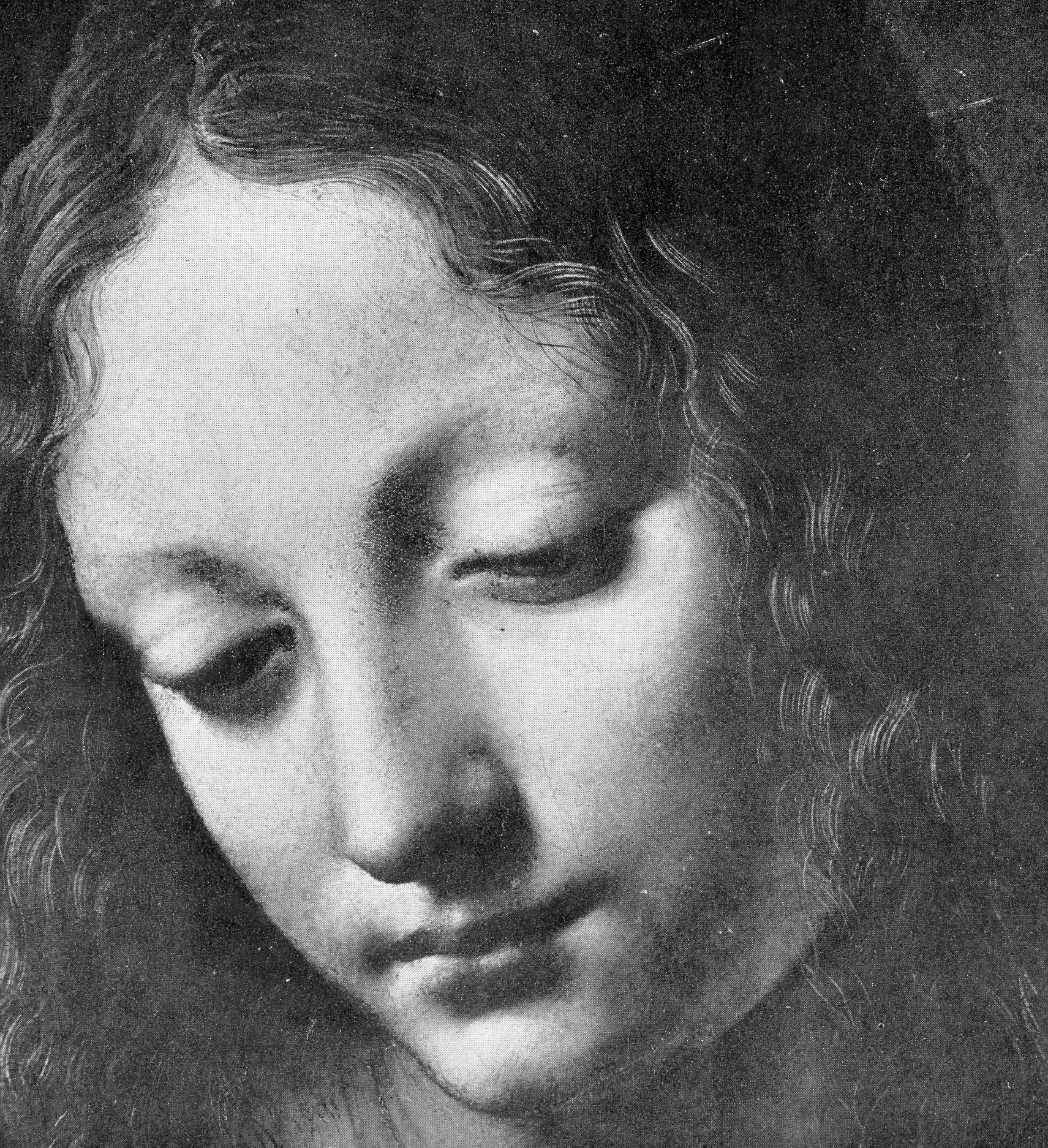
Above, top: The head of the Virgin in the National Gallery’s (second) version of Leonardo da Vinci’s The Virgin of the Rocks, as published in 1944 in Kenneth Clark’s One Hundred Details from Pictures in the National Gallery. Above, the Head of the Virgin as published in the 1990 re-issue of Clark’s “Details” book and, therefore, after its post-war restoration by Helmut Ruhemann but before its more recent re-restoration by Larry Keith (in which the mouth of the Angel was altered, on Luke Syson’s advice, as discussed here in “Something Not Quite Right About Leonardo’s Mouth ~ The Rise and Rise of Cosmetically Altered Art”).
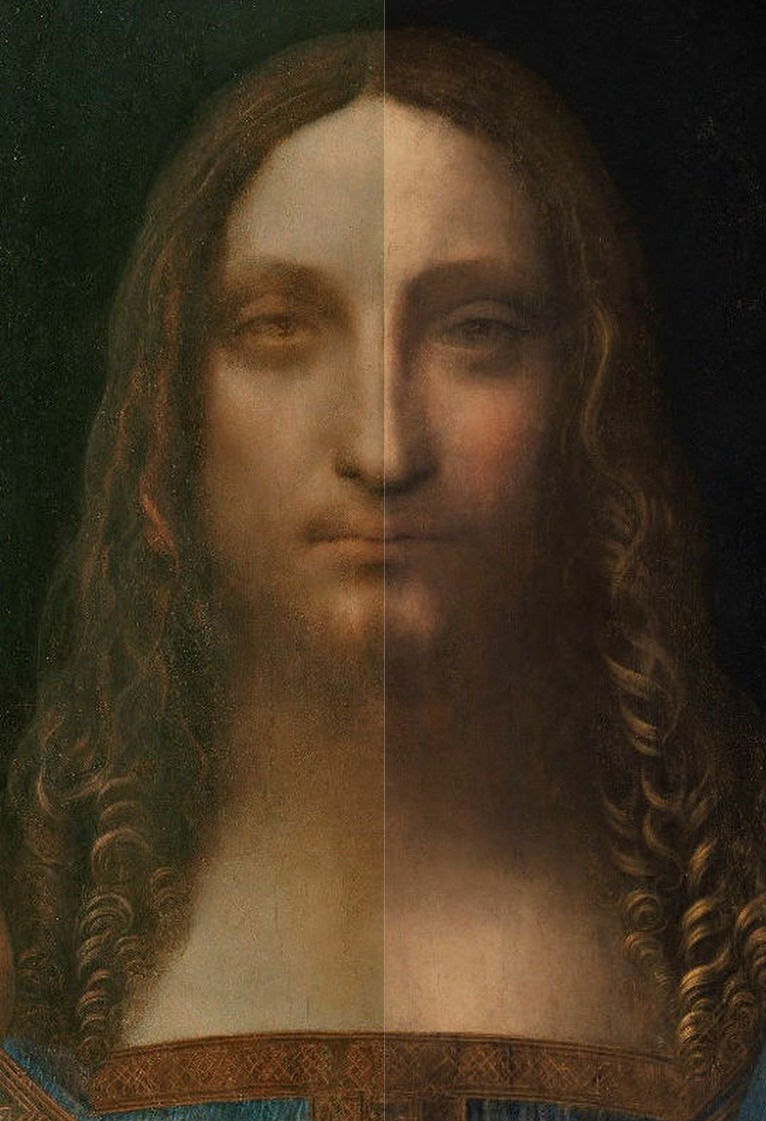
Above, the face in the accredited Leonardo da Vinci Salvator Mundi, as exhibited, left, in the National Gallery in 2011-12, and, right, as when sold at Christie’s in November 2017.
In 1990 the National Gallery remarked that “as a result of” the picture’s 1949 restoration “the differences between the heads are perhaps less apparent”. That being so, either one face had received new glazing or the other had lost original glazing. For Kemp, a crucial technical proof of Leonardo’s authorship of the Salvator Mundi is the fact that technical examinations had disclosed that “As is generally the case with Leonardo, infrared rays delivered the most striking results. It was good to be able to see that the artist had pressed his hand in to the tacky paint above Christ’s left eye – which we have seen to be characteristic of Leonardo’s technique.”
THE UNDERSTANDING TODAY ON THE SALVATOR MUNDI’S OWNERSHIP BETWEEN 2005 AND 2013
In his seventh chapter (“The Saviour”) Kemp twice discusses the ownership of the Salvator Mundi. He does so first with regard to the exclusion from the National Gallery’s 2011-12 exhibition of the “La Bella Principessa” drawing (– whose Leonardo ascription he has energetically advocated):
“This episode highlighted the rationale for the inclusion of the Salvator Mundi. Was it on the market? Would exhibiting it mean that the National Gallery was tacitly involved in a huge act of commercial promotion? It seemed highly likely that it was also ‘in the trade’ [like the ‘La Bella Principessa’]. All I knew at this stage [2011] was that it was being represented by Robert Simon. He told me that it was in the hands of a ‘good owner’ who intended to do the right thing by it, and I did not inquire any further.”
So, it would seem that the National Gallery had not disclosed the identity of the owner/owners to the scholars it invited to appraise the painting. Kemp continued:
“I was keen to consider the painting in its own right, not in relation to its ownership. I speculated, of course, that Robert might have a financial interest, perhaps a share in its ownership; and I assumed that he was gaining some kind of legitimate income from his work on the picture’s behalf. But the gallery was assured that the work was not on the market. Understandably keen to exhibit it, they were happy to accept this assurance…Might the Salvator have been less well regarded if its messy sale [in 2013, privately through Sotheby’s] to Bouvier [for $80m – $68m in cash and a Picasso valued at $12m, according to Georgina Adam in her “Dark Side of the Boom” book] and its resale [to Dimitry Rybolovlev for $127.5m] had been apparent before its public debut [at the National Gallery in 2011-12]? It has turned out to be a substantial mess. In November 2016, an article in The New York Times reported the latest developments: three ‘art traders’ (Robert Simon, Warren Adelson and Alexander Parrish) were disconcerted to find that painting was ‘flipped’ by Bouvier for $47.5m more than their selling price. Was Sotheby’s a knowing party to the the resale? The auction house claimed that it was not, taking pre-emptive legal action to block any law suit by the ‘traders’….It was however a great surprise to find that the Salvator was to be sold at Christie’s in New York on 15 November 2017 at a mega-auction of celebrity works from the modern era. The auctioneers sent the painting on a glamorous marketing tour of Hong Kong, San Francisco and London. I was approached by the auctioneers to confirm my research and agreed to record a video interview to combat the misinformation appearing in the press – providing I was not drawn into the actual sale process.”
Where would we be without a free and vigilant press? Where, precisely, is the $450m Salvator Mundi today?
Michael Daley, 10 April 2018
IN THEIR OWN WORDS: No. 3 [11 March 2018] – The Reception of the First Version of the Leonardo Salvator Mundi
Mounting concerns over transparency in art world deals are throwing back-dated light on the Salvator Mundi’s reception in its first-restored incarnation when included in the 2011 National Gallery exhibition Leonardo da Vinci: Painter at the Court of Milan.
THE SALVATOR MUNDI’S FIRST PUBLIC OUTING IN 2011

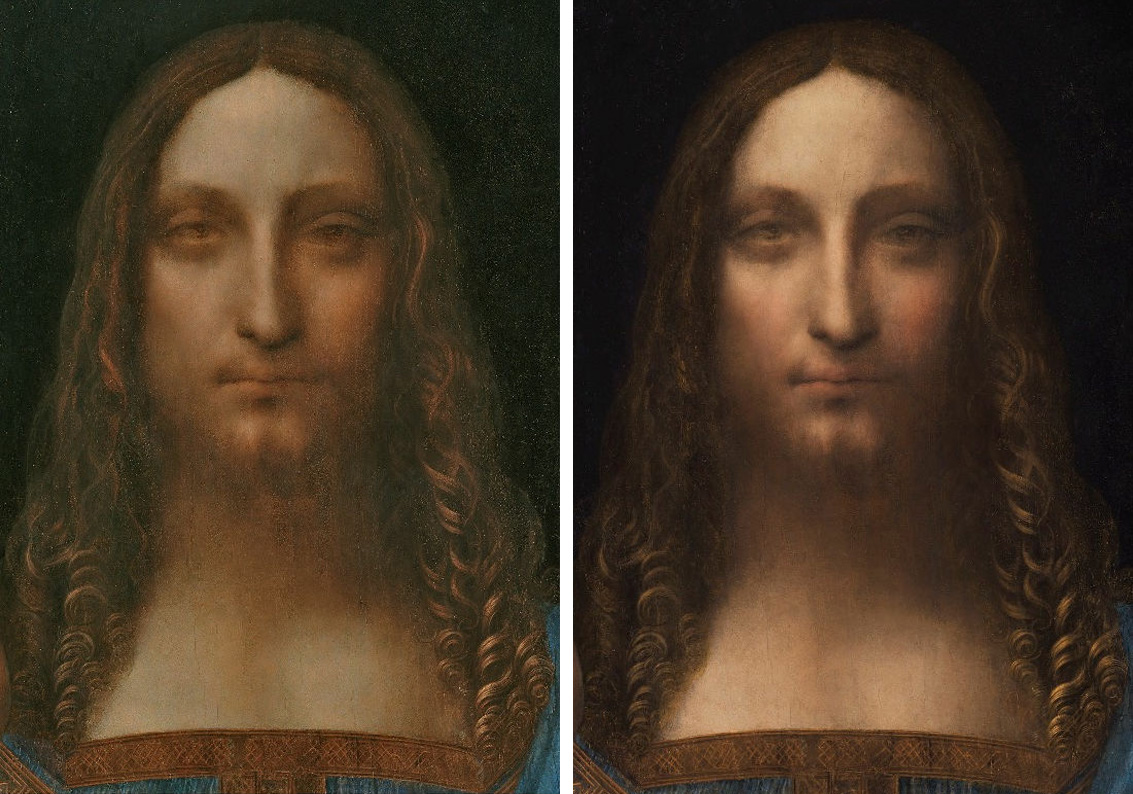
Above, top, the Sunday Times magazine cover of 9 October 2011. Above, the face of Christ in the Salvator Mundi as seen after repainting in 2011, left; above, right, the face of Christ in the Salvator Mundi as seen in November 2017 after further repainting between 2012 and 2017.
In the 9 October 2011 Sunday Times (“LEONARDO? CONVINCE ME”), Kathy Brewis wrote:
“For a few weeks in London you will be able to see the Salvator Mundi (Saviour of the World) up close. It might be your only chance. Much of the painting’s history remains obscure. Its ownership is a closely guarded secret. Robert Simon, a New York art dealer, is representing the owner or owners – the official line is it is a ‘consortium’. Why all the secrecy? ‘It’s just privacy and security’, says Simon, ‘One doesn’t want people knocking on the door.’
“…He showed it to Mina Gregori, a retired professor at Florence University, who was stunned: ‘I believe it’s by Leonardo.’ Then he showed it to Nick Penny, who had just been appointed director of the National Gallery. ‘He understood it in a nanosecond. He said that one of his ambitions was for the gallery to be a venue for scholarly inquiry and research and that he’d like the painting to be brought to London so it could be compared with the Virgin of the Rocks.’ It was Penny who told him [Simon]: ‘You need a consensus…’
“Since Robert Simon went public with the discovery, he has received many emails from Leonardo fanatics. ‘There’s the serious obsession and there’s the lunatic one – people for whom Leonardo is a source of fantasy. The paintings are not knowable,’ he muses. ‘Every one of them presents a problem and a challenge.’ Even at this stage? ‘Art historians are a prickly, competitive lot. I wouldn’t be surprised if someone stuck their hand up and said “I don’t believe it”’. Could the experts be wrong? ‘They could be wrong about anything. But as much as I believe anything in this world, I believe this is by Leonardo.’”
Above, and top left, the Salvator Mundi as exhibited in 2011 at the National Gallery’s big Leonardo exhibition.
Kathy Brewis continued:
“…Frank Zöllner of Leipzig University [- and author of the Leonardo catalogue raisonné] is a rare dissenter: he thinks the proportions of the nose (‘too long’ for such a perfectionist as Leonardo) make it more likely to have been painted by a talented follower. The rest are convinced, if a little jealous that they didn’t unearth it themselves. ‘People in the art world get sniffy about dealers,’ says Bendor Grosvenor, director of the London fine-art dealership Philip Mould. ‘But if it wasn’t for the trade, discoveries like this wouldn’t be made. Specialist dealers are the ones who are prepared to buy a dirty picture, roll their sleeves up and get stuck in to seeing what it is.’
“Is it wise for the National Gallery to put it on show so soon after its authentication? ‘They are taking a risk,’ says Grosvenor, ‘and I can’t applaud them enough for it. Connoisseurship is a nebulous discipline. There can never be absolute 100% proof. You have to accept there’s an element of doubt and go with it.’”
Note – On 5 March 2018 Grosvenor declared himself an ex-dealer on his blog Art History News: “Now, portraiture can be a hard sell – I know this from having spent over a decade actually selling portraits, in my former life as a dealer.” This did not come as an absolute bolt out of the blue: although he remains a director of the Scottish auctioneers Lyon and Turnbull Limited, last year Grosvenor briefly closed down his website following certain professional criticisms, commenting as he did so: “at the same time AHN also makes me a significant number of, well, ‘enemies’ is not too strong a term. Every walk of life has its Salieris, but in the art market there are an awful lot of them.”
Kathy Brewis continued with a discussion on the Salvator Mundi’s owners:
“Luke Syson, the show’s curator is one of the few people who know who owns the picture. ‘We couldn’t exhibit it otherwise. It’s not being wafted to us in a brown envelope.’”
Ben Hoyle reported the Salvator Mundi’s owners’ plans in the Times of 12 November 2011 (“It’s kind of scary – I wrapped it in a bin liner and jumped into a taxi with it”):
“‘Everyone involved recognises the importance of it as a work of art. Doing the right thing has been very important and will continue to be,’ Mr Simon says. If that means selling it for half the price they could attract, to ensure that it stays on public view, then they would prefer to do that.”
In the event the picture was sold privately by Sotheby’s in 2013 to a Swiss businessman, Yves Bouvier, who is known as the “Freeport King” (and who, among many commercial interests, owns an art conservation and authentication service), for appreciably less than the sums of $150-200m being talked about in 2011 (when the owners reportedly had turned down a $100m offer). The original consortium and Robert Simon received $80m for the Salvator Mundi from Bouvier who resold it for $127.5m to the Russian billionaire Dmitry Rybolovlev.
To this day we do not know who owned the Salvator Mundi before 2005 or between 2005 and 2013. From whomever and by whomever it was bought in 2005, the painting’s reception as an attributed Leonardo in 2011 was very far from uniformly rapturous. In addition to the dissenting scholars we cited on 14 November 2017 (see THE CRITICAL RECEPTION OF THE NEW YORK SALVATOR MUNDI), a number of newspaper art critics were un-persuaded.
In the 13 November 2011 Sunday Telegraph (“The genius of Leonardo”), Andrew Graham-Dixon wrote:
“…The picture is certainly Leonardesque. But is it by Leonardo? That is the considerably-more-than-million-dollar question for the consortium of art dealers who acquired the work a few years ago for an undisclosed sum. If the attribution holds up they can expect to reap £125m as a reward for their good judgement.
“Leonardo da Vinci: Painter at the Court of Milan is a breathtaking and truly remarkable exhibition which brings together around half of the surviving 15 or so surviving paintings by the famously dilatory artist of the Italian Renaissance…Two works in particular appear destined to come under scholarly fire.
“Although it gets the thumbs up from the National Gallery’s curator, [Luke] Syson, there will certainly be those who question the new Christ. The picture undeniably displays a number of the painter’s characteristic devices and mannerisms, but there are other aspects of it that seem foreign to Leonardo himself.
“He was prized by his contemporaries as one of the most innovative and forceful painters of emotion, yet the face of this Christ seems peculiarly inert. Taken individually, its elements are convincing enough, but viewed as a whole its expression seems to lack a certain subtle Leonardo magic: the spark of inner life and feeling…”
Even after the picture had been re-done-over by the restorer, Diane Modestini, ahead of the 15 November 2017 sale, the Sunday Times’ art critic, Waldemar Januszczak, responded with less tact than Graham-Dixon (“The Miracle of da Vinci: Turning a £45 Oddity into a £341m Old Master”, 19 November 2017):
“…To call the Salvator Mundi untypical is massively to understate the case. It resembles nothing else Leonardo painted
“The claim by Loic Gouzer, chairman of contemporary art at Christie’s in New York, that the record-breaking Jesus bears ‘a patent compositional likeness’ to the Mona Lisa had me laughing out loud. Yes, it shows the upper half of a figure in a frame. But that is the only compositional likeness the Salvator Mundi shares with the Mona Lisa…
“The next time I saw the painting was in 2011 when the big Leonardo exhibition was opened in London. Full of magnificent loans – the Lady With an Ermine, from Poland; the Virgin of the Rocks from the Louvre – it really was a once-in-a-lifetime event. And there on the wall was the recently rediscovered Salvator Mundi looking just as strange and sci-fi as I remembered it.
“At the time it was owned by a consortium of art dealers who had bought it in an American estate sale for $10,000 as a work by a follower of Leonardo. The dealers had it comprehensively cleaned and repainted. The National Gallery, eager to give its show a boost, announced it as the first new Leonardo discovered in 100 years. Wow…
“Soon after its London unveiling it was sold on to the Russian Billionaire, Dmitry Rybolovlev, for a reputed £98m. It was Rybolovlev who sold it again in New York last week.
“How did Leonardo’s sci-fi Christ, who looks as if he belongs on the cover on one of L Ron Hubbard’s scientology textbooks, end up costing all those shekels? It was mostly due to the wicked brilliance of Christie’s.
“Not only did the auction house tour the picture noisily to Hong Kong, and London before the New York sale, drumming up interest among the newly rich, but its hype department was also in full swing on this one. Finding a new Leonardo, boomed Gouzer, ‘is rarer than finding a new planet’. It’s ‘the greatest discovery of the century’ repeated the Christie’s chorus.
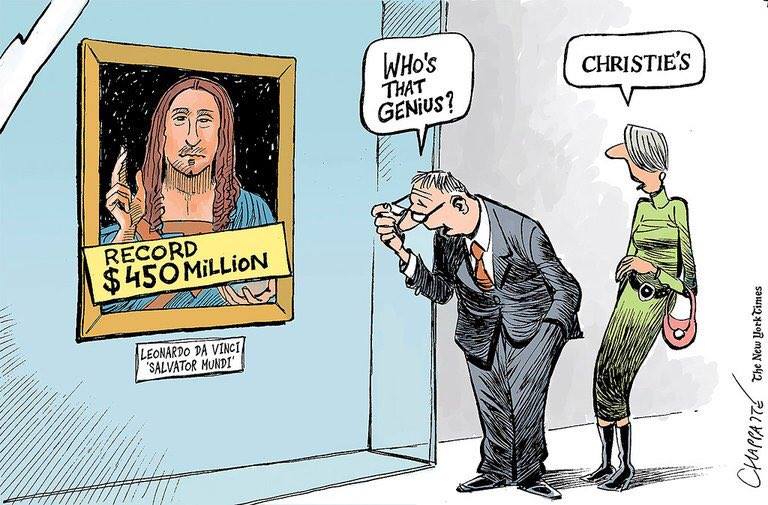
Above, Patrick Chappatte’s take on the Salvator Mundi sale/attribution for the New York Times. Below, Patrick Blower’s incorporation of the Labour Party leader, Jeremy Corbyn, for the Daily Telegraph:

Waldemar Januszczak continued:
“In recent years modern art has been where the money goes. A new generation of mega-rich collectors who know a lot about luxury brands but not much about art, have piled into the market and sent prices soaring.
“Earlier this year a quickly splattered Jean-Michel Basquiat of a face shaped like a skull sold in New York for an astonishing £85m. By putting the Leonardo in such a context, Christie’s circumnavigated the knowledgeable world of the Old Master collector and headed straight for the dumb f**** with the money.
“There are various ways to understand events in New York on Wednesday night [of 15 November 2017].
“You can see them as evidence of Leonardo’s treasured and mythic status in art. You can see them as testimony to the power of attribution. Or you can see them as proof that we live in a mad world that has lost sense of true value and in which obscenely rich people waste obscene amounts of money on the obscene acquisition of trophy art. Going, going, gone.”
SUPPORT AND DISSENT
It so happens that the scholar who first attributed the Salvator Mundi to Leonardo, Professor Mina Gregori, was also the first scholar to attribute the proposed Leonardo drawing that was dubbed “La Bella Principessa” by Professor Martin Kemp. However, “La Bella Principessa” was not included in the National Gallery’s Leonardo exhibition and, seven years later, it remains unsold. Although we know precisely why the dissenting scholars rejected the Salvator Mundi attribution (- they published their views in the scholarly press), we have virtually no information of who said what and in what order among the consensus of scholars listed by Christie’s (see Problems with the New York Leonardo Salvator Mundi Part I: Provenance and Presentation).
SECRET DEALS – AND THE ARTS CLUB
Since we began warning on this site in 2014 of the threat to market confidence posed by the art world’s toxic attributions and specifically called for increased transparency through a statutory requirement that vendors should disclose all that is known and recorded about the provenance and the restoration treatments of works of art (“As things stand, it can be safer to buy a second-hand car than an old master painting” – “Art crime”, ArtWatch UK letter, the Times, 13 August 2014), secret deals have come under increasingly intense investigation. In her 2017 book Dark Side of the Art Boom, Georgina Adam wrote:
“At its base, the Bouvier/Rybolovlev dispute was about the nature of their business conducted within a market that has always thrived on secret backroom deals. By keeping vendors and buyers apart – they may never know who the other is – and insisting on discretion, agents, dealers, advisors can use this anonymity to their advantage. Various reasons can be put forward, from the need for security to the desire to avoid family quarrels or the taxman, to the risk of someone else bagging the work for sale. In the Bouvier/Rybolovlev case, one of Bouvier’s emails about a Magritte, said: ‘I must carry out this [negotiation] with the greatest discretion to avoid drawing attention to the painting and its owner; the risk is that we could lose it at auction.”
In this weekend’s Financial Times (10/11 March 2018 – “Laundering Picasso: British dealer among accused in $50m case”), Melanie Gerlis cites the emergence of another highly embarrassing series of documents:
“Potential shenanigans involving art are in the spotlight once again. London art dealer Matthew Green is among defendants in the case against Beaufort Securities, three other corporations and five other individuals, accused by the US Department of Justice of a multiyear $50m-plus securities fraud and scheme to launder money, partly through the sale of a £6.7m painting by Picasso.
“The indictment alleges that Green, described as the owner of Mayfair Fine Art Limited, met last month with an investment manager from Beaufort Securities (now declared insolvent), as well as a property developer and an undercover federal agent masquerading as a client of the brokerage firm. At this meeting held around February 5, the court papers say that the agent-client was told he could ‘purchase a painting from Green using the proceeds of the stock manipulation deals and later sell the painting to “clean the money”’…The papers describe the art business as ‘the only market that is unregulated’”.
“The papers also say that Green – who had allegedly asked for a 5 per cent profit on the transaction, ‘so that he would not be asked why he was in the money laundering business’”. [Green] sent a message via What’sApp to the Beaufort Securities manager that read: ‘[O]bviously because of the nature of this transaction we need to preserve a certain amount of anonymity which [the undercover agent] and I discussed and clarified at the Arts Club!’”
UNDERCHARGING FOR CURRENT MARKET PRACTICES
The Art Market Monitor blogger, Marion Manneker, made this observation in his (5 March) comments on the trial:
“Green doesn’t seem to know that the price for laundering money is much higher than 5% which definitely isn’t worth the risk if it gets you indicted after being in business all of three months. Worse still, Green and his partners don’t seem to be the swiftest criminals. They boasted that the art market is unregulated but then created a scheme that seems to have had little to do with the art market itself.
“The art sale is only one of several money-laundering venues that the person was offered. Offshore banks and real estate deals figure prominently in the indictment. What’s more, Green’s scheme could have been conducted in just about any commercial transaction. And, since the payment for the Picasso was due March 6, 2018, we’ll never know if Green was actually capable of pulling off the sale at the price he claims or would have survived any kind of audit.”
OLD HABITS DIE HARD?
Manneker’s comments on the cut-price scale of Matthew Green’s alleged laundering service charges recalls certain comments of Kenneth Clark who recognized that his appointment as director of the National Gallery at a very tender age owed much to the fact, as he wrote in his 1977 memoir Another Part of the Wood, that:
“[T]he ideal candidate for the post was disqualified. This was a Finnish art-historian named Tancred Borenius. He was a good scholar, a pleasant companion and a passionate upholder of the concept of the monarchy. He would have made an ideal courtier. Unfortunately, he was known to have followed the continental practice, described above, of taking payments for certificates of authenticity; and what was worse, quite small payments (known as ‘smackers under the table’); if he had taken large payments like a few scholars on the continent, no one would have objected.”
Michael Daley, 11 March 2018
UPDATE, 12 March 2018. On 11 March, a Sunday Telegraph supplement (“Arts, Antiques and Collectibles”) carried a “Promotional feature” – “Managing Risk When Buying and Selling Art” – for the law firm Constantine / Cannon. In offering the firm’s services, the article began:
“TRADING IN ART has traditionally been done on a handshake, but this is changing. You would not buy or sell a house without relying on a lawyer to prepare the contract, would you? The same goes with art, and now buyers and sellers are increasingly turning to lawyers to help them manage the risks associated with expensive works. The art market used to function like a club of like-minded people, but that’s no longer the case. The market now is truly global, and it has become less transparent in the process…”
SAVE THE HITCHCOCK ODEON!
London’s architectural heritage is being devoured as a consequence of planning laxity in the face of Britain’s thriving economy and uncontrolled net inward migration (which, on official figures, is presently running at a rate in excess of three million people per decade).
That cities are living entities not museums is, as developers frequently claim, perfectly true – and migration brings benefits as well as pressures – but all that is new and lucrative is not necessarily of net social and cultural benefit. Today, every walk in the city reveals a fresh hole in the familiar and an ominous sprouting of cranes. As the Observer reports, some 400 skyscrapers are planned and 60% of Londoners oppose them. Initially clustered in the City of London, they now march westwards as planning authorities repeatedly prove toothless or supine with excesses granted in exchange for tiny “civic gains” or promised “modifications”. Every skyscraper serves immediately as precedent for a further neighbouring blight. (See also “A clear strategy on tall buildings is the only way to control developers”.)
A hideous 25-storey tower of 54 luxury flats in Somers Town that incenses heritage bodies and threatens to eclipse Nash and Burton terraces in Regent’s Park gained Camden Council planning approval by earmarking a portion of profits to a new primary school and other social purposes. The developer is none other than Camden Council itself. Further west, an approved private scheme to build forty-two townhouses and apartments in Kensington requires the destruction of the Art Deco cinema frequented by Alfred Hichcock. The (private) developers promise a seven-screen cinema amidst their housing project and to work hand in glove with the authorities “to the very highest standards”.
Cinema plus Design Museum
As the Evening Standard reports the new cinema-for-old scheme with a housing bonanza on top has triggered an imaginative and popular counter-proposal. A group, “Friends of the Kensington Odeon”, has marshalled support from 30,000 residents and a number of “philanthropic billionaires”. It propose a mixed arts centre (“The Hitchcock Odeon”) that would generate a “cultural hub” when joined nearby in November by The Design Museum. This scheme is backed by such distinguished actors as Sir Ian Mckellen, Dame Kristin Scott-Thomas, Sir john Hurt, Benedict Cumberbatch and David Suchet, and, “wholeheartedly” by Hitchcock’s daughter Patricia Hitchcock O’Connell.
Film-maker plus House
Hitchcock’s residency in Kensington was at 153 Cromwell Road. The recent history of that house testifies to a certain enduring commercial rapacity, as one of its present culturally distinguished residents, Selby Whittingham, outlines below. In 1975 Dr Whittingham, a student of medieval art and a devotee of both Watteau and Turner (two of the more restoration-vulnerable painters) founded a campaign for the creation of a proper and fitting Turner Gallery to house Turner’s great bequest. The campaign enjoyed much support – including that of Henry Moore, Hugh Casson, Kenneth Clark, and John Betjeman – and its committee meetings were held at 153 Cromwell Road until ended by dissensions that have left the realisation of a Turner Gallery unfinished business.
Selby Whittingham writes:
HITCHCOCK HOUSE AND OTHER DRAMAS
A recent proposal has been made, supported by cinematic celebrities, that the Odeon Kensington should become a new arts centre, The Hitchcock Odeon. The name was presumably prompted by the occupancy of the Kensington house where I have lived since 1970 by Alfred Hitchcock during the 1930s following his marriage at the Brompton Oratory, in token of which his daughter (Patricia Hitchcock O’Connell) unveiled a blue plaque on the centenary of his birth in August 1999.
The plaque celebrating Alfred Hitchcock’s residency at 153 Cromwell Road Kensington from 1926 to 1939
The Kensington Odeon was where I saw my first film, Scott of the Antarctic. I had come with my mother 70 years ago to live at 1 Scarsdale Villas, the previous tenant of which was Lady Benson, whose husband, Sir Frank, had toured the country with his company of actors selected mainly for their ability to play cricket. They had inspired my mother with a love of Shakespeare, which she transmitted to me. Lady Benson’s drama school was where John Gielgud received his first training as an actor. After her death the studio at the back reverted to being that of an artist called Maclaren, a loner of rather sinister appearance. It had been built for an illustrator, Leslie Brooke, ancestor of the onetime Culture Minister, Peter Brooke. Maclaren left and his place was taken by Flanders and Swann, attempts to commemorate whom with a blue plaque have so far been thwarted.
Alfred and Alma Hitchcock in their 153 Cromwell Road sitting room with a production secretary, right, taking notes. The photograph above comes from The Life of Alfred Hitchcock: the Dark Side of Genius by Donald Spoto.
In the 1930s many London cinemas were part of the Gaumont British empire controlled by the Ostrers. The presiding genius was Isidore Ostrer, for whom my mother-in-law worked for 30 years. One of his daughters married James Mason and another is my wife’s lively godmother. The history of the family and its eccentricities has been chronicled by Isidore’s nephew, Mark Ostrer, who has improved his portrait by Picasso, he says, by partially repainting it. In the 1970s he lived in Earls Court in a mews house, where he hid under the floorboards (where they remained when he sold it) giant tins of baked beans in preparation for World War III.
In the 1930s many London cinemas were part of the Gaumont British empire controlled by the Ostrers. The presiding genius was Isidore Ostrer, for whom my mother-in-law worked for 30 years. One of his daughters married James Mason and another is my wife’s lively godmother. The history of the family and its eccentricities has been chronicled by Isidore’s nephew, Mark Ostrer, who has improved his portrait by Picasso, he says, by partially repainting it. In the 1970s he lived in Earls Court in a mews house, where he hid under the floorboards (where they remained when he sold it) giant tins of baked beans in preparation for World War III.
That may not have broken out yet, but since 1983 at Hitchcock’s former home there have been intermittent skirmishes between the leaseholders which have enraged them and successive managing agents. In 1970 the superior lease was owned by a benevolent lady living nearby in Cornwall Gardens. She now decided to sell it. The purchaser was an outfit called Stateplan Ltd, of which the directors were Simon Longe and Richard Weston, who thought that they could make money by splitting up the two maisonettes (the top one having been Hitchcock’s) and two flats into a series of studio flats, the leases for the unexpired term being sold to the occupants and newcomers.
Longe started a series of enterprises which, like Stateplan, failed, and Weston, who practised as a solicitor at Taunton, was struck off the roll in 1991 and fined a few years ago for pretending to be a qualified solicitor. These geniuses helped provoke a new Thirty Years War. Weston drew up our lease whereby we would pay service charges in proportion to the relative values of the flats, there then being still only four, which of course changed after new ones were created, making nine in total. But in the leases he subsequently drew up for the new ones he took no account of that, with the result that we were at loggerheads with other owners almost from the start.
Above, Hitchcock film posters; top, a still from “The Lady Vanishes”
The inconsistency, and the consequent overcharging of ourselves, was quickly pointed out by our solicitors, Loxdales, also of Cromwell Road. A century ago they had acted for Sir Thomas Beecham, whose American father-in-law lived in South Kensington, in his dispute with his father, who had upset him by banishing his wife, Thomas’s mother, to a mental asylum. The father had as his lawyers my great-grandfather and grandfather. As a teenager I photographed his first wife in the garden of Clopton Manor, from where she claimed several of Shakespeare’s most famous scenes took their origin, a claim treated with contempt by a Shakespearian professor who called on me at Hitchcock House, which I had earlier named Turner House (I had founded the Old Turner Society there in 1975), in pursuit of his wife’s claim to be related to J.M.W.Turner, just as Lady Beecham claimed a family relationship to Shakespeare.
Mr Longe had promised to put the whole house in good repair before he started levying service charges. This did not happen. After the bedlam of the conversion of the other flats there suddenly collapsed the ceiling over the impressive staircase, up which luminaries such as G.B.Shaw and Michael Redgrave, whose rehearsals at Stratford I once witnessed, trod as Hitchcock worked on films such as The Lady Vanishes and Thirty-Nine Steps. Great chunks of plaster landed outside our flat door, through which I had passed minutes before. An even more impressive staircase in Belgravia was centre stage in a film by Graham Greene and Carol Reed in which my cousin Bobby Henrey, its boy star, imagined (or was it real?) he saw, as he leant over the banisters, a murder committed. (His mother wrote a book about the making of the film and more recently Bobby has published his own account). There have been no murders on our staircase, real or imagined – so far.
Next a water tank in the roof burst flooding many flats including ours. Repeated inundations afflicted the half-landing room which formed part of our “flat”, the lessors refusing to repair its roof, on to which all sorts of rubbish mysteriously landed making the flooding worse. Eventually we sold it to other leaseholders for a modest £12,500 on condition that our percentage of the service charges, which after 15 years of stalling had been reduced, should be further reduced. They reneged on the agreement to do that. They adapted the room to make a self-contained pied-à-terre which now must be worth at least ten times what they paid for it. Yet they felt indignant at having to pay the agreed increase in service charges, enforced only 10 years later after we took the matter to a tribunal, or indeed any service charges at all on it.
They named the studio Flat 2B (ours being 2). When we pointed out that it constituted a tenth flat, but was not listed among the flats paying service charges, all signs indicating 2B disappeared. At the tribunal it was still claimed that it was still just a spare room, though the council had at last got round to acknowledging its existence and had registered it as liable for Council Tax! We had drawn the council’s attention to its existence earlier, but it had done nothing and now said that it was too late to prosecute the owners. The Royal Borough moved in a similarly stately way over Leighton House, only accepting it long after all the contents from Lord Leighton’s time had been sold.
Troubles continued over the years and some disgruntled leaseholders sold their flats. At the top of the house remained the panelled room which the Hitchcocks had as their living room, decked out for them by Heal’s, while the bedrooms were on the floor below. On hearing that the panelling was being sold by its departing owner, Sandra Shevey, biographer and interviewer of Hitchcock and organiser of Hitchcock Walks, complained to the council, which again declined to do anything. Yet the house, if anywhere, should be Hitchcock’s London shrine. The dramatic spirit which invests it, and which has suspended our hopes of justice for so long, indicates that his ghost lives on in the crucible of his first triumphs.
Selby Whittingham, 30 August 2016
Problems with “La Bella Principessa” – Part II: Authentication Crisis
In Part I we discussed the look of the so-called “La Bella Principessa” drawing and showed that while it bears no comparison with Leonardo’s female portrait type, it sits comfortably among 20th century fakes (see Fig. 1). Here, we consider the singular campaign to have this work accepted as a Leonardo.
“LA BELLA PRINCIPESSA” AND THE (DECOROUS) COMPANY SHE BEST KEEPS
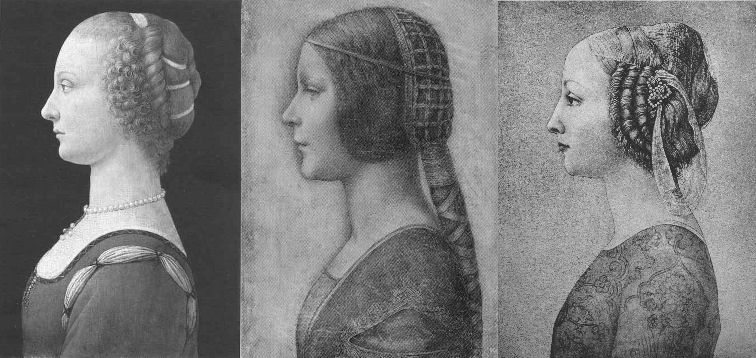
Above, Fig. 1: “La Bella Principessa” (centre) among 20th century fakes. For the drawing’s striking mismatch with secure Leonardo works – and with other bona fide associated works of the period – see Problems with “La Bella Principessa” – Part I: The Look.
A SINGULAR CAMPAIGN OF ATTRIBUTION
The nine years long campaign to have the drawing “La Bella Principessa” accepted as an autograph Leonardo da Vinci is faltering even before our series of examinations is completed. The leading proponent, Professor Martin Kemp, is said in the May 2016 Art Newspaper (Vincent Noce’s “La Bella Principessa: Still an Enigma”) to have his “reputation on the line” in the wake of our posts and an article “How reliable are today’s attributions in art? The case of ‘La Bella Principessa’ examined”, that was published in the Polish scholarly journal Artibus et Historiae, no. 71, 2015 (“La Bella Principessa – Arguments against the Attribution to Leonardo”) by Dr. Kasia Pisarek, an independent art historian (and ArtWatch member). In delayed response to our January 2014 suggestion that the disputed drawing’s author might have been the painter/restorer Gianinno Marchig (see Art’s Toxic Assets – Part II), Kemp now alleges on his blog that we are making “scurrilous and unsupported” attempts to “divert the argument into claiming that Jeanne Marchig lied profusely”. This is not the first such slur against us from that quarter. When Professor Kemp reviewed the James Beck/Michael Daley book Art Restoration: The Culture, the Business and the Scandal in 1994 he made similarly unfounded charges which we rebutted immediately. In recent years Kemp has cast his denunciations more widely and generally against his fellow scholars. (See below.)
Notwithstanding the “La Bella Principessa” campaigners’ belligerence towards doubters, and Professor Kemp’s own publicly bullish support for the attribution, his position on “La Bella Principessa” is untenable in terms of the work’s artistic properties and its emerging circumstances – as indeed is the methodological model for attributions that he hubristically offers to fellow scholars in connection with the Leonardo upgrades that he supports (see below).
Pace Kemp’s charge of evasion, it would be evasive not to consider Marchig’s role when appraising a drawing reportedly bought by a Panamean, Jersey-based company nine years ago at a requested discount for $19,000 but which now, as a claimed Leonardo, lives in a Swiss vault and is said to be insured for $150 million. We should all consider the circumstances and nature of this particular work and the assiduous, sometimes muscular campaign to upgrade it. The old masters market is fragile. The accelerating expanionism of recent years cannot be sustained. The market cannot afford to take in too many too-hopefully upgraded Leonardos, Michelangelos, Rubens’s, Van Dycks, Caravaggios and so forth. Aside from the resulting adulteration of scholarship, markets, as we all now appreciate, lose confidence and crash when too high a proportion of toxic assets is thought to have been bundled in among the bona fide.
PROMOTING THE DRAWING THAT CAME FROM NOWHERE
What is now presented as Leonardo’s “La Bella Principessa” of c. 1496 was sold anonymously at Christie’s, New York, in 1998 for $22,850 as a work without provenance. Twelve years later, Jeanne Marchig, the widow of the artist/restorer Giannino Marchig who had worked as a restorer for Bernard Berenson (who, Kenneth Clark said, sat on a pinnacle of corruption), identified herself as the vendor. She did so not in the disinterested cause of scholarship but to claim damages after sensational but unfounded and misleading media reports that fingerprint evidence had shown the drawing to be a Leonardo.
As we reported, aside from the widow’s hearsay claims concerning the ownership of the drawing by the painter/restorer, the drawing otherwise possesses not a shred of recorded history in its supposed five centuries. On the widow’s account (as variously reported by Kemp, by the drawing’s owner, Peter Silverman, and by a journalist selected by Silverman to promote the attribution, Simon Hewitt), Marchig, an unsuccessful artist who had grown rich and acquired a collection of valuable historic works, had declined to say even to his wife when or from whom he had acquired the framed drawing which he is said to have kept in a portfolio.
Jeanne Marchig dangled the possibility that he might have acquired it from Berenson, with whom he had grown close and for whom he had hidden paintings, photographs and documents during the war. Had he done so that would hardly dispel doubts and suspicions but even that possible lifeline to a past now seems unlikely: the drawing’s present owner and Kemp vainly trawled Berenson’s archives at I Tatti for any sign or mention of the drawing. The trail of this supposed Leonardo begins and ends with the Marchigs. Marchig, if his widow is reliable, said nowt and simply had. By coincidence, the widow was born in Warsaw where a book is housed that was later said (unpersuasively for reasons given by Dr Pisarek) to have contained the vellum sheet on which the drawing was made. Professor Kemp thinks the late Jeanne Marchig “a person of great credibility”. The journalist Simon Hewitt reported in the Huffington Post that:
“Jeanne Marchig was born Janina Paszkowska in Warsaw, into a family of doctors and lawyers. She was an only child: her father died in an accident before she was born. Her mother Elzbieta Chrostowska, an amateur wood-carver, took her to Sweden in 1939, where she grew up and married, became Janina Hama. The marriage didn’t last. She met the artist Giannino Marchig on a train between Stockholm and Florence, where he worked as a picture restorer. Berenson and Wildenstein were his top clients. Although a youthful exponent of racy nudes, Giannino was no lady’s man. He lived at home with his mother on the banks of the Arno. He was over 50. Jeanne was an art student. Their age-difference ran into decades. They married. People talked. Talked, too, about Giannino’s wealth. What had he done during the war? Helped hide Berenson’s collection from the Nazis, among other things. Did Berenson give him the Bianca portrait? Jeanne Marchig didn’t know. Or wasn’t saying. They moved to Switzerland. She morphed from a flirtatious livewire into a coquettish Miss Marple of unfluffy shrewdness. Giannino died in 1983. Jeanne published a sumptuous catalogue of her husband’s career and religiously kept the box of pastels he had used to restore the Leonardo.”
PROFESSOR KEMP’S EYE
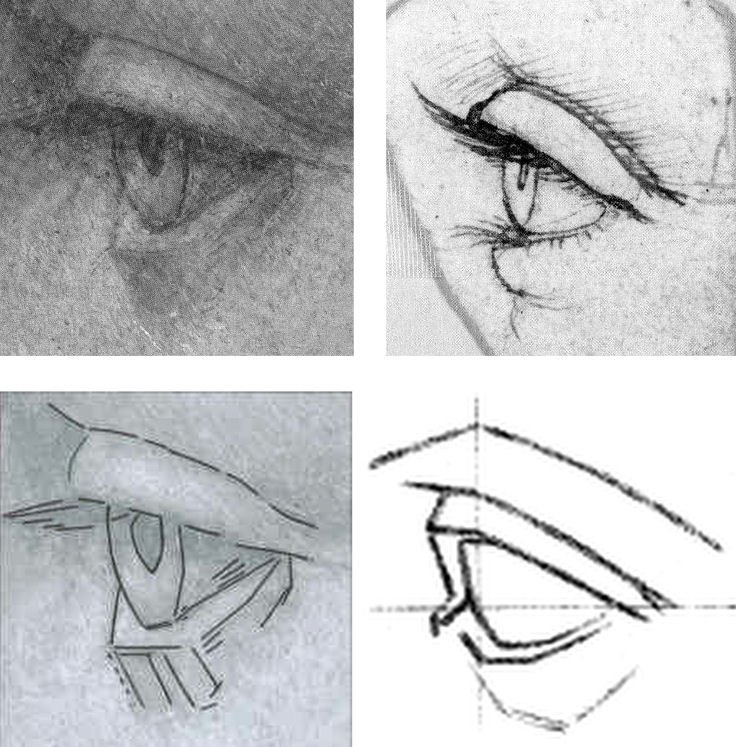
Above, Fig. 2: The eye of “La Bella Principessa”, top left, and above left (with a superimposed diagram). Top right, an eye drawn by Leonardo (reversed). Above right, an eye featured on a sheet of eyes drawn and reproduced as aids to students and artists in a famous drawing course published in the late 1860s – and later used by the young Picasso.
THE NUB OF CONNOISSEURSHIP DISPUTES IN THE VISUAL ARTS
Martin Kemp and I have recently discussed the eye in “La Bella Principessa” (top left) vis-à-vis the eye by Leonardo (top right) and I am grateful to him for this.
He believes that both eyes are drawn by Leonardo. I (a left-handed draughtsman) hold that the “La Bella Principessa” eye, with its pronounced, almost Cubist, angular and planar construction cannot conceivably have been drawn by Leonardo. There is simply nothing like it in Leonardo’s oeuvre. It is a construct of an alien, more modern kind. Kemp now admits that the unnaturally thick and angular lower lid is problematic but writes: “With the exception of the angularity of the lower lid, which is in an area of some damage, it is consistent (above all the amazingly delicate lashes) with the attached [the eye by Leonardo, top right]. Leonardo’s works of art are not anatomical demonstrations. It’s easy to find ‘anatomical erors’. I find the seizing on such things is to divert the arguments into issues of a peripheral nature in the face of evidence of a non-arbitrary kind.” This is a helpfully clarifying statement, but the suggestion that the eye might have been repaired is new.
In the 2010 Martin Kemp and Pascal Cotte book Leonardo da Vinci “La Bella Principessa” The Profile Portrait of a Milanese Woman, there is no indication given in Cotte’s map (Fig. 3) of repairs to “La bella Principessa” that the eye had been damaged, and Kemp, when comparing the eye with that of Leonardo’s Windsor Castle drawing Portrait of a Woman in Profile (Fig. 5), wrote of it “Even Boltraffio could not achieve this. The structure of the eyelids, the delicate flicks to create the lashes, and the translucent iris of the eye are extremely close on both portraits…” Pascal Cotte goes further, claiming a “distinct and identical logic” with the eye in Leonardo’s portrait of Cecilia Gallerani (The Lady with an Ermine, Fig. 4). Making no reference to injuries or repairs, Cotte specifically points in his diagram (Fig. 4) to the “The juxtaposition of the edge of the lower eyelid with the bottom of the iris”. Speaking generally of the analysed physical evidence of the drawing, Cotte adds “There have been some diplomatic retouchings over the years, but this has not affected the expression and physiognomy of the face to a significant degree or seriously affected the overall impact of the portrait.”
THE PRIMACY OF VISUAL EVIDENCE IN THE VISUAL ARTS
What Kemp sees as a peripheral issue that lacks “non-arbitrary” evidential value, I take to be of the essence in the evaluation and critical appraisal of (visual) works of art. In traditional connoisseurship – an area which Kemp frequently disparages on quasi-scientific professional and leftist political grounds – the test is not to identify similarities (which exist in abundance between authentic works, copies and forgeries) but to discern differences, to discriminate between products of the authentic autograph hand and closely related but variant artefacts.
Of course, Leonardo did not draw every eye as an anatomical demonstration, but nor did he ever draw an eye in ignorance of that crucial feature’s anatomical construction. The eyeball, being an orb, determines the shape and forms of the surrounding soft protective tissue of the lids. Leonardo’s eyes and lids are constructed with curves, not straight lines. With the four images above at Fig. 2, a connoisseur’s ‘eye’ should recognise that even when constructing an eye with straight and not curved lines (as in the lower right demonstration drawing) it is possible to render the visible part of the eyeball conceptually if not literally spherical. That schematic drawing displays greater sculptural and anatomical acuity than does the more laboured and “finished” “La Bella Principessa”. It recognises and describes with three (faint) straight lines, what Leonardo depicts with curves: the line(s) of collision between the bulging soft flesh of the lower eyelid (when the eye is open) and the more taught flesh that is stretched over the cheekbone. In the infrared image at Fig. 6 we can see with crystal clarity how Leonardo saw the structure of the lower eyelid and how he set out this structure in preliminary drawing form. While Leonardo gave fluent anatomically-informed account of eyes, Marchig was insecure in his treatment (see Art’s Toxic Assets – Part II). Had Leonardo complied – against everything else in his output – with an irresistible court demand for a strictly profile treatment of a female subject’s head and torso, as Kemp claims in defence of La Bella Principessa, he would have had the wit and the judgement to render the eye, too, in strict profile. “La Bella Principessa’s” eye – which is smaller – is not drawn in accord with that strict out-of-perspective formal convention. Rather, it strays into looking both outwards and downwards, imparting an insecure, wary, not proud air.
MAPPING THE “RESTORATIONS” OF “LA BELLA PRINCIPESSA”
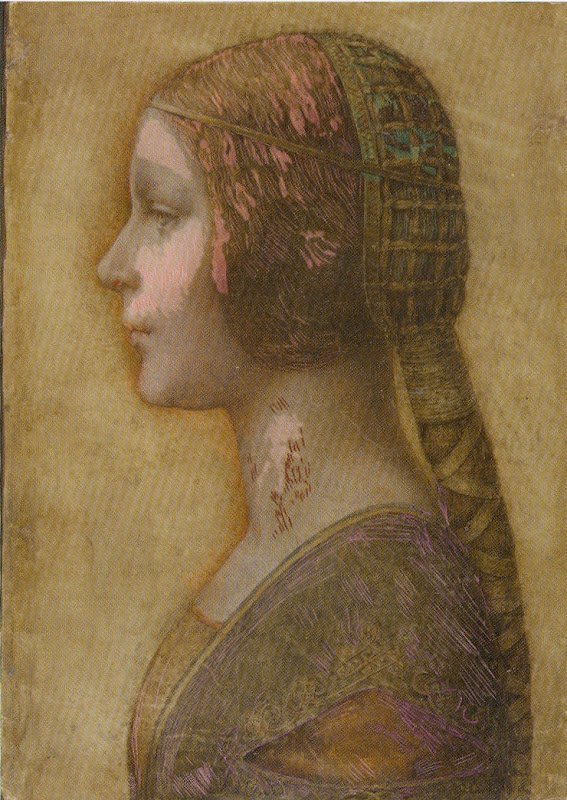
Above, Fig. 3: The colour coded map that is said to show areas of restoration in “La Bella Principessa”, as published on page 133 of the 2010 Kemp/Cotte book Leonardo da Vinci “La bella Principessa” The Profile Portrait of a Milanese Woman. It is striking how discretely localised are the areas of “restoration”, and how fortuitously the corresponding areas of injury had fallen in the least important parts of the image.
CONFOUNDING THE SIMILAR AND THE DISSIMILAR
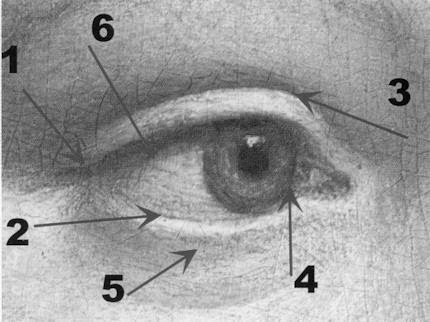
Above, Fig. 4: Top, the (true) right eye of The Lady with an Ermine. Above, the eye of “La Bella Principessa”. In this diagram Pascal Cotte, a brilliant engineer, sees confirmation of a common author – even at his arrowed point 2 where Leonardo’s curved demarcation between the eyeball and the lower lid is set against the form-denying straight demarcations in “La Bella Principessa”.
Above, Fig. 5: Left, the eye of Leonardo’s Windsor Castle Portrait of a Woman in Profile (reversed). Right, the smaller, more angular and more sunken eye of “La Bella Principessa”.
A common fault of copyists, pastiche-makers and forgers is to get details correct while missing the larger unified relationships which, collectively, they should constitute. The author of “La Bella Principessa” not only misses the cohering sense of the eye as a ball but even misconstrues the form and anatomical function of particular details. This error testifies to forgery rather than pastiche. We will be showing “La Bella Principessa” to be a “portmanteau work” composed from features drawn from a number of bona fide Leonardos. It can hardly seem a coincidence that the most disqualifying error of drawing in “La Bella Principessa” – the lower eyelid – occurs at the very point where damage is found in the (“prototype”) work which it is most closely said to resemble. At this point the drawing’s author has clearly been required to invent rather than copy or paraphrase. Indeed, in “La Bella Principessa’s” eye we find a progressive falling off of anatomical and artistic credibility from top to bottom: most plausible in “La Bella Principessa” is the somewhat simplifying paraphrase of the upper eyelid. Less plausible is the treatment of the more complex and elusive eyeball and iris. Least plausible of all is the fabricated lower eyelid. Martin Kemp’s claim that by drawing attention to such incompatibility we seek to divert the arguments “into issues of a peripheral nature in the face of evidence of a non-arbitrary kind” is not only unfounded – much material is in train on this attribution – it betrays a technically philistine misapprehension of sound scholarly method. Let us be clear: art, not the devil, lies in artistic detail and these details testify to authorship. We have the clearest possible understanding of how much Leonardo knew and how well he gave expression/record to what he knew/saw. It is for those who would count “La Bella Principessa” as a Leonardo to explain the disparity between its eye and that below at Figs. 7 & 8, which, on Kemp’s account, were both made at the same date.
SPOT THE ODD ONE OUT
Above, Figs. 6, 7 & 8: Top, the eye of “La Bella Principessa”; Centre, the (true) left eye of Leonardo’s La Belle Ferronnière, as seen in an infrared reflectogram by E. Lambert for C2RMF as published in Leonardo’s Technical Practice, Paris, 2014; Above, the (true) left eye of Leonardo’s La Belle Ferronnière, as seen in Pietro Marani’s Leonardo da Vinci – The Complete Paintings, New York, 2000. It is, for reasons given here, inconceivable that both of these eyes could have been produced by Leonardo at the same time – c. 1496.
There is another sense in which Kemp’s espousal of “La Bella Principessa” exposes his art historical method. By drawing attention to “La Bella Principessa’s” many points of direct correspondence with the Windsor Castle profile portrait in terms of overall effects, pentimenti, anatomical details and so forth, the scholar strains credulity. The Windsor Castle portrait is clearly of a mature woman. It was made some 15 years earlier than the supposed portrait of Bianca Sforza who died when a child of fourteen. The Windsor drawing is made in another (and single) medium – silverpoint – in which Leonardo was effortlessly, supremely fluent. “La Bella Principessa”, however, was made in an unprecedented combination of materials on a never or extremely rarely encountered-in-Leonardo support. How likely, then, is it that Leonardo would produce an elaborately finished drawing in an un-encountered mix of graphic and pictorial media and of a type nowhere else encountered in his oeuvre, of a young girl who, on Kemp’s account, was drawn either directly from life or from some other unknown record of her appearance, in commemoration after her death, some fifteen years later, that would, when reversed, produce a near perfect coincidence of proportions, features and, even, pentimenti?
It would, of course, be entirely unremarkable for a forger or pastiche-maker to engineer a similar reversed coincidence of features and traits with a bona fide Leonardo work. A canny forger who happened to be a restorer of old masters – including Leonardo, as was the case with Marchig – would well appreciate the need for evidence of one or two reassuring “campaigns of restoration” in a supposed work of five centuries of age. Marchig’s widow has reportedly claimed that he had indeed conducted restorations on the front of the drawing and on the back of the oak panel to which it was – unprecedentedly and, it is now claimed, irreversibly – glued. Kemp has not discussed, as far as we know, technical evidence that has been discussed by another Leonardo scholar – Cristina Geddo – that the back of the vellum is not blank as it would surely have been had it ever faced the the elaborately illuminated frontispiece of a major book as Kemp claims. For Dr Geddo, it is reassuring that the back of “La Bella Principessa’s” vellum support bears “superimposed numbers…like others written in pen, such as a very pale inscription visible along the upper border of the sheet and the little winged dragon – at least this is what it seems – in the lower left corner. This feature, too, counts in favour of an attribution to Leonardo, who, even though he has never to our knowledge used a parchment support in his work, was in the habit of re-using the paper on which he wrote or drew.” Of course, forgers too re-use old material.
THE AiA: AN OPEN FORUM; A PROFESSIONAL TALKING SHOP; OR, A CONSERVATION-FRIENDLY CLOSED SHOP?
Nothing can bring greater benefit to the art world than free, frank discussions and debate. The annual three-day Hague Congress is organised by a body that addresses the subject of authenticity in art and is titled AUTHENTICATION IN ART. This year’s AiA congress (11-13 May) specifically addresses the voguish museum world hybrid discipline known as Technical Art History, the misapplied and anti-aesthetic scientism of which we have criticised since its earliest days (see, for example, the first post on this site The New Relativisms and the Death of “Authenticity”). Attendees at this year’s AiA congress comprise “art collectors, collection managers, directors of museums and galleries, art dealers, appraisers, connoisseurs, advisors, auctioneers, insurers, investors, lawyers, authors of catalogues raisonnés, restorers, conservators, material scientists and art historians.” This particular critic of Technical Art History will not be speaking even though our proposal for a paper was encouragingly received by a congress organiser who wrote:
“Dear Michael, Thank you. Very valuable to the whole set up of AiA 2016. Get back to you in the coming weeks.”
The proposal had opened:
“Technical Art History is presented as a multi-discipline, international museum-standard professional synthesis that eliminates error and delivers enlightenment when, in truth, it testifies to little more than the ascendency in museums of technicians over curator/connoisseurs. This putsch began with the creation of in-house museum restoration departments where staff restorers could no longer be sacked. The National Gallery in London claims pioneering authorship of the new hybrid discipline and it perfectly reflects the new pecking order.”
We were subsequently “dis-invited” through a form notification to unsuccessful applicants. Among this year’s speakers will be Professor Kemp, a member of the AiA’s advisory board, and Pascal Cotte, of Lumière Technology. Cotte was, as mentioned, co-author with Kemp of the 2010 and 2012 English and Italian editions of a book of advocacy, La Bella Principessa – The Story of the New Masterpiece by Leonardo da Vinci. (Kemp has been critical of Cotte’s recent, go-it-alone book Lumière on the Mona Lisa – Hidden Portraits.) A working group was set up to organise this year’s congress. It is comprised entirely of conservators or conservation scientists. Curators and connoisseurs are not represented. One member of this advisory group was David Bomford, who is presently the Chair of Conservation and Head of European Art at The Museum of Fine Arts, Houston. Formerly, as a senior restorer, Bomford was the architect of the National Gallery’s presently stated cleaning philosophy – which we had discussed in some detail in our proposed congress paper (“…The false assurances of Clark’s aesthetics/science sleight of hand haunt and deform the National Gallery. Its official conservation guide declares restorations to rest on individual restorer’s own aesthetic inclinations…”)
PROFESSOR KEMP’S ART HISTORICAL METHOD
In his 2014 AiA congress paper (“It Doesn’t Look Like Leonardo”) Kemp discussed two other Leonardo upgrading attributions with which he is associated. Namely, the two versions of the Madonna of the Yarnwinder (one of which was restored badly, Kemp once complained, by Marchig) and the massively restored wreck of a panel painting, the Salvator Mundi. His paper’s abstract ran:
“The state of methods and protocols used in attribution is a professional disgrace. Different kinds of evidence documentation, provenance, surrounding circumstances of contexts of varied kinds, scientific analysis, and judgement by eye are used and ignored opportunistically in ways that suit each advocate (who too frequently has undeclared interests). Scientific evidence is particularly abused in this respect. The status of different kinds of evidence is generally not acknowledged, particularly with respect to falsifiability… I will attempt to bring some systematic awareness into this area, which is a necessary first step in establishing some rational protocols. The case studies will be drawn from Leonardo.”
On reading this abstract with its scattergun slurs “opportunistically”, “disgrace” and “undeclared interests”, we laughed out loud. Partly because of the grandiose title – “The 2014 Hague Congress Authentication in Art – What happens when the painting you are buying, selling, investigating, exhibiting, insuring – Turns Out to be a Fake or a (Re)Discovery…” – chosen at a time when Kemp and others had failed to achieve a consensus of support for the drawing he had portentously dubbed “La Bella Principessa”. But also because, as mentioned, two decades earlier we had experienced Kemp’s invective and sneering distaste for traditional connoisseurs whom he sees as “a self-proclaimed (and often class-based) elite whose skills are insulated from systematic scrutiny”.
In his review of the James Beck/Michael Daley book Art Restoration – The Culture, the Business and the Scandal”, the authors – much as with Kemp’s peers today – were found professionally wanting and morally deficient: “…Their problem is that they seem unwilling to acknowledge the status of different kinds of evidence…The slanting of arguments, manipulation of quotations, and rigging of visual evidence may be effective journalism but it is poor history…” A more focussed barb was aimed at artists’ evaluations of conservation treatments: “Stalking throughout their book… is a very particular notion of ‘Art’ and its creators. ‘An Artist’ (ie What Beck and Daley understand as an artist in today’s terms) is adduced as the most important arbiter of the criteria for the treatment of our historical heritage. I am unclear about the identity of this archetypal beast.” Unclear indeed.
Kemp’s professional aversion to the views and judgements of artists is presented as a token of “higher”, more philosophically sophisticated notions of scholarly method and a scientist’s preference for non-judgemental, non-subjective “evidence” within it.
CRITICAL SILENCES
While some are cowed by Professor Kemp’s trademark abusive critical put-downs, others, like the blogger and art “sleeper” hunter, Bendor Grosvenor (21 April), openly admire them. We called Kemp’s bluff in a letter to the THES (2 May 1994):
“…he alleges… a misuse of historical and material evidence. Professor Kemp’s notions of misuse would seem to be singular: he complains, for example, that Professor James Beck and I accepted Charles Heath Wilson’s clear and detailed testimony that Michelangelo had extensively revised his frescoes with glue painting, ‘with unquestioning approval’. This is presented as proof of our ‘lack of discrimination’. But Wilson saw what he saw and said what he said… Does Kemp have any grounds for rejecting Wilson’s record?… Kemp is silent on this evidence. Why? The photographic evidence we supply of restoration-induced injuries is impugned by Kemp as ‘rigged’. It is nothing of the sort – most of it was provided by the restoration authorities themselves… Does Kemp wish to defend that restoration? Is he in possession of any photographs which tell a different story?”
No grounds for rejecting Wilson were offered in reply. No contra-testifying un-rigged photographs were ever produced.
For a fuller account of the spurious charges raised by art conservators and Kemp to Art Restoration, see “Why are picture restorers allergic to appraisal?”, Jackdaw, May/June 2016.
THE 2016 AUTHENTICATION-IN-ART CONGRESS AND ‘DISORDERLY’ SCHOLARSHIP
In this year’s AiA congress paper Kemp returns to his 2014 AiA congress attack on the shortcomings and abuses he perceives in the methodologies and behaviour of all other scholars in the field, albeit in muted form. Today his abstract reads:
“A speech on Technical Art History and the way he [Kemp] implements the research on Leonardo’s La Bella Principessa: the varieties of evidence and arguments, and how reactions to the attribution shed light on the disorderly nature of current methods”.
A clue to where he might be going can be found on his blogsite where he has published a “reworked” version of his 2014 paper that excludes his earlier linking remarks on other Leonardo attributions he supports – “Science and Judgement by Eye in the Historical Identification of Works of Art”.
The methodological schema Kemp outlines and censoriously offers to others seems little more than an overly complicated regurgitation of the tendentious, the self-evident and the true-by-definition. It leans heavily on and misapplies Karl Popper’s famously illuminating discussion of scientific knowledge and methods. Kemp seems to crave an aesthetic equivalent of the decisive Popperian test of scientific “falsifiability”. This is a vain, misdirected quest. Because of the profound differences between appraisal of works of art and the technical analysis of their constituent materials, Kemp is forever complicating and caveating his proposed model method. He compiles tables of hierarchies that are organised into polarising dualities. He is constantly extricating himself from fogs of his own making:
“In this and the following table, I am using the terms ‘scientific’ and ‘art historical’ in a conventional way without intending to signal that they can be isolated in the actual practice of attribution – and certainly not to suggest that the application of scientific analysis necessarily delivers more certainty than art historical evidence. In the actual practice of art history, its isolation from scientific analysis is all too common.”
Which? What? To help orientate us, Kemp devises a table of criteria that are more traditionally “art historical” with the “the most malleable [being] at the top.” But nothing ever comes to rest. Here, “I have added standard kinds of evidence relating to provenance and documentation that are highly constructive.” If baffled by the usage “constructive”, the reader must back-track to an earlier explanation that “The kinds of evidence and explanation that can be subject to various degrees of falsification can be grouped under two headings: constructive and permissive.” Thus, “By constructive I mean those that add positively and accumulatively to the case being made for a specific attribution. By permissive I am signalling those that present no obstacle to the attribution being made, i. e. they offer a nil obstat.”
JUDGEMENT BY EYE
When Picasso was asked what he thought of the philosophical discipline aesthetics, he replied: “Aesthetics is to the artist what ornithology is to birds.” In Kemp, everything is dunked in pseudo-philosophical terminology. Take the simple clear self-explanatory notion “judgement by eye” which he offers in preference to snobby, elitist, class-based etc “connoisseurship”:
“As we have seen, judgement by eye plays a key role in key scientific techniques. Although the most constructive of the kinds of art historical evidence, documentation and provenance, do not rely upon judgement by eye, it is common that this kind of evidence is not available or is less conclusive than we would wish. In many cases judgement by eye necessarily provides the actual starting point, before other kinds of investigation are undertaken. This is often the situation when a previously unknown or unrecognised work first emerges with specific claims attached to it. Let us try to formulate some propositions about judgement by eye in a somewhat Popperian manner”
Why, apart from intellectual snobbery, in a “Popperian” manner? Well, they help Kemp to conclude with the twin observations that “Judgement by eye is malleable in the light of multiple interests”, and “Judgement by eye is falsifiable only by factors outside of itself.” Kemp’s Popperian edifice is, as it were, a perniciously misleading red herring. In truth judgements by eye cannot be equated with falsifiable scientific propositions, they are a different beast – they are critical appraisals. As such they are gambits in a discussion. They can be countered by demonstrably superior, more percipient and persuasive judgements that accord better with the material circumstances and visual facts of a given work of art. Because Kemp sets the hard and “irrefutable facts” of material analysis (many of which, he acknowledges, require judgement by eye) against what he deems the “subjective”, “relative” and “malleable” act of appraisal of the (despised) connoisseur, he misrepresents what is indispensable to proper appraisals of art. Connoisseurship (the term should not frighten or repel us) cannot sensibly be treated as a natural science – properly, rigorously conducted it is an open, competitive adversarial system that is full of checks and balances wherein anything that is proposed may examined, challenged and deposed. Art world abuses certainly exist but they flourish best when legitimate criticisms and demonstrations are blocked and disqualified and critics are ruled out of court. Kemp, who despises the “class-based” connoisseur, does not respond well to criticism and prefers abuse and denigration to straightforward and healthy critical engagement. That is his loss, but also, he being a talented man, it is that of scholarship itself.
AN INTELLECTUALLY OPEN CONFERENCE
When ArtWatch UK, The Center for Art Law, and the London School of Economics Law Department, organised a conference on connoisseurship in London last December (“Art, Law and Crises of Connoisseurship”), one of the papers, “How reliable are today’s attributions in art? The case of ‘La Bella Principessa’ examined”, by Kasia Pisarek, presented a number of the interlocking art historical, aesthetic and technical criticisms she had recently published in the above mentioned Polish scholarly journal Artibus et Historiae.
Because this paper was a strong and detailed rejection of the attribution, we invited Martin Kemp to give a paper. He declined. We then invited Nicholas Turner, an independent scholar and drawings expert who had championed the “La Bella Principessa” drawing before Prof. Kemp. He, also, declined to speak. To represent the restoration-pro-active, attribution-making school of art dealers, we invited Philip Mould. Mr Mould, too, declined to speak. Shortly before the conference, Kemp, Silverman and a Polish art historian, Kasia Wozniak, all lobbied for the “balancing” inclusion in our conference proceedings of the journalist Simon Hewitt who is writing a book with the owner of La Bella Principessa, Peter Silverman – who tells us that the book is on “various aspects of the art market, sometimes highlighted by others’ and my own discoveries”. Hewitt attended the conference and, from the floor, launched an assault on Pisarek’s case – but did so, we later learned, on the borrowed authority of Kemp who had “prepped” him for the occasion on objections he had framed in response to Pisarek’s Artibus et Historiae article. Kemp later submitted his lengthy response to Artibus et Historiae for publication but it was turned down. This article has now been posted on the AiA Congress website. Perhaps, in the interests of scholarly balance, the AiA congress will now also post the article by Dr Pisarek which Professor Kemp aims to rebut? Perhaps the Congress might also consider posting our own initially valuable-to-proceedings but later rejected paper on Technical Art History?
Michael Daley, 3 May 2016
COMING SOON: The Salvator Mundi, Giannino Marchig, Left-handedness and “La Bella Principessa”
Problems with “La Bella Principessa”~ Part I: The Look
The world famous drawing that was dubbed “La Bella Principessa” by Professor Martin Kemp is insured for $150 million and lives in a “secure vault in Zurich”. It is not a portrait of Bianca Sforza by Leonardo da Vinci, as has been claimed, but a twentieth century forged or pastiche Leonardo.
WHITHER “LA BELLA PRINCIPESSA”
In 1998 the now so-called “La Bella Principessa” appeared from nowhere at Christie’s, New York. A hybrid work made in mixed media that were never employed by Leonardo (three chalks, ink, “liquid colour”), on a support that was never used by Leonardo (vellum), and portraying a woman in a manner that is nowhere encountered in Leonardo, it was presented as “German School, early 19th century” and “the property of a lady”. It went for $22,850 to a New York dealer who sold it nine years later on a requested discount of 10 per cent for $19,000 to an art collector, Peter Silverman, who said he was buying on behalf of another (unidentified) collector whom he later described as one of “the richest men in Europe”. Thus, at that date, it was not known who owned the drawing or by whom it had been consigned to Christie’s and it remained entirely without provenance. In its nine years long life, no one – not even its new owner(s) – had taken it to be by Leonardo.
In a 2012 book (Lost Princess ~ One man’s quest to authenticate an unknown portrait by Leonardo da Vinci), Silverman claimed a successful upgrading to Leonardo and described how he had gained the support of distinguished scholars including Professor Martin Kemp who had formulated an elaborate hypothetical history in which the drawing was said to be a Leonardo portrait made either from a living subject in celebration of her wedding or in commemoration after her death in 1496.
Nonetheless, the drawing failed to gain a consensus of scholarly support and is rejected in centres like New York, London and Vienna. Carmen Bambach, the Metropolitan Museum’s Renaissance drawings authority dismissed “La Bella” on the grounds that “It does not look like a Leonardo”. Thomas Hoving, a former Metropolitan Museum director, held it to look “too sweet” to be Leonardo. ARTnews reported that the Albertina Museum’s director, Klaus Albrecht Schröder, had noted “No one is convinced it is a Leonardo”. In the Burlington Magazine Professor David Ekserdjian suspected it to be “counterfeit”.
THE LOOK OF “LA BELLA” AND THE COMPANY SHE BEST KEEPS
In matters of attribution the most important consideration is the look of a work. Many things can be appraised simultaneously but, conceptually, the “look” of a work might be broken down into two aspects: an initial at-a-glance response to a work’s effects and appraisal of its internal values and relationships; and, a comparison of the effects, relationships and values with those of bona fide productions of the attributed artist, or with those of the artist’s students, associates or followers. It can also be useful to compare the looks of works with those of copyists and known forgers. It might fairly be said that in connoisseurship, as in the evaluation of restorations, visual comparisons are of the essence. (In ArtWatch we take pride in the extent to which we seek out all possible comparative visual material and regret that some institutions still hinder our efforts in this regard.)
Above, Fig. 1. If we put aside questions of attribution and simply look at the group above, we find works of remarkably similar figural motifs and formats that clearly relate to and derive from a most distinctive type of 15th century Italian profile female portrait. These similar-looking works are similarly sized, being, respectively from left to right:
A Young Woman, 14 and 1/4 x 10 inches;
“La Bella Principessa”, 13 x 9 and 3/4 inches; and,
A Young Woman, 18 x 12 1/2 inches (here shown mirrored).
All show young women depicted in the strict early Renaissance profile convention made in emulation of antique relief portraits on coins and medals. Although very widely encountered (see Fig. 4), Leonardo side-stepped the type in order to intensify plastic and expressive values with sculpturally-purposive shading and axial shifts in the bodies and gazes of his portraits (see Fig. 6). The portrayals above are strikingly similar in their head/torso relationships; in their absences of background; in their highly elaborated coiffures which offset ‘sartorially’ skimped and unconvincing simplifications of costume; in their sparse or wholly absent depictions of jewellery; and, even, in their almost identically cropped motifs. Collectively they might be taken as a suite of variations on a simple theme. We take all three to be twentieth century Italian artefacts. At least two of them are linked to Bernard Berenson and the two on which reports have been published have unusual and problematic supports.
As mentioned below, the Detroit picture is painted on top of photographic paper. It is suspected that it might have been a photograph of the Frick sculpture to which the painting was initially related. The “La Bella Principessa” is drawn, exceptionally for Leonardo, on a sheet of vellum which appears to have been removed from a book and it is, most unusually, glued to an oak panel. The panel itself is a curiosity: although a number of “butterfly keys” have been inserted into its back, as if to restrain splitting, there is no evidence of splits in the panel and, if there were, the present four such keys in such a small panel might be considered restoration “over-kill”. If the panel had split while the vellum was glued to it, the drawing would have split with the panel. The fact that the vellum has been “copiously glued” to a (possibly pre-restored) oak panel makes it impossible to examine the back of the drawing which is said by one of its proponents, (Cristina Geddo, an expert in Leonardo’s students and Milanese “Leonardesques”) to bear “superimposed numbers…a written inscription…[and a] little winged dragon – at least that is what it seems.” For Geddo, this unexamined content is reassuring: “This feature, too, counts in favour of an attribution to Leonardo, who, even though he never to our knowledge used a parchment support in his work, was in the habit of re-using the paper on which he drew.”
(In reading the compendious literature on this proposed attribution, we have sometimes wondered what might be allowed by its supporters to count as evidence against the attribution.)
CONSIDER THE HISTORIES
The portrait on the left, A Young Woman, was bought in 1936 by the Detroit Institute of Arts as by Leonardo da Vinci or Andrea del Verrocchio. The institute’s director, W. D. Valentiner, made this attribution on the strength of clear correspondences with the curls in the hair of Leonardo’s painting Ginevra de’ Benci (see Fig. 6) in the National Gallery of Art, Washington, and with those found in the above-mentioned marble sculpture in the Frick Museum, A Young Woman, given to Andrea del Verrocchio. (Valentiner had made a study of Leonardo’s work in Verrocchio’s workshop.) In 1991 Piero Adorno, specifically identified the Detroit picture as Verrocchio’s lost portrait of Lucrezia Donati. Notwithstanding seeming correspondences with secure works, this picture is now relegated to “An Imitator of Verrochio” – and this is an extremely charitable formulation. In Virtue and Beauty, 2001, David Alan Brown described it as “a probable forgery by its anachronistic materials and unorthodox construction”. “Probable” [!] because: “after a recent technical examination, the picture turns out to have been painted on photographic paper applied to a wood panel that was repaired before it was readied for painting. And at least one of the pigments employed – zinc white – is modern…” Valentiner judged one of two Leonardo studio works of the Madonna with a Yarnwinder to be “more beautiful than the Mona Lisa”.
The portrait on the right, A Young Woman, was attributed to Piero Pollaiuolo by Berenson in 1945. While this figure is perhaps the most attractive of the above three, with its nicely constructed counterbalancing of the thrusts in the neck/head and torso, and its credibly proportioned arm, the work itself has, so far as we can ascertain, sunk without trace. In truth, this female profile portrait type has been assailed by forgeries. Alison Wright notes in her 2005 book The Pollaiuolo Brothers, that “Complications for the historian lie both in the fact that the subjects of most female portraits are no longer identifiable and that, because of their exceptional decorative and historical appeal, such portraits were highly sought after by later nineteenth- and early twentieth-century collectors, encouraging a market for copies, fakes and over-ambitious attributions.”
The portrait in the centre (“La Bella Principessa”) has been precisely attributed by Kemp to Leonardo as a book illustration portrait of Bianca Sforza of 1495-96.
DISTINGUISHING BETWEEN THE LOOKS OF THEN OF NOW
Above, Fig. 2. In My dear BB (an incalculably valuable new resource edited and annotated by Robert Cumming), we learn that in November 1930 Kenneth Clark’s wife, Jane, wrote to Berenson: “K has seen Lord Lee’s two new pictures…The Botticelli Madonna and Child you probably know too. K thinks the latter may be genuine about 1485 or rather part of it may be, but it is not a pretty picture…” A footnote discloses that Lee had bought The Madonna of the Veil, a tempera painting on panel in 1930 from an Italian dealer for a then huge sum of $25,000 (Fig. 3). It was widely accepted by scholars as autograph Botticelli and published by the Medici Society as a “superb composition of the greatest of all Florentine painters”. Clark, doubting the attribution on sight, objected that it had “something of the silent cinema star about it” – and he likened the Madonna to Jean Harlow (Fig. 3). Lee donated the picture to the Courtauld Institute Gallery in 1947. In June 2010 Juliet Chippendale (a National Gallery curatorial intern working in association with the Courtauld Institute MA course) disclosed that scientific examination had identified pigments not known before the 18th and 19th centuries and worm holes that had been produced by a drill. It is now designated a work of the forger Umberto Giunti (1886-1970), who taught at the Institute of Fine Art in Siena and forged fresco fragments.
ART HISTORICAL SILENCES
Four months later Clark wrote to Berenson: “Just in case Lee has sent you a photograph of his new Botticelli may I ask you to forget anything Jane may have reported me as having said of it. It is one of those pictures about which it is best to be silent: in fact I am coming to believe it is best for me to be silent about every picture. Did I tell you that my Leonardo book was a mare’s nest. The man had sent photographs of two drawings from the middle of the Codice Atlantico. They must have been early copies done with some fraudulent motive – perhaps the book really did belong to Leonardo – he certainly had read it – & some pupil thought to enhance its value.”
Above Fig. 3. The young Kenneth Clark (then twenty-seven years old) displayed an admirable “eye” by spotting a fraud on sight some eighty years ahead of the pack. Is it better for a connoisseur to see but not speak than it is not to see at all? Undoubtedly, it is. Would Clark have enjoyed his meteoric rise had he humiliated the mighty and exposed the big-time fraudsters of his day? (That question might be taken as self-answering.) If Clark bided his time on Berenson, eventually he delivered an unforgiving former-insider’s repudiation in 1977 by chronicling how Berenson had “sat on a pinnacle of corruption [and] for almost forty years after 1900… [done] practically nothing except authenticate pictures”
PRETTY – AND NOT SO PRETTY – WOMEN
Above, Fig. 4. In the middle and bottom rows we see three bona fide works of the female profile type – respectively:
Portrait of Bianca Maria Sforza, c. 1493, by Ambrogio de Predis, The National Gallery of Art, Washington;
Domenico Ghirlandaio’s 1488-1490 Giovanna degli Albizzi Tornabuoni, Museo Thyssen-Bornemisza, Madrid; and,
a portrait of Beatrice d’Este tentatively attributed by Kemp to Ambrogio da Predis.
The differences between this trio and the works in the top row are pronounced and eloquent. The secure works are highly individuated and immensely richer in their effects. Collectively, they do not constitute an inadvertent suite. Individually, they are greatly more various compositionally. Collectively, they are markedly richer in jewellery and ostentatiously sumptuous costumes. The distinctive physiognomies of their subjects derive from living persons, not from other art or photographs of other art. Flattery and loving attention are channelled more into the costume and bling than into the facial features. In every respect the opposite is the case in the top row where prettiness has been held at a premium with an eye on the modern photographically-informed market.
LEONARDO BREAKS THE MOULD
Above, Fig. 5: As mentioned, “La Bella Principessa” and her two companions are of a piece, and of a type never followed by Leonardo whose female portraits (see below) pioneered an unprecedentedly complex and sophisticated evocation of real, sculpturally palpable women in tangible spaces or landscapes. To include the figurally impoverished and stylistically anachronistic “La Bella Principessa” in Leonardo’s oeuvre would disjunct his revolutionary arc of insights and innovations in portraiture. Such inescapably disruptive consequences have been ceded tacitly by Kemp, “La Bella Principessa’s” principle defender – some say advocate. In “La Bella Principessa ~ The Story of the New Masterpiece by Leonardo da Vinci” (Kemp’s 2010 book jointly written with Pascal Cotte of Lumiere Technology and including chapters by the drawings scholar Nicholas Turner and the recently discredited fingerpints expert Peter Paul Biro), Kemp converts an intractable problem into an asset by begging the essential question. That is, he underwrites “La Bella’s” credibility on an assertion that “Any important new work, to establish itself, must significantly affect the totality of Leonardo’s surviving legacy over the longer term.” Without question, the de-stabilising inclusion of “La Bella Principessa” would produce knock-on effects, but arguing backwards from that predictable disturbance to some endorsement of its source is patently unsound methodologically – the inclusion of any atypical work, whether bona fide or forged, into an oeuvre would affect its “legacy”.
LEONARDO’S ACCOMPLISHMENTS
Above, top, Fig. 6: Left, Andrea del Verrocchio’s Lady with a Bunch of Flowers of c. 1475; and (right) Leonardo’s (hypothetically extended) Ginevra de’ Benci of c. 1474-1478.
Above, Fig. 7: Left, Leonardo’s The Lady With an Ermine of about 1489-90; centre, Leonardo’s La Belle Ferronnière of about 1495-96; right, Leonardo’s Mona Lisa (La Giaconda) of about 1503-06 onwards.
In the group above we see extraordinary development in Leonardo’s portraits of women over the last quarter of the fifteenth century as he strove to incorporate the entirety of sculptural, plastic, figural knowledge, and to surpass it by making it dance to an artistically purposive tune liberated from the happenstance, arbitrary lights of nature on which sculpture then necessarily depended. Some have attributed the Bargello sculpture, the Lady with a Bunch of Flowers, to Leonardo on the grounds that its subject was Ginevra de’ Benci, the subject of Leonardo’s painting. Others have seen Leonardo’s authorship of it in the beauty of the hands. In Leonardo da Vinci and the Art of Sculpture, 2010, Gary M. Radke holds that the two works show differences that emerged in the mid-1470s between the two artists. Against this, it has been suggested that the painting might originally have borne a closer relationship to the sculpture with a possible inclusion of hands in a fuller length treatment. A study of hands by Leonardo was incorporated in a hypothetical and digitally realised extension of the painting by David Alan Brown (Virtue and Beauty, 2001, p. 143). Frank Zollner sees the painting as marking the point (1478-1480) at which Leonardo broke away from “the profile view traditionally employed in Florence for portraits of women” in favour of the three-quarters view in order to impart “a pyschological dimension to his sitter – something that would become the hallmark of Renaissance portraiture”. Which is all to say that Leonardo had broken away from the profile convention some sixteen to eighteen years before, on Kemp’s hypothesis, he made a solitary and exceptional “return” to it.
Speaking of the reconstruction of Leonardo’s Ginevra de’ Benci painting, Brown writes:
“Ginevra’s portrait, the lower part of which was cut down after suffering some damage, may have included hands. A drawing of hands by Leonardo at Windsor Castle, assuming it is a preliminary study, aids in reconstructing the original format of the picture. As reconstructed, Leonardo’s portrait may be seen to have broken with the long-standing Florentine convention of portraying women in bust-length profile. In seeking an alternative to the static profile, Leonardo, like Botticelli, seems to have turned to Verrocchio’s Lady with a Bunch of Flowers in the Bargello, Florence. Because of the sitter’s beautiful hands which mark an advance over the earlier head-and-shoulders type of sculpted bust, the marble has even been attributed to Leonardo. But the highly innovative conception of the half-length portrait bust is surely Verrocchio’s achievement. What young Leonardo did was to was to translate this sculptural protype into a pictorial context, placing his sitter into a watery landscape shrouded in a bluish haze…”
A CASE CONSPICUOUSLY NOT MADE
For the owner and the art historical proponents of “La Bella Principessa”, the very chronology of Leonardo’s female portraits constitutes an obstacle. Given Leonardo’s famous eschewal of strict profile depictions of women, the onus is on those who would include “La Bella Principessa” (- albeit as a solitary and exceptional stylistic regression that was undertaken without ever attracting attention or comment) to make a double case.
First, they must show how and where “La Bella Principessa” might plausibly have fitted within the trajectory of Leonardo’s accepted works. Second, they must demonstrate by comparative visual means that “La Bella Principessa” is the artistic equal of the chronologically adjacent works within the oeuvre. Kemp has proposed the precise date of 1495-96 for the execution of “La Bella Principessa” but, conspicuously, has not presented direct, side-by-side visual comparisons with Leonardo’s paintings. Instead of comparing “La Bella Principessa” of 1495-6 directly with Leonardo’s La Belle Ferronnière of about 1495-6, Kemp writes:
“If the subject of Leonardo’s drawing is Bianca, it is likely to date from 1495-6. In style, it seems at first sight to belong with his earlier works rather than to the period of the Last Supper. However, Leonardo was a master of adapting style to subject. Just as his handwriting took on an earlier cast when he needed to adopt a formal script, so his drawing style could have reverted to a meticulous formality, appropriate for a precious set-piece portrait on vellum of a Sforza princess.”
“If”? “Could have”? “At first sight”? The pro-attribution literature is bedecked with daisy-chains of such tendentious and weasel words and terms. With which earlier works is “La Bella Pricipessa” deemed to be artistically comparable or compatible? With the Ginevra de’ Benci of c. 1474-1478? With The Lady With an Ermine of about 1489-90? Never mind the red herrings of handwriting and the giant, near-obliterated historical figures of the Last Supper, what of the relationship with Leonardo’s (supposedly) absolutely contemporaneous La Belle Ferronnière of 1495-96? (On this last we volunteer a pair of comparisons below.)
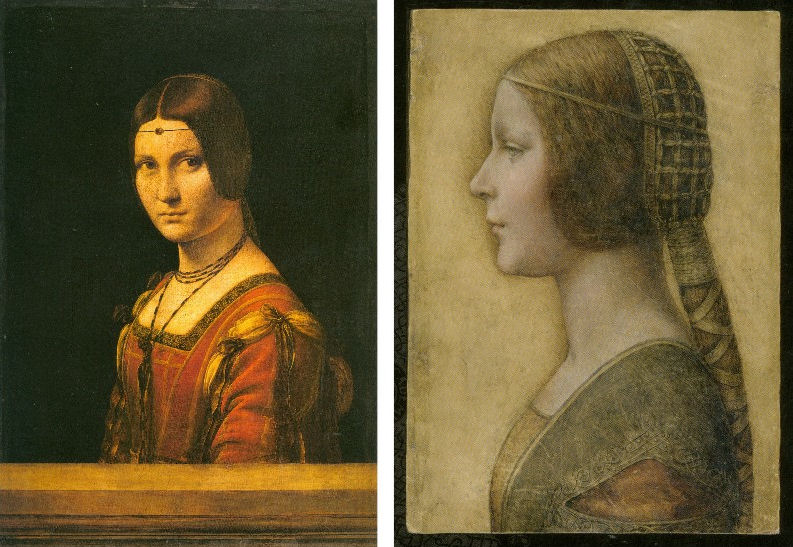
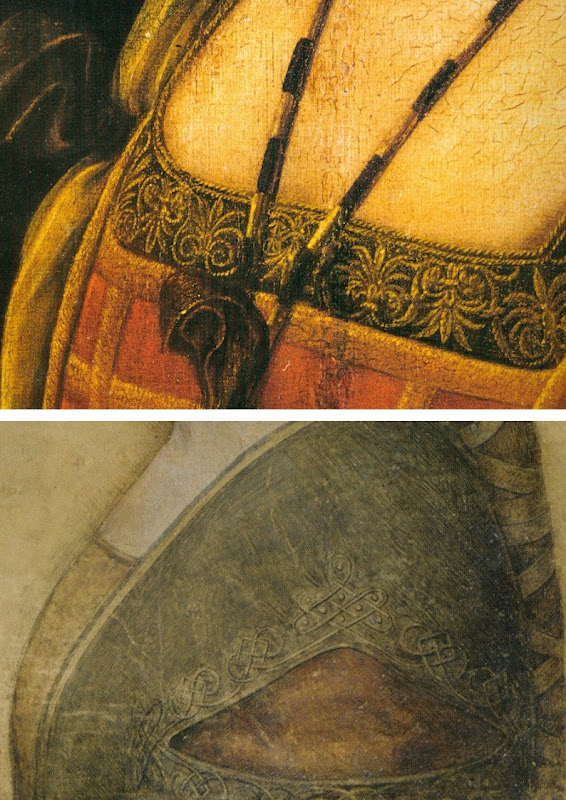
Above, Top, Fig. 8: Leonardo’s La Belle Ferronnière, left, and the “La Bella Principessa”.
Above, Fig. 9: Details of Leonardo’s La Belle Ferronnière, left, and the “La Bella Principessa”.
Kemp insists: “The Lady in profile [“La Bella Principessa”] is an important addition to Leonardo’s canon. It shows him utilizing a medium that has not previously been observed in his oeuvre…It testifies to his spectacular explosion and development of novel media, tackling each commission as a fresh technical challenge. It enriches our insights into his role at the Milanese court, most notably in his depiction of the Sforza ‘ladies’ – whether family members or mistresses. Above all, it is a work of extraordinary beauty.”
Even if we were to assume that for some reason Leonardo had opted to “revert” in 1496 to a type he had never employed, what might explain a pronounced indifference in “La Bella Principessa” to the detailed depiction of the “stuffs” of costume with which the artist was simultaneously engaged in La Belle Ferronnière? Given that Leonardo clearly appreciated and celebrated the fact that courtly costume required sleeves to be made as independent garments held decorously in place by ribbon bows so as to permit undergarments to peep through; and, given that Leonardo lovingly depicted not only the varying thicknesses of the costume materials but every individual twist in the threads of the elaborately embroidered band in La Belle Ferronnière, how could he possibly – when working for same ducal master, at the same time – have been so negligent and indifferent in the execution of “La Bella Principessa’s” costume? Kemp acknowledges and offers excuse for the distinct poverty of the costume: “It may be that the restraint of her costume and lack of celebratory jewellery indicates that the portrait was destined for a memorial rather than a matrimonial volume.” In so-saying, he jumps out of one frying pan into another.
If “La Bella Principessa” was made after Bianca Sforza’s death, from whence did the likeness derive? One reason why Kemp settled on Bianca as the preferred candidate subject for “La Bella Principessa” was that while (disqualifying) likenesses of the other Sforza princesses existed, none survives for her – she is an image-free figure. Kemp offers no indication of a possible means for Leonardo’s (hypothesised) post-death conjuring of Bianca’s supposed likeness other than to claim that “Leonardo has evoked the sitter’s living presence with an uncanny sense of vitality.” This again begs the crucial question and fails to consider any alternative explanations for the image’s qualities. (We will be showing how the profile of “La Bella Principessa” could well have been a “portmanteau” composite image assembled from one particular work of Leonardo’s and from that of another, unrelated painter.)
The most strikingly “Leonardesque” feature on the costume of “La Bella Principessa” – the knot patterning around the (implausible) triangular slash in the outer garment – is a source of further concern and constitutes evidence of forgery. First, the motif on which much effort will have been expended, is brutally cropped along the bottom edge of the sheet, as if by a careless designer laying a photograph into a book. Why would any Renaissance artist, let alone Leonardo, design a complicated feature so as to “run it off the page”? Further, the illusion of form (created by lights and shades) in the patterning is feeble in the extreme for Leonardo – as when compared with his treament of relief seen in the above embroidered passage in La Belle Ferronnière, for example. Leonardo probably better understood than any artist in history the vital connection between a thing made and a thing depicted. He took bodies and organs apart to understand their construction and he sought to create mental models that would make the otherwise terrifyingly arbitrary and capricious forces of nature graspable if not checkable. Most seriously of all, as our colleague Kasia Pisarek has noted and reported, while the patterning present on “La Bella Principessa” matches none found in any work of Leonardo’s, it more closely matches that found in a carved marble bust by Gian Cristoforo Romano in the Louvre – see “La Bella Principessa – Arguments against the Attribution to Leonardo”, Kasia Pisarek, artibus et historiae, no. 71, 2015. (To receive a pdf of Dr Pisarek’s article please write to: news.artwatchuk@gmail.com )
Michael Daley, 24 February 2012.
In Parts II and III we examine: the provenance of “La Bella Principessa” and the work’s problematic emergence from within the circle of Bernard Berenson; the claim by the forger Shaun Greenhalgh to have produced “La Bella Principessa” in Britain in the 1970s; the spurious “left-handed-ness” of “La Bella Principessa” and the low quality of, and the means by which the drawing was made…
Brian Sewell – Still Stinging in Death
The death on September 19th of the famously acerbic art critic Brian Sewell was generally marked by fair, balanced and sometimes touching obituary notices. For one of his critical victims, Susan Loppert, a signatory to the infamous 1994 “Gang of 35” letter calling for Sewell’s dismissal as the Evening Standard art critic, this seems to have been taken as a personal affront.
The now legendary Evening Standard letter of 5 January 1994 from thirty-five self-appointed contemporary art establishment worthies began pompously – “As members of the art world – writers, critics, artists, art historians, curators, dealers – we take the greatest exception to Brian Sewell’s writing in your newspaper…”, proceeded viciously – “His virulent homophobia and misogyny are deeply offensive, particularly the remarks made in the review of the exhibition Writing on the Wall”, and ended with pomposity, viciousness and self-pity: “We believe that the capital deserves better than Sewell’s dire mix of sexual and class hypocrisy, intellectual posturing and artistic prejudice”. This public attempt to silence a maverick critical voice was entirely self-defeating. As demonstrated below, it generated an explosion of support, catapulting the then 63 year-old art critic into a national prominence that would run for two decades.
This happy unintended outcome was, however, the exception to other manoeuvres in a bid to rig press coverage of deeply unpopular experimental art practices. A post hoc rationale for advancing against the press was given by the Tate’s director, Nicholas Serota in the 2000 Dimbleby Lecture with this plaint: “For in spite of much greater public interest in all aspects of visual culture, including design and architecture, the challenge posed by contemporary art has not evaporated. We have only to recall the headlines for last year’s Turner Prize. ‘Eminence without merit’ (The Sunday Telegraph). ‘Tate trendies blow a raspberry’ (Eastern Daily Press), and my favourite, ‘For 1,000 years art has been one of our great civilising forces. Today, pickled sheep and soiled bed threaten to make barbarians of us all’ (The Daily Mail). Are these papers speaking the minds of their readers?” Well, yes, of course they were, that is one of the things that sensible newspapers do. And that was why the articulation of such dissent posed a political threat to the contemporary art establishment’s ambitions.
COVERT MANIPULATION OF THE PRESS
The bid to unseat Sewell occurred when the Tate Gallery had become the greatest promoter of experimental art and was working closely with contemporary art dealers. In 1991 one such dealer, Jay Jopling, served on a secret Tate committee. When the editor of the art magazine Jackdaw, David Lee, later asked the Tate for the members of this shadowy committee, that gallery replied curtly that it could not say because no minutes had been taken. But why a secret committee in a publicly-funded registered charity? All businesses and institutions angle for favourable press coverage – that is why they employ large press departments. What additional purpose or purposes were best served secretly? Were there other secret committees at the Tate? Only two press accounts of this shadowy committee exist, and from these we learn that its express purpose was to plant stories to generate press coverage of, and foster interest in, what was widely reviled avant-garde art. Both insights stem from interviews with Jay Jopling when he was about to open the new White Cube gallery in Hoxton Square. The first, on 20 September 2002, was by Rose Aidin in The Guardian:
“Following a brief flirtation with film-production, Jopling started working with artists such as Damien Hirst and Marc Quinn, putting on warehouse-style shows from his Brixton home. When Nicholas Serota formed a think-tank upon his appointment to the Tate in 1991 [NB Serota had been appointed in 1988 – now some twenty-seven years ago!], Jopling was asked to join it. ‘I was very flattered to be included in this meeting to discuss how we got the newspapers to take contemporary art more seriously,’ he recalls. ‘Yet it seemed to me that if the tabloid press was only interested in ridiculing contemporary art, then get them to ridicule it properly, so that people actually take notice.
‘So we got the Daily Star to take a bag of chips to one of Damien’s fish in formaldehyde pieces which was then on show at the Serpentine and photograph it as the most expensive fish and chips in the world. Stunts like that forced people to know about the art and if they know about it, then that encouraged them to go and see it, and then they were forced to take a view. It certainly was a way of getting art into the public arena.'”
In another interview, “Thinking outside the square”, in the Financial Times on 21-22 September 2002, Lynn MacRitchie reported:
“Jopling recalls a ‘dark period’ when he was among a group summoned by Nick Serota to what was then simply the Tate to discuss how to get press coverage for contemporary art. At that time Jopling and his soon-to-be-star Damien Hirst, who proved a tabloid natural, were happy to go along with whatever the papers wanted – posing with a bag of chips next to the shark for the headline ‘The World’s Most Expensive Fish Supper’ was just one stunt. While Jopling concedes that the tabloids’ insistence on making ‘characters’ out of the artists went further than he had expected, the tactics, however dubious, worked – the British public, notoriously indifferent to contemporary art, was hooked…”
At the other end of the press, Tate-friendly art critics set about persuading their broadsheet newspaper editors that publishing comment articles and news page reports mocking avant garde art made their papers look down-market and “tabloid”. Both ploys worked: serious commentary articles questioning Tate policies were killed in the quality press, while in the tabloid press earlier “You call this art?” stories morphed into colourful tales of endearingly whacky new art world celebs “having a larf” at The Establishment. In no time at all, the one-time rebels were the establishment and they, like their dealers, made killings. Sometimes, the Tate’s secret manipulations of the press involved suppressing stories rather than planting them.
“DANGLED DOSH, UNDERWORLD CONNECTIONS… AND NO ARRESTS”
Above, Tate players, Sandy Nairne, left, Nicholas Serota, centre, and Stephen Deuchar, right, announcing the recovery of two stolen Tate Turners at a press conference in December 2002.
When the Tate lost two Turner paintings to thieves after loaning them to an insecure German museum in 1994, it later obtained permission from the High Court to buy them back from Serbian gangsters for a ransom of more than £3 million. Secrecy at the Tate went into overdrive when in 1998 Serota set up a so-called “Operation Cobalt”. The gangsters feared a police recovery action might be in operation. Although this was not the case (on the gangsters’ insistence the police had been “stood down” and the banknotes were unmarked), as a precaution, they released the paintings one at a time. When the first Turner was brought back secretly to London, the man who had negotiated the dangerous transfer of cash, Sandy Nairne, a signatory to the 1994 Sewell-Must-Go letter and the then director of the National Portrait Gallery, wanted to release the news. The Tate’s director, Nicholas Serota, refused on the grounds that by holding back until both pictures were recovered it would be possible to achieve a spectacular publicity coup. Hitherto, Serota said, most of the Tate’s “positive” press coverage had not been real news but, in his words, “merely promotional material”. Nairne recalled (in Art Theft, his 2012 book on the affair) that when stories began appearing in the British press “Nick [Serota] questioned me as to whether I was doing enough to ‘control’ those working for us and preventing anyone from speaking to the press…It then emerged that someone had talked to the senior crime writer on the Mail on Sunday [a sister paper to the Evening Standard]. He had heard that one painting was back in London, and he was keen to find some corroboration for this notion – something I wanted no one to know…” A high-powered press consultant, Erica Bolton, was hired on Serota’s advice and she prepared a dissimulating press statement in Serota’s name:
“November 2000 Turner Paintings
There has been much speculation over the years about the whereabouts of two paintings by J. M. W. Turner stolen in Frankfurt in 1994. And like the authorities in Germany, Tate has always been interested in any serious information which might lead to their recovery. But currently there is no new information, nor are any current discussions being conducted. Of course I remain hopeful that one day the paintings might return to the Tate.
Nicholas Serota, Tate Director“.
Nairne did not say whether or not the Tate had denied outright to the Mail on Sunday that one of the paintings had already been returned but, in any event, the dreaded article did not appear. As Nairne put it, the paper “did not publish and my fears about further investigative pieces, with imputations about ‘Serbian criminals’ receded.” The identity of the criminals had been disclosed in a 2001 book, The Unconventional Minister, by the former Treasury minister (the Paymaster-General) Geoffrey Robinson, who had bullied Lloyds’ insurance underwriters into allowing the Tate to buy back the rights for the paintings, should they be recovered, for only a small fraction of the £22 million insurance payout the gallery had earlier collected. After the final part of the ransom was paid and the second Turner painting was returned, no arrests were made. (For more on this saga, see Michael Daley, “Ransom or Reward? Part III”, the Jackdaw, January/February 2012, and our posts Questions and Grey Answers on the Tate Gallery’s recovered Turners, and Dicing with Art and Earning Approval.)
THE ELEVATION OF BRIAN

On 7 January 1994 the blow-back against the Gang of Thirty-five’s letter began on the Evening Standard letters page.
The Education Secretary, John Patten, wrote:
“I have read with dismay the letter signed by a number of the great and the good in the art world (5 January) attacking Brian Sewell. He shouldn’t be dismayed, but rather cheered…It’s not the whiff of censorship, nor the heavy scent of political correctness which pervades their letter, which concerns me, but its extraordinarily inward-looking nature. In other words, the attitude that cultural life is only for the self-styled cultured, a narrow group alternately puffing and then gently ‘criticising in context’ each other’s work…Their letter marks the barrenness and imploding nature of so much contemporary British intellectual and artistic life, with a few notable exceptions.”
Michael Daley wrote:
“Bravo, Brian. There have been signs for some time that members of our illiberal, modernist, visual arts establishment are becoming unnerved by their own self-constructed isolation. But for one critic, with one review, to derange and bag no fewer than 35 mewling, whining, Arts Council apparatchiks and awards recipients is a splendid achievement.
Long may Mr Sewell (and his Spectator comrade-at-arms Giles Auty) speak for the thinking public and the majority of practising artists. Please give him all the space he needs – the job is urgent. And overdue.”
Vaughan Allen wrote:
“What a laughable reflection on contemporary metropolitan culture was the whingeing letter by its self-appointed spokespeople (Letters, 5 January). And how arrogant to open with ‘As members of the art world’ as though this entitled them to some kind of privileged treatment. Since the sad death of Peter Fuller, Brian Sewell has emerged as one of the few critics consistently to resist the hijacking of the arts by politically correct trendies and mindless charlatans. His denunciation of the pretentious rubbish regularly paraded as art by London’s curators, dealers and critics is a welcome breath of fresh air. Without it Londoners risk suffocation by endless phoney art propaganda and pseudo-intellectual pyscho-babble beloved by a media desperate to foster any artistic fad no matter how imbecilic. Reading down the list [see below] one cannot but help notice the number of indignant signatories who constitute the capital’s incestuous and self-perpetuating art-scene maffia. No wonder they resent Mr Sewell for exposing their specious, life-diminshing but fashionable cultural values. For it is the public’s very acceptance of these warped criteria that they depend on to guarantee their inflated incomes and even more inflated reputations.”
On 14 November 1994, James Beck wrote:
“I read with relish Brian Sewell’s extraordinary ‘Down with bilge, gush and greed’ piece (10 November), nodding my head in agreement after every paragraph. There is no doubt that such views, effectively and brilliantly articulated, are annoying to the art world’s establishment, which has been running a marathon of naked emperors for decades.
Art criticism, and, I would add, official art history, is at the same low ebb, and they feed on and support each other with the aid of colossal sponsorship from international business and foundations, many of them America-based, with limitless funds.
Only with the constant and intelligent criticism by people like Brian Sewell can we hope to open honest debate on the issues that count.”
THAT WAS THEN, THIS IS NOW:
Looking back, two decades on, what effect did that affair have? And, more personally, how is Sewell now regarded on his departure? The television campaigner Mary Whitehouse suffered decades of vilification until the feminist writer Germaine Greer conceded that she had had a point all along when campaigning against gratuitous televised depictions of (male) violence against women. So Sewell was lucky to have his vindication arrive so fast. But on his death it would seem that, for the signatories of the Sewell-Must-Go letter, time brings no reprieve. Even in his grave, the still-righteous letter-writing collective casts him as wrong, vile and repellent, and themselves as both morally vindicated and art-politically triumphant. The generally balanced and charitable tone of the obituary notices pushed one of the original letter’s signatories (- in fact, we now learn, its author), Susan Loppert, into public rebuttal mode. Protesting against Jonathan Jones’ 21 September article “Brian Sewell was Mr Punch to modern art’s Judy”, Ms Loppert took affronted sisterly umbrage on behalf of Judy in a letter to the Guardian:
“As the author of the ‘naive’ letter by ‘art world types’ published by the Evening Standard in 1994 objecting to Brian Sewell’s attitude to contemporary art, I’d like to clarify why the letter was written. Sewell was an art historian whose main area of expertise was old master paintings. He was hostile to and ignorant about contemporary art, yet at the Standard he wrote lengthy reviews giving vent to his splenetic old fogeyism, virulent homophobia (surprising given his own homosexuality) and misogyny. The review that prompted our protest was a 3,000-word diatribe inveighing against a small exhibition at what is Tate Britain of work by female artists, selected by female curators, the catalogue with contributions from female writers. Sewell dismissed it all as ‘a show defiled by feminist claptrap’, in particular a ‘frightful’ female nude by Vanessa Bell that was so ‘ugly and incompetent, it could hardly be the favourite of even a purblind lesbian’.
The letter did not demand that Sewell be fired, as was erroneously claimed at the time. Stewart Steven, editor of the Standard, had told me that Sewell had been hired to be offensive without being libellous, that his work was deliberately targeted at the lowest common denominator: ‘Essex Man – the strap-hanger on the Ongar Line’. Since we recognised that ‘very occasionally, [Sewell] says something perceptive on subjects where he has some expertise’, we felt that the paper should have two art critics: one for art dating from the early 1900s with its dreaded abstraction, and Sewell for what he called ‘traditional’ art.
The 35 signatories included Bridget Riley, Rachel Whiteread, Sir Eduardo Paolozzi, Michael Craig-Martin, Marina Warner, Richard Shone, Christopher Frayling, George Melly, Angela Flowers and John Golding. Perhaps Jonathan Jones was right to say we were naive, but he’s wrong if he thinks ‘Sewell really scared [us]’. What we objected to was his deliberate cruelty and viciousness, and that he was, in the words of your obituary (21 September), ‘puffed up’; like his invented Edwardian voice – and like so many works of art – he was a fake. In the end though, as Jones notes, none of Sewell’s flailing at windmills stopped the inevitable triumph of modern art. Is Sewell turning in his bile-filled grave?”
Note the unreconstructed presumption: “We felt that the paper should have…” We, another respondent, and Ms Loppert herself, replied in letters to the Guardian (3 October) – see “Brian Sewell spoke timely truth to power”. Our letter reads:
“Susan Loppert’s defence of the notorious gang of 35’s attempt to unseat Brian Sewell at the Evening Standard is as disingenuous as her present attack on him is tasteless. Tasteless, too, for her to crow ‘none of Sewell’s flailing at windmills stopped the inevitable triumph of contemporary art. Is Sewell turning in his bile-filled grave?’.
Inevitable triumph? The triumph of all contemporary art – or of just the Tate/Arts Council-sanctioned varieties? In truth, much of the strongest support for Sewell came from contemporary artists of non-state-approved persuasions. I recall this well, having been one of the first to defend Sewell in the Standard: ‘There have been signs for some time that members of our illiberal, modernist, visual art establishment are becoming unnerved by their own self-constructed isolation. But for one critic, with one review, to derange and bag no fewer than 35 mewling, whining, Arts Council apparatchiks and awards recipients is a splendid achievement.
Long may Mr Sewell (and his Spectator comrade-at-arms Giles Auty) speak for the thinking public and for the majority of practising artists. Please give him all the space he needs – the job is urgent. And overdue.’
And so there were but, as it happened, the illiberal gangs did win out, modernism has triumphed and Serota has been anointed (Mugabe-like) Tate director-for-life. But goodness, how close it was then and how deliciously rattled they were – and still are, if Ms Loppert is any indication.”
I should not, perhaps, have mentioned Auty in 1994. He too was attacked at the Spectator by partisans of the Tate and a trendy gallery (see below). Some months later, and again in the Spectator, another of the thirty-five signatories, Richard Shone, then a deputy editor of the Burlington Magazine, attacked every single non-trendy writer on art, including Auty in his own paper – he was branded “didactic”. John McEwen of the Sunday Telegraph was dubbed “world-weary” and so forth. Shone, just like Loppert, demanded a different kind of press and called for a “shake-up of the way fine arts are treated in the press” – even as he admitted that there were “wider individual sympathies for [Sewell] among 20th-century artists than he is given credit for”.
A PAINTER AND A PAINTER/CRITIC IN DEFENCE OF SEWELL:
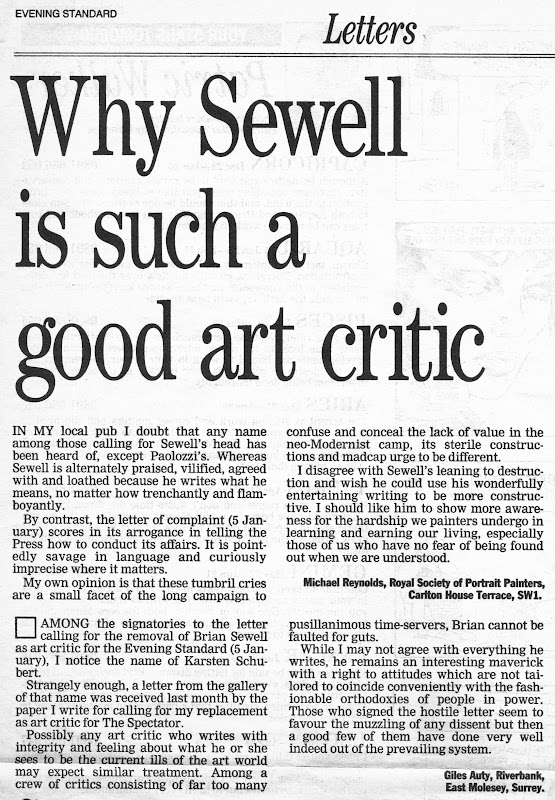
TAKING OUT A CRITIC ~ THE 35 SIGNATORIES:
Kathy Adler, Don Anderson, Paul Bailey, Michael Craig-Martin,
Graham Crowely, Joanna Drew, Angela Flowers, Matthew Flowers,
Pofessor Christopher Frayling, Rene Gimpel, John Golding, Francis Graham-Dixon,
Susan Hiller, John Hoole, John Hoyland, Sarah Kent,
Nicholas Logsdail, Susan Loppert, Professor Norbert Lynton, George Melly,
Sandy Nairne, Janet Nathan, Prue O’Day, Maureen Paley,
Sir Eduardo Paolozzi, Deanna Petherbridge, Bridget Riley, Michele Roberts,
Bryan Robertson, Karsten Schubert, Richard Shone, Nikos Stangos,
Marina Warner, Natalie Wheen, Rachel Whiteread.
THE WIDE-RANGING CONSPIRACY TO UNSEAT DISSIDENT VOICES
Richard Shone’s assault on politically unacceptable writers prompted a further brace of letters to the Spectator (28 May 1994):
“Out Shone”
“It is heartening to see how jumpy and ratty members of our illiberal, modernist visual arts establishment (for example, Richard Shone, Arts, 21 May, Anthony Everitt, Guardian 16 May, Richard Dorment, Daily Telegraph 14 May) are becoming. Having seized all outlets from the Tate Gallery to the Royal Academy, the Arts Council to the art schools, the Late Show to Time Out and the Burlington Magazine, today’s mandarins seem to be recognising that their grip is precarious. The outside world will not be bullied into believing that commonplace materials (like brick, chocolate and dead animals) can, by fiat or alchemy, be converted into bona fide works of art. Rare, professionally dissenting voices (such as your art critic Giles Auty and the Evening Standard’s Brian Sewell) are increasingly seen, therefore, as menaces who must be removed. Fortunately, the present establishment campaign to this end is proving spectacularly counter-productive. The Gang of Thirty-five’s notorious call for Sewell’s sacking led to an embarrassing avalanche of support for his writing. Mr Shone’s linked attacks on your art critic and on ‘visually illiterate’ art editors is similarly inept: Auty’s authority and influence as a critic is underwritten precisely by his long and first-hand familiarity as a painter with the mechanics and the grammar of the art. There are visual illiterates at large but, mercifully, they rarely find space in The Spectator.
What really sinks Shone’s case, of course, is its self-contradictoriness and hypocrisy. After pious calls for disinterested criticism in general and for a plurality of voices, he ends with the prescriptive demand that critics present exclusively ‘enthusiastic account[s] written with warmth for the subject’ – no cut, no thrust, no scepticism, just remorseless sycophantic, promotional gush.
That such should come from a deputy editor of the Burlington Magazine says much of the health of our arts establishment and of the arrogance of its members. But it also betrays a fatal weakness: if, nearly a century on, modernism truly remained a vigorous, healthy and life-enhancing force, it would hardly require the present ugly, repressive machinations being made on its behalf, would it?”
Michael Daley
“Possibly the long article written by Richard Shone about the current state of art criticism needs placing in a wider context. Mr Shone was one of the signatories to a recent letter to the editor of the Evening Standard calling for the sacking of their art critic Brian Sewell. My own editor has recently received letters from two employees of another of the signatories, Karsten Schubert [the dealer], calling for my removal from this paper. The grounds are that I am not sympathetic to the sort of art that Mr Shone and his kind find quite wonderful, as exemplified by the current exhibition at the Serpentine Gallery ‘Some Went Mad, Some Ran Away’, for which Mr Shone has written a eulogistic catalogue essay. The fact that I think this last is composed largely of hot air, however elegantly written, will not be causing me to write to the editor of the Burlington Magazine, of which Mr Shone is deputy editor, calling for the latter’s instant dismissal. The fact that I do not do so may reflect differences in my character as well as writing from those of Mr Shone. I do not feel any need to defend myself against any of Mr Shone’s charges except one, being content to let 428 articles I have written for this journal on a wide variety of artistic topics, including the old Masters, make my case.
Mr Shone hints that critics grow increasingly unsympathetic to the sillier excesses of the avant-garde as they grow older. This is not my case at all; if anything I have mellowed. The logical conclusion to this argument is that only an unintelligent teenager could write rewardingly about unintelligent teenage art. In spite of Mr Shone’s boyish appearance, I would be alarmed to believe he thinks anything so silly.”
Giles Auty
Richard Shone and I have never met, and I know as little of him as he of me. Had his biographical notes in ‘The Art of Criticism’ suggested that I have reached the sad end of a once-promising career, none could disagree, but he preferred mischievous distortion for the sake of irony, omitted much of substance from my early years, and betrayed a museum’s privacy – fine and fair behaviour for the deputy editor of a scholarly magazine. He mocks my contribution to televised advertisement, but it seemed to me a more honest means of putting jam on my gingerbread than the ekphrastic bilge written for dealers’ catalogues by most other critics (and is far less well paid). He praises Richard Dorment as an exemplar to the errant – Dorment, who in praising Damien Hirst, described himself as a ‘thrill junkie’. This is, alas, a level of critical insight and language quite beyond me.”
Brian Sewell
“PEOPLE LIKE US”
At the end of the Second World War, patricians like Maynard Keynes and Kenneth Clark, recognising that the future in Britain would be socialist, turned a modest highly cost-effective little organisation CEMA (- the 1940 Committee for Encouragement of Music and the Arts) that had taken art and performances around the country during the war to improve morale, into what became today’s sinister instrument of state control for the arts – The Arts Council. With tax on earnings peaking at over 90%, the logic then was impeccable: future art patronage could come only from the state, no longer from rich individuals. This being so, as Clark put it, “people like us had better be sure to get in there to run it”. At first, the Council busied itself with good and useful works – Clark himself had generously supported fine artists like Henry Moore, Graham Sutherland, and John Piper out of his own pocket. But a fateful step was taken in the 1970s when a worthy Northern adult education academic, Roy Shaw, was appointed Secretary General of the Arts Council. Shaw took the disastrous “managerial” view that the Council’s chief function was to create a secure and proper “career structure” for professional arts administrators. This resulted in an explosion of professionally pro-active but artistically-impoverished middlemen – see below. Because the Council was entirely state funded and precisely because its managers lacked the cultural confidence or judgement of a Clark or Keynes, the Council set its face against appraising art and artists in terms of quality. Instead, it took its role, simplistically and perversely, to consist of aiding that which was unlikely ever to find commercial or private funding. Thus, those who made wilfully unintelligible works, or transparently political and provocative ones or, above all, disembodied, “conceptual” and inherently un-saleable works, were ipso facto favoured over those working in any traditional medium and genre. In a blink, the Council switched from assisting and disseminating quality, to being an ideologically coercive enforcer of its own no longer-artistic socio/cultural purposes.
For all of its new professional clout and financial muscle, the Council’s widely mocked and disparaged bias in favour of pretentious novelty and socio-cultural provocations carried clear political dangers. The Council could not afford to become a public laughing stock for the art it was propagating if its own future was to remain politically secure. In addition to warping and constricting the varieties of “acceptable” art, the Council thus itself acquired a vested partisan interest in restricting the range of art-critical discourse. To impart a spurious respectability on its favoured recipients, the Council established a nation-wide chain of galleries in which the right sort of artists could be exhibited and written about by the right sort of art critics. It became possible for someone like Nicholas Serota to leave university and pass swiftly up the food chain of Arts Council funded venture and galleries – namely, becoming chairman of the new Young Friends of the Tate in 1969, a regional Arts Council officer in 1970 and then, respectively, director of MoMA (“Modern Art Oxford is extremely grateful to Arts Council England”) in 1973, the Whitechapel Gallery in 1976, and, since 1988, the Tate Gallery as was, Tate and Tate Modern today, picking up a Knighthood in 1999 and being made a Companion of Honour in 2013.
BUT WHAT IF?
If Serota has led a charmed professional life within the Arts Council family, it has also been one dogged by controversy – as over the notorious buy-back of the two ransomed Turners described above. He obtained funding from the National Art Collection Fund for purchasing the work of a serving trustee by submitting false information. In 2006 he was ruled to have broken Charity Law with many other such purchases of trustees’ work. In 1999 opposition to his rule at the Tate led to the founding of a dedicated group of opponents, The Stuckists. Many figurative artists have called for him to be sacked. He has generated a school of satirical novels. See Ruth Dudley Edwards’ Killing the Emperors – which author has held Serota to have “used his power as head of the Tate galleries to promote talentless self-publicists and to encourage the proliferation of the ugly and the pointless”. Alex Pankhurst’s Art and the Revolutionary Human Fruit Machine chronicles the collisions between modern art’s titans and small town sceptics.
The 1994 letter seeking to remove Sewell was produced at a time when the art critical running was being made by a small group of critics who were entirely immune to the appeals of state-sponsored avant-gardism. In addition to Sewell in the Evening Standard, the painter/critic Giles Auty was writing in the politically influential Spectator. The then recently deceased Peter Fuller, having migrated from both the far left and avant-garde art had been made art critic of the Daily Telegraph in 1989 and from 1987 had been the founder/editor of the heavy-weight, pro-figuration glossy magazine Modern Painters. The Art Review had been transformed since 1992 by David Lee, a vigorous champion of figurative art and artists and a relentless critic of Serota and the Arts Council. Between 1992 and 2001, when the Art Review was acquired by a new owner who wished “to get on board with Saatchi”, Lee had more than tripled the circulation and rallied many supporters. Not wishing to join the then ascendant Charles Saatchi band waggon, Lee left to found his own modestly-produced, proprietor-free, success d’estime – the still-thriving magazine Jackdaw. (He will be writing on Sewell, his great personal generosity, and other matters in its next issue.) At that time, Nicholas Serota was only six years into his reign and had yet to perfect his chillingly autocratic rule at the Tate and its proliferating satellites. However, in the event, the combined and interlocking institutional forces against the small dissident band did prove insuperable. In addition to Fuller’s death at a tragically young age in a car accident in 1990, Auty was to emigrate to Australia. It is remarkable today that notwithstanding the immense institutional power of the modernist establishment and contrary to its barrages of propagandistic hype, public disdain for “cutting edge” art forms remains firm and resolute. That this is so is demonstrated on the rare occasions when its strength is put to some objective test.
In 2003 Sir Roy Strong, a former director of the Victoria and Albert Museum, and ArtWatch UK’s director Michael Daley, took part in a live BBC Radio 4 “Straw Poll” programme debate against a minor Arts Council regional apparatchik and the Saatchi-friendly (but short-lived) editor who succeeded David Lee at the Art Review. The motion under debate was “Is contemporary British Art more about money than art?” and it was supported by Strong and Daley. Each speaker was invited to make a short opening statement. Daley’s was:
Contemporary British Art is more about money than art because much of it is not about art, as such, at all. Its leading figures prosper by playing anti-art games, by flouting artistic norms, intellectual standards and even common notions of human decency.
In Britain today, an arts administrative caste, through the Arts Council and its interlocking client organisations, has rigged the contemporary art market and subverted art practices by displacing aesthetic criteria with social or political ones. Officially-approved artists now swim in a sea of subsidies, free of any need to demonstrate individual artistic skills, original thought, or sensitivity. Ideas can be begged, borrowed, stolen or supplied directly by dealers. The execution of these appropriated “ideas” is frequently farmed out to unsung technicians.
There is, of course, a glaring logical problem with the present system: if such things as an unmade bed, an enlarged toy, or a collection of navel-fluff can now count as art, then anything and everything can be art – and if everything is art, nothing is.
Two years ago, a single sheet of stained lavatory paper was presented by a Young British Artist as a self-portrait and sold at auction for £1,500. That is a lot of money for not very much art.
The debate – which was lively – was held before an invited audience at the Ashmolean Museum, Oxford. It was drawn from “Friends” of both the Ashmolean and the Museum of Modern Art, Oxford. When a vote was taken among the invited studio audience, the motion was narrowly defeated. The next day, the sequel programme on Radio 4 consisting of listeners’ comments on the live debate was broadcast. At the end of it a poll of the programme’s listeners was announced. Radio 4 listeners are acknowledged to be comprised of the most educated and culturally/politically sophisticated variety in the UK. With that much larger and geographically dispersed audience, the motion was carried by 86% to 14%. The slur that opponents of the contemporary art establishment were benighted “strap-hangers” on the London underground had fallen at the first objective hurdle.
“WITHIN A FAIRLY SMALL WORLD…”

Private Eye carried the cartoon above over the exposé below:
On 24 June 2014 Sir Christopher Frayling (right) and Sir James Dyson (left) at the opening of Frayling Building – aka a renamed old block – at the Royal College or Art. (See: “The RCA Renames Kensington Common Room Block Honouring Former Rector Frayling”.)
On 22 December 1994 Professor Christopher Frayling, a signatory of the Stop Sewell Campaign, rose in the Evening Standard to defend the competence and the probity of the Arts Council’s visual arts panel (which he had chaired) against an attack from Brian Sewell. To the charge that the Arts Council was rewarding its own administrators, Frayling played a bureaucratic hand familiar to us – brushing off charges while confirming the evidence on which they rested:
“The Visual Arts Panel is criticised for being populated with ‘nobodies’. In fact it consists of an excellent committed group of well-respected artists, curators, historians and arts administrators and is chaired by Sir Richard Rogers. He [Sewell] implies that members of the Visual Arts panel have sometimes been direct beneficiaries of grants awarded by the Arts Council.
There are two basic misunderstandings here: first, the Arts Council, in general gives grants to institutions not to individuals (and it is up to the institutions to decide how they then distribute the funds); where it does give grants to individuals there are several formal mechanisms to ensure that those who have a direct or indirect interest take no part whatsoever in any decisions that might affect them. To take one of Sewell’s examples, the award to the Prudential for the Prudential Awards for the Arts. Anyone who has visited that gallery and seen its stunning transformation will not cavil at this acknowledgement. It is invevitable, if the Council seeks advice from the very best sources within a fairly small world, that some of those sources will sometimes also be recipients of public money.”
Yes, indeed, they sometimes are – and it came as no surprise to us for this particular overlap within the exceedingly small world of publicly-funded arts merry-go-rounds to be confirmed. In 1981-82 we had encountered precisely the same pattern of explanation/justification/apologia from another of the Sewell letter signatories, Joana Drew, the head of visual arts at the Arts Council. Where Frayling accused Sewell in 1994 of having produced “an article full of factual errors”, in 1982 Joanna Drew had claimed that my accounts of Arts Council subsidies (published on the letters page of the magazine Art Monthly) contained “inaccuracies of detail”. This routine bureaucratic ploy had been parodied in the advice given to a Government minister by a mandarin civil servant in the television programme “Yes, Minister” (- “Accuse them of inaccuracies of detail, Minister. We’ll find them – there are bound to be some”). My researches in art funding had come about by accident.
In the late 1970s Joanna Drew asked the painter R. B. Kitaj to commend artists to receive Arts Council grants. He had been taken by my work and wrote a generous letter of commendation to the Arts Council and so, in some hope, I applied for the first (and last) time for an Arts Council grant. Despite submitting the invited letter of commendation from Kitaj, my application was unsuccessful. The letter of rejection identified the recipients and I noticed that the awards in what was a national scheme had been swamped with abstractionists, performance artists, conceptualists and such. The Arts Council threw a press lunch so that journalists (and unsuccessful applicants) might meet the winning artists. At this lunch, with a few like-minded artist friends, I staged a small protest. After Ms Drew’s speech to the press, we handed out (silently) a sheet of paper with a list of questions concerning the manifest artistic biases of the awards scheme. We were attacked the next day in a newspaper by an art critic who defended the Council against the disruptive “nobodies”. Had he spoken to any of us at the time he would have appreciated that he had written a glowing piece appreciation of one of the protesting artists for a catalogue to his recent one-man show at the Marlborough gallery. Having made our point and registered our protest that had seemed the end of the matter. I carried on teaching part time in two London art schools and continued to read Art Monthly.
A few years later a regional Arts Council officer on the Greater London Arts Association complained in Art Monthly of “underfunding”. Having noticed that all subsequent awards winners were of the same limited artistic persuasions as those encountered earlier, I sent this short letter to the magazine:
“Given that the GLAA has now noticed that there are indeed 18,000 practising artists in London (AM 43), would it not be helpful if they stopped giving their grants to the same twenty?”
It took the Council four months to reply. In the July/August 1981 issue of Art Monthly, the (unrepentant) officer claimed that my chide of repeated funding was “inaccurate” and that “A more justifiable criticism of GLAA’s grant aid might well be that we spread our butter too thinly. We certainly do not spread jam on one corner of the slice”. Reeling with incredulity I went off and bought copies of past annual reports, and began collating the accounts of the various awards schemes, the findings of which I reported in a letter in the next Art Monthly.
JAM FOR THE FEW
Far from it being the case that only two artists had ever received more than one GLAA award, as had been claimed, I had identified no fewer than 13 artists who had received two or more awards in the previous three years alone. Four had received two awards in the same year and one had received two awards in each of the previous two years. Taking the longer period from 1973-4 to the (then) present, I found that eighty-three artists had received two or more awards, thirty-five had received three or more awards, twenty-four had received four or more, eight had received five or more, four had received six or more, one had received seven, and one – who had been successful in 1978-79, the year in which I applied – had received nine awards. Many of this lucky band had received awards when they themselves, their spouses, their partners or their colleagues were judging the schemes: “Michael Kenny is also a member of a rather more select group of artists, namely those who have, while serving as judges on awards schemes, themselves received awards – a feat achieved by Kenny [then six awards in total] in 1976-77 and by Michael Craig-Martin [a signatory to the Stop Sewell letter] and Tess Jaray in 1975-76.” It was common for artist x to make an award to artist y who, on becoming a judge, made an award to artist x. The correspondence of discovery ran for months (when the bemused editor, Peter Townsend, removed the bails, he noted that the exchanges had run to 582 column inches). To every denial from Council officers I presented fresh and further corroborating evidence. I was able to show, for example, that in the previous year, of twenty recipients, three-quarters were receiving their second, third, fourth, fifth or sixth awards. This game of “pass-the-parcel” was not an easy system for outsiders to enter. When wrongly charging me with inaccuracies, Joanna Drew made errors of her own. On scandals connected with the composition of the judging panels, she said that only five people had served as judges twice and one three times. I showed that nine had served twice, seven three times, four four times, two six times. One had served seven times and one had – at that moment – already served eight consecutive times.
Establishing the prevailing patterns of patronage within awards schemes from the Council’s own records was tedious but easy. I was taken to task in Art Monthly by a correspondent who claimed that I’d missed all “the fat cats” but who declined to identify them and proposed to carry out no research of his own. There were other dimensions to the culturally deadening and warping ideological biases of the Council (see below). One was the extent to which even private galleries and public commissions were being brought into ideological line by the wheeze of “matching funding” schemes. Shortly after finishing the researches I was offered an exhibition by a private gallery in London but it came with strings: I should apply to the Arts Council for support for a travelling exhibition (around Arts Council-sponsored regional galleries) at the end of which the show would be brought to a concluding exhibition at the London gallery, all framing and promotion costs having been met by the Council.
Having stumbled into the grossly mismanaged system of awards for artists it would have been temptingly easy to take the MacGuffin for the plot but in the March 1982 Art Monthly we put the grubby dispensations in their proper institutional and ideological contexts. First, we explained, a sense of proportion was needed: “The awards schemes have engendered hostility out of all proportion to their actual cash values. Council spends, for example, more on the pension scheme for its own central staff (£205,138 in 79-80) than it gives as awards to all visual artists combined.” It spent over twice as much on central staff travel and subsistence allowances as on all painters, sculptors and print-makers combined. The sum spent on all public art throughout the land was barely half that spent by the Council on its own “publicity and entertainment”. A massive switch of resources from artists to administrators had taken place. In the previous four years grants to artists had been halved while those to administrators had tripled. Self-interest was manifest as in all bureaucracies but even this trait did not constitute the root of the Council’s cultural perniciousness.
THE POISON OF STATE SUBSIDISED ARTS
This root, we explained, lay in a fatal ambiguity in the Council’s role as the most powerful artistic patron in the country:
“In its least contentious (and earliest) guise the Council was simply a purveyor of subsidy to the arts: the means by which a culturally responsible society augments the inadequacies or stringencies of private means to support its artistic life. But increasingly, and more and more explicitly, the Council has taken on the role not simply of almoner but of cultural commissariat […so as] to seize outright the possibility of actual intervention in cultural life. It has come to portray itself as a force for initiation and perpetration of artistic trends, for bestowing artistic accreditation, for explicitly political and and sociological direction of artistic activity.”
Bad as the situation seemed back then, worse was to come. The model I examined proved to be but a maquette for what would follow as state and Lottery monies poured in. What was started as an aid to art and artists at a time of national penury morphed into an instrument of control, direction, manipulation and subjugation during times of unimagined plenty. For two decades or more Brian Sewell wrestled with the consequences and legacies this cultural leviathan (as he did also with the Tate and others). It is not really difficult to see why so many felt that he had to be stopped at any price, is it?
Michael Daley, 6 October 2015
POSTSCRIPTS…
1) On the above-mentioned anxiety felt by the trendy establishment at the scale of opposition to its beliefs and actions, we note that in 2005 the critic Richard Cork confessed: “Even so, we would be foolish to imagine that the battle has been completely won. I still meet people who say they love Tate Modern’s spectacular building, along with the views it provides. But then they declare that the art inside is rubbish…and they think I am mad to find anything of interest on display in there. Deep-seated suspicions continue to fester. I remember the Tate director’s striking lack of elation a few months after the gallery opened. ‘Many young people are interested in the visual arts’, said Sir Nicholas Serota, ‘but I’m conscious that a huge part of the public remains sceptical about modern art. Whether it’s people in positions of power, or the many letters I receive that complain about < lack of standards > in the art displayed at Bankside, a lot of people clearly find it difficult to live in the present.'” (- “People ask: ‘But is it art?’ Yes, actually, it is ~ Richard Cork springs to the defence of modern works”, The Times, 2 March 2005.)
What an extraordinary conceit/delusion it is to maintain that unless one likes and admires the kind of works that people like Serota and Cork promote, one is not living in the present. Has this man been in charge of a national institution for twenty-seven years, while harbouring the belief that most people in the country are living, zombie-like, outside of their own time?
Art’s Toxic Assets and a Crisis of Connoisseurship

“Buy land”, Mark Twain advised, “they’re not making it anymore”. This logic ought to apply to the old masters but does not. Land makes sound investment not only because of its scarcity and its potential for development but because, in law-abiding societies, it comes fixed with legally defendable boundaries. Karl Marx, plundering English classical economists, held that all value is unlocked by human labour – but all labour does not generate equal values. In given periods and places all painters work pretty much with the same materials but their artistic transformations of those materials are various and unequal in accomplishment and merit. Such differences drive reputations and hence the market value of artists’ works but they do so in ways that are intrinsically problematic.
Artists’ reputations may or may not endure. With many surviving works the identities of authors are either not securely established or entirely unknown. In such cases paintings are appraised and then attributed to particular artists or schools. Attributions, however, are neither guaranteed nor immutable. They are made on mixtures of professional judgement, artistic appraisal, art critical conjecture and, sometimes, wishful thinking or deceiving intent. They remain open to revision, challenge, manipulation or abuse. The experts who make attributions exist in professional rivalry with one another (sometimes with vehemence) and while their disagreements are signs of art critical health, a consequence is that legal guarantees for attributions are untenable and non-existent, as some buyers later discover to their costs. Buyers are advised in the small print to beware and to proceed on their own judgement. With art, as we recently pointed out (see Endnote 1) it can be safer to buy a second-hand car than an old master painting (- and few people would dream of buying a house without legal searches and a structural survey.)
“Scientific” red herrings
In recent years attempts have been made to impart quasi-legal assurances to attributions by appealing to the authority of supposedly “scientifically verifiable” technical proofs. The exercise is vain and, technically, philistine: by its very nature, art is not reducible to scientifically quantifiable component parts. The technical evidence cult reflects a collapse of confidence in powers of connoisseurship on the one hand and a grab for cultural and institutional power by technocrats and bureaucrats on the other. The new hybrid discipline “Technical Art History” in which restorers, conservation scientists and curators pool expertises in attempt to arrive at professionally impregnable positions, has proved pernicious. Art-politically, this united front seeks to neutralise all charges of art critical and methodological failure with professional mystification and displacement activities – by fostering a “closed-shop” mentality and claiming that its mysteries are beyond the reach of any outsiders [2]. The new technocrats insufficiently appreciate that paintings are no more and no less than the products of artists who, working by brain, eye and hand, fix values and the relationships between values so as to produce specific and unique artistic effects that can be comprehended by others using eyes and minds in response. In the visual arts the visual should remain paramount – what you see is what it is about. Art loving viewers and professional art experts alike might be said to have duties of appropriate response to art itself and not to its shadows and encumbrances. It is the optically perceived quality of artists’ artefacts that drives reputations and market values. Understanding art is not the same thing as poking and poring over the component parts of its fabric – let alone presuming, as “restorers” (or now, “conservators”) perpetually do, to undo and redo its features at regular intervals. What matters is what you see, not what might be said or thought to lie under the surface.
Managing lapses of connoisseurship
This is not, of course, to say that technical examinations can serve no purposes. Rather, it is to say that in matters of art attribution and appreciation technical examinations of the physical composition of works might supplement informed visual appraisals but they cannot stand in lieu of them. Nor can the supposedly disinterested and neutral character of technical examinations themselves be taken at face value. In practice, with every technical investigation and its resulting “findings”, someone, some institution, some interest group, has commissioned/conducted the exercise and controlled its dissemination. Paintings in powerful institutionally-protected locations (particularly major museum) can be afforded dispensations from otherwise injurious findings [2]. It sometimes seems that just as banks are now too big to be allowed to fail, so big museum attributions cannot be allowed to fall, whatever evidence and arguments accumulate against them [3], for fear of undermining public, political and art market confidence.
Follow the money and look at the drawings
Concerning the frequency of art world upgrades, it would seem easier to grow old master drawings than paintings. Where only 250 sheets of drawings were attributed to Michelangelo in the 1960s, today that oeuvre has been expanded to over 600 sheets. Although drawings do not command the high prices of paintings they can greatly assist their attributions. In the late 1920s a firm of antiquarian dealers in Holland, R.W.P. de Vries of Amsterdam, sold a number of old master drawings some of which have ended in museums, and two of which concern us here (Figs. 1 and 2). Neither of these had a provenance (i.e. a proven history of previous ownership). Both had simply materialised in the dealers’ hands with old master attributions. The first sold in 1927 for 26 florins (guilders), some € 235.80 at today’s values. The second sold two years later for 750 florins, some €6,801.91 today. The first was attributed to van Dyck, the second to Veronese. Neither attribution survived and the original perplexing ratio of value between them (which approached thirty to one) has reversed dramatically.
The Veronese attribution crashed in 1984 when Richard Cocke published his catalogue raisonné Veronese’s Drawings and dismissed the drawing with the single (apt) sentence: “The heavy forceful cross-hatching in the drapery and the forms of the head and hands have nothing to do with Veronese.” That drawing sold in 1991 at Christie’s for £7,000 as “attributed to Agostino Carracci”. In contrast, the former van Dyck drawing morphed into the work that sold at Christie’s on July 10th as an autograph Rubens ink sketch for a world record Rubens drawing price of £3,218,500. The former “van Dyck” has thus enjoyed a 14,000-fold increase of value since 1927.
The extraordinary success of the van Dyck that is now a Rubens was due only in part to Christie’s masterful promotion. It was very much on the strength of its current art-historical position that the drawing was drum-rolled as the starred lot in a sale of part of the prestigious I. Q. van Regteren Altena drawings collection. Most helpfully of all, the drawing was precisely characterised as Rubens’s “first thought” preparatory ink sketch for the National Gallery’s Samson and Delilah painting (Fig. 4). Notwithstanding its anomalous traits (see our previous post), its artistic shortcomings and its dubious provenance, the drawing remains bolstered by its crucial allotted role in a sequence of three Samson and Delilahs, two of which have been acquired by museums (Figs. 3 & 4). Although Christie’s July 10 sale realised more than twice its highest estimates and broke many records for individual artists, only one of the top ten works went to an art gallery or museum. Two were sold on to the trade. Seven, including the Samson and Delilah drawing, went to anonymous individuals.
Making four Rubens’s
Christie’s catalogue entry burnishes the drawing’s pedigree with upbeat optimism. It is said for example: “When I. Q. van Regteren Altena bought the drawing in 1927, he listed it in his inventory under its traditional attribution to Sir Anthony van Dyck (1599-1641). That attribution also accounts for an earlier owner’s inscription of the letters ‘V.D.’ in the lower left corner.” What traditional attribution? Which earlier owners? Christie’s account of the provenance begins: “with R.W.P. de Vries Amsterdam; from whom purchased by I.Q. van Regteren Altena on 20 December 1927 for 26 guilders (‘387.t. A. v. Dijck. Samson & Delilah’)”. And that is all. There had been no previous owners and no evidence exists of any “traditional” reception as a van Dyck – or anything. Any suppositions aside, all that can safely be said is that this drawing emerged from nowhere at a time when forgery was rife and the art world suffered from what Bernard Berenson [!] described as “the universal tendency to ascribe a given work of art to the greatest artist to whom wishful thinking and excited imagination can ascribe it.” (“Essays in Appreciation”, 1958, p. 95.)
Christie’s entry continues: “With the emergence of the finished painting and the connected oil sketch the drawing’s significance rapidly became apparent.” There was no rapidity and the claimed significance is mythic. The supposed second stage oil sketch or modello did not appear until 1966. The claim that, “The picture of Samson and Delilah was only rediscovered in 1929”, also misleads. The painting was not “rediscovered” as a Rubens. It had never been a Rubens. When it appeared in 1929 it was, just like the ink drawing three years earlier, without provenance and it was not judged a Rubens by its German dealers, Van Diemen and Benedict, who were offering it as a Honthorst. It was later upgraded to Rubens in a certificate of authenticity by Dr Ludwig Burchard and it then sold in 1930 to August Neurburg, a German tobacco magnate.
Burchard was a leading Rubens scholar, but today his attributions have a notoriously poor record [4]. Far from the ink drawing being corroborated as a first stage sketch by the arrival of the painting, Burchard had upgraded the painting on the authority of the drawing which he had himself upgraded to Rubens in 1926. In Christie’s catalogue the drawing’s “Literature” begins with Burchard’s attribution: “L. Burchard, ‘Die Skizzen des jungen Rubens’ in Sitzungsberichte der Kunstgeschichtlichen Gesellschaft, Berlin, 8 October 1926, p. 30, no. 2.” At that date no one had previously owned or discussed the work. Burchard thus upgraded a drawing that had never been exhibited and was in a dealer’s hands without any provenance. Notwithstanding his claims on behalf of the drawing, in 1927 both the dealer selling and the collector buying still held it to be a van Dyck.
When the modello eventually appeared in 1966 it had no provenance. Its history consisted of a hearsay account (from the anonymous lady vendor) of an ancestor said to have bought the work for a few shillings in an antique shop in York during the 1930s because she liked the frame. This supposed Rubens oil sketch had been painted on a support that is found in none of the artist’s oil sketches – on a soft, conifer wood, not on his customary oak panel. Its appearance was, for a Rubens oil sketch, disturbingly close in design and effects to those of both the ink drawing and the finished painting (see Figs. 2, 3 and 4). Its arrival completed an unicum in Rubens’ oeuvre: a suite of stages of work without evidence of development. Notwithstanding that problem, the modello on the wrong wood was given to Rubens by Christie’s themselves, to join the company of a panel painting whose back, it later emerged, had disappeared in an operation for which no one acknowledged responsibility, and a drawing whose back was concealed by being pasted onto a second sheet even though it bore drawing itself. The modello sold to a London gallery for £24,000, going to a private collector before passing through Agnews to the Cincinnati Art Museum in 1972. The last of the trio to emerge, this technically problematic work-without-provenance was the first to achieve museum status. At some point, pieces of wood were removed from its sides (creating a closer compositional alignment with what is now the National Gallery painting) and, at another, the Cincinnati museum claimed the panel to be oak. Presently the wood is not identified, the work being described as on “panel”.
Why? Why? Why? Delilah?
In July 1980, the supposed third stage, the Samson and Delilah painting, was sold by Neurburg’s heirs through Christie’s to Agnews, acting on behalf of the National Gallery, for a then Rubens world record price of £2.53m. In 2002, with two parts of the Samson and Delilah trio now secure in museums and the third in a respected private collection, Sotheby’s sold a painting, The Massacre of the Innocents (see Fig. 13), as an autograph Rubens on the back of its perceived shared characteristics and collections history with the National Gallery’s Samson and Delilah for £49.5m, to Lord (Kenneth) Thompson. Even though those paintings are riddled with problems (see “Is this really a Rubens?” Michael Daley, Art Review, July/August 1997, and “Is this a Rubens?” Michael Daley, Jackdaw, October 2002), and the Samson and Delilah had been challenged for over a decade [5], the price was an outright old masters’ world record. Thompson loaned the Massacre to the National Gallery and then bequeathed it to the Art Gallery of Ontario, Toronto, thereby making it publicly available and greatly enhancing its pedigree. Thus, today, three high valued well-placed but individually problematic museum Rubens’s owe their positions to a belated acceptance of Burchard’s initial attribution of what is still a privately (but now anonymously) owned ink drawing.
Who cut Samson’s toes?
The reason why all of these subsequent Rubens upgrades rest on the authority of this ink drawing is because of a glaringly anomalous feature in the National Gallery painting – the fact that the toes of Samson’s right foot are cropped by the edge of the picture. This was not because the panel had been trimmed at some point. Rather, it is because the painting simply stops disturbingly, inexplicably, at the beginning of the toes. Thus, without the drawing’s seeming testimony that Rubens had planned to crop Samson’s toes by cropping his own initial design within a precisely drawn ruled box that anticipated (even before he had executed an oil sketch) the final format of what is now the National Gallery painting, that painting could never have been attributed to him. This is so for reasons that are implicit in Burchard’s 1930 certificate of authenticity. It read:
“The photographed painting on the other page is one of Peter Paul Rubens’ major works from the time of the master’s return from Italy. It must have been painted in 1609 or 1610. With Rubens’ agreement, Jacob Matham reproduced the painting with a copper engraving around 1615. As witnessed by the inscription of the painting, the picture at that time was in the possession of Antwerp mayor Nicolas Rockox. Indeed, the inventory of Nic. Rockox’ estate, dated 19 Dec. 1640, lists the picture as “Eene schilderne…(Annales de l’Academie d’Archaeologie de Belgique, Anvers 1881, p. 437). On pp. 143-44 in vol. I of 1886, the five-volume catalogue of Rubens’ work by Max Rooses, the painting is described in detail as number 115, based on the Matham engraving and mentioning the Rockox inventory. The picture itself remained as unknown to Rooses as to all literature since. It is further notable that a picture of an interior by Frans Francken (Pinakothek Munchen No 720), which appeared to be of mayor Rockox’s living room, showing the painting in pride of place above the mantelpiece, while in an adjoining room is the picture of the “Doubting Thomas” which we know Rubens painted for Rockox. According to S. Hartveld of Antwerp, the room with the mantelpiece exists even today in the Kaiserstraat in Antwerp where Frau Gruter-Van der Linden now lives in the Rockox house. A sketch for the Samson picture (pen, varnished, 16.4 x 16.2) is in Amsterdam in the collection of Mr J.Q. Regteren, Altena. The picture is in a remarkably good state of preservation, with even the back of the panel in its original condition.” [By courtesy of the National Gallery Archives Department.]
Note, even as Burchard asserts that this is the original painting of the subject that Rubens is known to have made shortly after 1608, he acknowledges that the original painting itself had universally been understood to have been lost since 1641. (To this day, despite detailed and sustained searches, nothing connects the present version to the original painting.) Crucially, Burchard also acknowledges that the appearance of the original Samson and Delilah had been recorded in two contemporary copies, one of which had been supervised by Rubens. Both of these copies by two artists who likely worked decades apart, testify that Samson’s original right foot had not been (improbably) cropped at the toes, as in the National Gallery version, but had originally been painted intact and set comfortably inside the composition and consistently with the artist’s known manner. See, for example, the almost contemporary, probably pendant (and near mirror-image compositional group) Cimon and Pero – “Roman Charity”, at Fig. 9.
A perplexing silence
It was in defiance of such hard historical testimony that Burchard claimed his own upgraded ink drawing to be not only by Rubens but, specifically, to be his preliminary sketch for the former Honthorst painting that is now in the National Gallery. When attributing that painting to Rubens Burchard executed a sleight of hand by implying but not stating that the ink drawing (which had only recently been sold as a van Dyck) was by Rubens. The truth is this ink drawing-from-nowhere and without-history had needed to exist if the Berlin Honthorst were to be presented remotely credibly as a Rubens. Had Burchard sincerely believed that the cropped-foot drawing was Rubens’ original ink sketch, he would have felt himself the agent of a remarkable double art historical coup: first, for having identified a famous masterpiece that had been lost for 289 years; second, for having further established that both of the contemporary copies of that original Rubens’ painting (through which it had been known for centuries), had been compositionally misleading in identical manners.
Conspicuously, Burchard trumpeted neither of these “discoveries” [6]. His diffidence contrasts markedly with the reaction of the day’s leading Vermeer scholar, Dr. Abraham Bredius, who believed in 1937 that he had found an unknown Vermeer (in what was the first of a stream of Han van Meegeren fakes). Firstly, Bredius’ certificate of authenticity was ecstatically and unreservedly fulsome: “…I found it hard to contain my emotions when this masterpiece was first shown to me and many will feel the same who have the privilege of beholding it. Composition, expression, colour – all combine to an unity of the highest art, the highest beauty”. Secondly, he rushed news of his discovery onto the scholarly record via the Burlington Magazine (“A New Vermeer”, November 1937).
If Bredius betrayed credulousness as an eighty-two year old scholar, what of Burchard’s manoeuvres as a forty-four year old at the peak of his powers? It can only be said that suspicions are in order. When, shortly after the First World War, the great German scholar, Wilhelm von Bode, was reproached for having certificated an implausible Petrus Christus, he replied, “You don’t understand the intricacies of the German language. After a brief description of the subject I say ‘I have never seen a Petrus Christus like this!'” (- “The Partnership”, Colin Simpson, 1987, p. 240). One must suspect that Burchard’s twinned and circular Rubens attributions were made sotto voce out of fear that his “attributional” heist might be exposed by anyone with an alert eye who appreciated that it is surprisingly common for later copies of original works to be cruder compositionally cut-down and abridged versions – and who would, therefore, recognise the “Honthorst” as a prime member of that type.
We have found that not only are such insensitively truncated pictures frequently encountered (in Rubens twice-over with the Samson and Delilah and the Ontario Massacre, and in artists like Leonardo, Raphael, Caravaggio and Annibale Carracci – see opposite) but, also, that with a little effort they can in almost every instance be shown to post-date the superior models and prototypes from which they derive. As shown opposite, in copyists’ hands, no part of an original composition can be considered sacrosanct. As well as toes, dogs’ noses and cupids’ wings, even portions of dead infants have been cropped to fit pre-existing images to new supports and formats. Mistaking a copy for an absent original is one thing. Disregarding clear and contrary historical evidence, as Burchard would seem to have done, is another altogether. Knowingly elevating adulterated versions to a master’s oeuvre pollutes the well of scholarship and ultimately threatens the credibility of the field.
Such lapses of critical judgement are as common in appraisals of restorations as they are in the making of attributions. How much or little of an original surface has survived the vicissitudes of time and “conservators” attentions might seem a lesser matter but it is not. Professional art critical failures to spot the tell-tale differences between autograph and studio works are the twins of failures to recognise restoration-induced injuries. The differences of states within individual works can be as pronounced as the differences between autograph and studio works (see Figs. 28a, 28b, 29 and 30). Failures of judgement in both areas are frequently found in even the most high-ranking individual scholars.
Making two Caravaggios in one decade
Within little more than a decade the late Sir Denis Mahon upgraded two pictures to autograph Caravaggio status. This might seem unremarkable given that Mahon was a prolific finder/maker of old masters. What is remarkable is that he did so with two versions (of more than a dozen) of the same painting – Caravaggio’s The Taking of Christ. This Caravaggio survives in two formats, one being a truncated version of the other. Mahon managed to endorse one version of each type, doing so in the wake of two “investigative” restorations in which each team claimed revealed authenticity on the basis of its own “discoveries”. (Mahon had serious form in the double attributions stakes – we discuss opposite a painting of Annibale Carracci where he authenticated one version and later suavely switched to another, less abridged, picture. See Figs. 25-30.)
During the first restoration in 1993 in Dublin, a long-attributed Honthorst copy was found to have been made largely without revisions and it was declared the original autograph Caravaggio by Mahon precisely by virtue of its revisions-light painterly fluency. This version was of the truncated type. In Rome in 2004 Mahon conferred autograph Caravaggio status on a work from Florence (where acquired from the Sannini family) that was found to have been made with many and major revisions taken to be “serious afterthoughts as was Caravaggio’s wont”. This version was composed in the larger format and Mahon reportedly said he had “no doubt that this was now the original work”. Dublin was not best pleased and Mahon promptly rowed his position back and claimed that both versions were now original but that one was rather more so than the other. (See “New twist in the tale of two Caravaggios”, Daily Telegraph, 17 February 2004; “A dangerous business”, Michael Daley, letter, Daily Telegraph, 19 February 2004; and, “The real Caravaggio is . . . both of them” Daily Telegraph, 20 February 2004.)
Like the two R.W.P. de Vries of Amsterdam drawings, the two “autograph” Mahon Caravaggios have enjoyed unequal fortunes. In 1993 the (revisions-light) Dublin Caravaggio was loaned to the National Gallery in London and then, permanently, to the National Gallery in Dublin. The later 2004 Florence/Rome Caravaggio with numerous major revisions and other “cast iron” technical proofs enjoyed no institutional protection, being still in private hands. Its cause seems to have fallen into abeyance following legal disputes over ownership. In 2005 the initial 1993 “discovery” of the now institutionally protected Dublin Caravaggio (Mahon enjoyed a long-standing relationship with the National Gallery in London, as a trustee and as a generous benefactor-in-waiting) became the subject of an illuminating, if somewhat parti pris book, “The Lost Painting”, by Jonathan Harr.
In an epilogue, Harr has described a falling-out over the ownership of the Florence/Rome version. Technical examinations of the painting were ordered by court prosecutors without the knowledge of the owners. They were carried out by Maurizio Seracini, a leading private technical diagnostician who has examined something like half of Caravaggio’s output. The pigment Naples Yellow, which contains the metal antinomy, was found. Because that pigment is presently said not to have been used on paintings before 1630 (or “from around 1620”, according to Wikipedia), and therefore twenty years after Caravaggio’s death in 1610, Seracini held the painting inauthentic. Harr accepts the force of this technical testimony and, concluding that Mahon had demonstrably blundered in his support for the Rome/Florence painting, imagines that that old scholar’s long-time adversary, Roberto Longhi, might now be enjoying “a mirthless laugh” over Mahon’s discomfiture. The conclusion was hasty and perhaps too trusting of technical testimony.
It is certainly the case that the presence of a modern, manufactured pigment within the fabric of a supposedly old painting can safely be considered fatal to an attribution. However, Naples Yellow is not a product of a known and precisely dated modern manufacture – such as Prussian Blue of 1704 – it is ancient and greatly pre-dates Christ. Harr acknowledges that the pigment is found on a painting of 1615 by Orazio Gentileschi – just five years after Caravaggio’s death. Harr further reports that traces of this pigment had been found on another Caravaggio, his Martydom of St Ursula, which is owned by Banca Intesta in the Palazzo Zevallos, Naples. He reports a suggestion that the offending material might have come from an 18th century restoration that had subsequently been removed. Such hypothetical exculpation would only be necessary if claims that Naples Yellow could not have been used by anyone before 1630 were Gospel and if the painting’s attribution was insecure. Neither is the case. The Martyrdom is one of Caravaggio’s most reliably and completely documented works so there can be no question about its authenticity. Further, it was almost certainly his last work. It was recorded as still being wet in May 1610. If this painting contains antimony, and unless evidence exists to support the former existence of a now entirely disappeared 18th century restoration, we should accept that this material has now been found in two Caravaggio paintings and adjust the technical literature chronologies accordingly.
In this episode, we see that negative hard “scientific evidence” can be discounted on the basis of assumptions, hunches, and suspicions. We also see that the claimed chronologies of materials within the literature of technical analysis are moveable and, only ever, provisional feasts. (For such chronologies to be considered reliable it would be necessary for every painting in the world to be analysed at the same time by the most advanced technologies – and even then, subsequent technical advances would require further examinations: it is common for old formerly “advanced” tests to be re-run in conservation departments when new and improved apparatus become available.) We have asked Seracini, in the light of Harr’s comments, if “it is still the case that the presence of antimony is considered an absolute technical disqualification in paintings made before 1630?” Meanwhile, Jacques Franck, the Consulting Expert to The Armand Hammer Center for Leonardo Studies at The University of California, Los Angeles, advises that:
“The best scientific bibliographic reference concerning the history and chemistry of pigments over here is: J. Petit, J. Roire, H. Valot, “Des liants et des couleurs pour servir aux artistes peintres et aux restaurateurs”, EREC éditeur, Puteaux, 1995. Regarding Naples yellow, it says: ‘(Lead antimonate yellow) was rediscovered in Europe at the end of the Middle-Ages and was later mentioned in a document dating from 1540, “Pirotechnia”. The oldest recipes, written in 1556-1559, were supplied by Cipriano Piccolpaso…who was a painter of ceramics”
Although those recipes were indeed written primarily in connection with ceramics, given that they existed before Caravaggio’s birth (1571) it should never have been insisted that knowledge of them could not have been obtained by contemporary painters. As it happens, a study on Lorenzo Lotto’s pigments was made in connection with the exhibition “Lorenzo Lotto” (Venezia, 1480 – Loreto, 1556-57) at the Scuderie del Quirinale in Rome in spring 2011. On that occasion, more than fifty Lotto paintings spanning from 1505 to around 1556 were studied using non-invasive techniques by Maria Letizia Amadori, Pietro Baraldi, Sara Barcelli and Gianluca Poldi. The authors’ report (pages 2 and 19):
“About yellows, he uses both lead-tin and lead-antimony (Naples yellow) pigments, the latter found by XRF, in works starting from 1530 to the last years: it can be related to the ‘zalolin da vasarj’ cited by Lotto in 1541 in his account book (Libro di spese diverse)”, and, “As XRF analyses show, in some works, starting from 1530 to the last years of the century, also lead-antimony (Naples yellow) pigments, can be found, together with the previous yellow or almost alone: they can be related to the “zalolin da vasarj” cited by Lotto in 1541 in his account book (Libro di spese diverse).”
Thus, the presence of antimony would seem not to have given grounds for dismissing the Florence/Rome version of the Taking in the courts. Perhaps we can see that it might have been more to the point for the courts to require the production of the best possible photographs of as many of the versions as possible to permit visual comparisons of the two rival versions. There are many indications of the limitations of modern conservation practices to be had in Harr’s fascinating account. On page 169 he describes an encounter between the Dublin National Gallery of Art’s two picture restorers, Andrew O’Connor and Sergio Benedetti (who had re-attributed the Hontorst Taking to Caravaggio, and who had experienced “a fleeting moment of doubt” about his attribution while cutting ever larger ‘windows’ through the painting’s varnish):
“One day, about three weeks after the painting’s arrival, O’Connor and Benedetti crossed paths in the studio. Benedetti was staring at the painting. He stood with his arms crossed, his eyes narrowed in concentration, his mouth compressed into a frown. ‘Look at the arm of Judas’, Benedetti said to O’Connor. ‘What do you think?’ O’Connor studied the painting. ‘What are you getting at?’ he asked. ‘It seems too short, doesn’t it?’ said Benedetti. It did…O’Connor realised that Benedetti was wrestling with his doubts. ‘Well’, said Benedetti finally, ‘he wasn’t a perfect anatomist. He made other errors like this. In the Supper at Emmaus, the apostle’s hand is too large.’”
In this recollection we might be witness to a double failure of art critical methodology. Given his doubts, Benedetti might have assembled all available photographs of the many versions of this painting to determine whether or not the short-coming that concerned him was unique or common to (some or all) other versions. A greater lapse may be evident in the fact that while Benedetti expressed anxiety over the arm of Judas, he seems not to have done so over the compositionally and emotionally more important advancing left arm of the fleeing St John who is seen behind Christ and Judas. In the Dublin version, the arm of St John is cropped above the elbow and not above the wrist as it is in the Florence/Rome version. (On the compositional function of the arm in the Florence/Rome version, see comments at Figs. 21 and 22.)
To repeat what should be self-evident: pictures are made to be looked at. When, as with this Caravaggio, multiple versions exist we should make hard detailed visual comparisons of each against the others, if necessary (and it could hardly be otherwise when so many versions exist) by photographic means. When later copies or engravings exist we should make careful comparative estimations of their relationships to the various contenders. Whenever there are cut-down versions of more expansive compositions, we should always consider which state is likelier to have been the primary and which the secondary one. Visual comparisons in attributions, as in restorations, are of the essence. They should never be neglected, let alone discounted, on the authority of some technical evidence that may or may not be soundly framed; that may or may not be selective or loaded in its presentation; and, that will, in any event, soon be rendered obsolete by more up-to-date equipment. The informed human eye is our best “diagnostic tool” in the study of art and will remain so no matter how much money and resources might be thrown into technical studies. It remains the greatest tragedy that Bernard Berenson so badly debased his own critical currency with his shady Duveen dealings. On the primacy of the visual in visual art forms he was peerless:
“I am here concerned with names in painting. When I pronounce the words Giotto, Michelangelo, Leonardo, Giorgione, Durer, Velazquez, Vermeer, Ingres, Manet, Degas and hundreds of others, each stands for certain qualities which I expect to find in a painting ascribed to them. If the expectation fails, then no argument, no documentary evidence, be it biographical, historical, psycho-analytical, or radiological and chemical will persuade me.”
That was and is how it should be.
Michael Daley
ENDNOTES:
1 The Times, letter, 13 August 2014:
“Sir, Gerald Fitzgerald (letter, Aug 12), misses an important point when calling for a tiny levy on art sales to fund an independent centre for provenance research. Although such a levy might cost only .05 per cent of annual art sales, currently standing at some $60 billion, if effective, such a centre would reduce the supply of works on the market by something like 40 per cent – at least in the view of the late Thomas Hoving, a former director of the Metropolitan Museum of Art, New York. The art world is very quick on its feet: when calls were made in the 1930s for an independent centre of art restoration research, then director of the National Gallery in London, Kenneth Clark, promptly established a department of conservation science in order, as he later confessed, to ‘have in the background what purported to be scientific evidence to “prove” that every precaution had been taken’. Although self-policing may be an unrealistic ambition, governments could help considerably and at little cost by making it a statutory requirement that vendors should disclose all that is known and recorded about the provenance and the restoration treatments of works of art. As things stand, it can be safer to buy a second-hand car than an old master painting.”
Michael Daley, Director, ArtWatch UK, London
2 The Massacre of the Innocents which came up at Sotheby’s on 10 July 2002 as a very recent Rubens upgrade is a case in point of misleading assurances and over-ridden technical evidence. In a long sale catalogue entry it was said that technical analyses and condition reports had been commissioned and that these were available on request. The implication was clear: we have exercised all possible due diligence and this painting has emerged with flying colours. That implicit reassurance evaporated on a close reading of the material – as we reported in the October 2002 Jackdaw (“Is this £49.5 million painting by Rubens?”). The reports were, by their nature dense and couched in technical language. Nonetheless they clearly contained information that was highly injurious to the attribution and to the picture’s claimed early dating of c. 1609-11. One technical fact alone should have sunk the attribution. It was found in the last paragraph of the last report. As we put it: “The author of a report on the tree-ring dating…concludes that a date of execution for the picture only becomes ‘plausible from 1615 upwards’.” In other words, the panel on which this picture was painted could not have been manufactured at the time the picture is said to have been painted – and this dating could not be amended because, like the Samson and Delilah, the picture was only remotely credible on stylistic grounds if seen as the product of a (fancifully claimed) brief stylistic abberation in Rubens’ oeuvre said to have occurred on his immediate return from Italy in 1608. As well as being on wood that was too recent, the picture contained the wrong materials: “A pigment, orpiment, that is found in no Rubens is present here. A second pigment, smalt, said to have been in use ‘mainly in the mid-seventeenth century’ and which seems only to be found in Rubens’ later works is also present. The orpiment yellow is anomalous not only in its presence but in its manner of application – it is mixed with lead-tin yellow. Such a combination is said to be ‘unusual since it was considered unstable’ and, even, to be a practice ‘not encountered in 17th century works’”. This was not just a twice-over dead attribution: “Speaking of Rubens’ debt to classical sources, the anonymous author of the catalogue entry correctly concedes, ‘one of the background figures appears to derive from the Borghese Gladiator’. There follows immediate self-disavowal: ‘it cannot’ so derive, he/she contends, because ‘though famous in subsequent centuries, the Borghese Gladiator was not excavated until late in 1611”. This painting on the wrong (too recent) wood, with what would normally be considered disqualifying (out of period)materials, and which contained a miraculous allusion to a future event, was presented to the world as a major art historical discovery. That “discovery” had taken place very shortly before the sale. The upgrading of this centuries old studio work had been made by just five experts only three of whom were identified. We put the question: “Can it be right that we are all being asked to share this leap of faith when the experts, displaying a seeming ignorance of – or disregard for – so much germane material evidence, have yet to declare their hands or publish accounts of their vital endorsements?”
3 Jonathan Harr reports in his 2005 account of the upgrading of a Honthorst to Caravaggio (“The Lost Painting” p. 222) that when the picture, The Taking of Christ, was examined at the National Gallery in London it was found that its ground (priming layer) was anomalous: Ashok Roy, the head of science, observed, as Harr reports, that “the composition of this particular ground was strange – ‘bizarre’ was the word used. It contained reds and yellows and large grains of green earth, a pigment composed of iron and magnesium. Grounds usually contained lead-based pigments and calcium, which dry quickly. Green earth dries slowly. This primer looked to Roy like a ‘palette-scraping’ ground – the painter had simply recycled leftover paints from his palette board to make the priming layer.” Well, yes, someone evidently had – but what in Roy’s detailed technical analysis of the ground might have suggested that on this occasion Caravaggio had departed from his own habits in order to do so? When the painting was exhibited in a special exhibition (“Caravaggio ~ The Master Revealed”) at the National Gallery of Ireland in 1993, the catalogue gave a different spin to Roy’s research: “Analyses have shown that the ground is composed of a brown pigment, heterogeneous and unevenly applied. Several pigments were mixed with it: lead white, red and yellow ochre, umber and large granuli of green earth.” On a casual reading: impressive and reassuring technical detail and expertise. No mention of bizarreness. No acknowledgement of what was for Dr. Roy, a perplexing departure from Caravaggio’s known practices. On page 160 Harr reports that Sergio Benedetti (the Dublin National Gallery of Art restorer who first made the attribution)“saw immediately that the painting had been relined at least once before” and judged the present lining canvas to be at least a hundred years old. In the National Gallery catalogue Benedetti reported that “the picture has undergone at least three interventions, probably accompanied each time by a relining of the canvas. One of these linings caused a shrinking of the surface in some limited areas.” What is not said is that Benedetti two of the three-plus hypothecated linings had been made by Benedetti himself the first having caused cracking. Harr reports that after the first lining “There is much dispute about what happened next. For Benedetti, restoring the Taking of Christ was the greatest moment in his professional career, and to this day he adamantly denies that he had any problem relining the painting. O’Connor and others at the gallery, however, tell a very different story. According to them, he came close to ruining the painting.” Andrew O’Connor, the Gallery’s chief restorer, said that Benedetti had elected to use a densely-woven Irish canvas rather than wait for an appropriately matching loose-weave canvas to arrive from Italy. When Michael O’Olohan, the gallery’s photographer, who had made detailed photographic records of every inch of the picture’s surface, saw the painting immediately after its first relining, he could not believe his eyes and recalled “There were areas that had hairline cracks, like a sheet of ice that has started to melt, a flash of cracks all over it. I was shocked. I couldn’t believe it.” O’Connor explained that because the Irish canvas was densely woven, “it did not absorb the [water-based] glue at the same rate as the old Italian canvas. It had not dried properly and had contracted, pulling with it the Italian canvas and raising ridges, small corrugations, in the paint surface. Along these corrugations, the paint layer had cracked and lifted.”
4 In the ArtWatch UK Journal No. 21, (“The ‘Samson and Delilah’ ~ a question of attribution”), Kasia Pisarek wrote: “Dr. Ludwig Burchard was an active Rubens attributionist in Berlin before the Second World War and in London afterwards. Several paintings formerly attributed to Rubens’s school or studio or even to another artist (such as Sampson and Delilah), were reinstated by Burchard as by the master. I traced many of his attributions – he was not infallible in his judgement and changed his mind. Surprisingly, over 60 pictures attributed by Burchard to Rubens were later down-graded (in Corpus Rubenianum) to studio works, copies or imitations.”
5 The principal challenges to the attribution came from two artist/scholars, Euphrosyne Doxiadis, author of the award-winning 1995 book “The Mysterious Fayum Portraits: Faces from Ancient Egypt”, and Kasia Pisarek whose 2009 doctorate dissertation was entitled “Rubens and Connoisseurship ~ On the problems of attribution and rediscovery in the British and American collections (late XIX – XX c.)”. In 1986 Euphrosyne Doxiadis began researching the painting’s credentials with fellow art students Steven Harvey and Siân Hopkinson. Their findings were compiled in a report submitted to the National Gallery in 1992 and which is now held in the painting’s dossiers. (It is also available online at this site: www.afterrubens.org.) Their challenges to the attribution were covered in reports in the Times (“Artists raise fresh doubts on gallery’s Rubens masterpiece”, 22 September 1996, and “Expert denounces National Gallery’s Rubens”, 25 November 1996), and in The Independent on Sunday (“Tell-tale sign that £40m Rubens could be a copy”, 21 May 2000). Researches begun in 1990 by Kasia Pisarek prompted two articles on 5 October 1997 by the Sunday Times’ art critic, Waldemar Januszczak (“A Rubens or a costly copy?” and “National’s £40m Rubens could be fake”). In the latter article, the then director of the National Gallery, Neil MacGregor, conceded that “the scholar raises some serious questions that I cannot easily answer”.
6 As Dr. Pisarek put it in the ArtWatch UK Journal 21 (“The ‘Samson and Delilah’ ~ a question of attribution”): “Both the rediscovery and the sale of this early Rubens masterpiece should have been well publicised in the press, yet there are no records of it in any art magazine (I checked most art journals published in 1929-30). However, other, even minor, Rubens discoveries could easily be traced (‘Forgotten Rubens found in Austria’ – Art News, 1930; ‘Van Diemen sells notable Rubens’ – Art News, 1931 etc.) Strangely, the Samson and Delilah was not even included in Valentiner’s ‘Unknown Masterpieces’, co-edited with Burchard, and published in 1930, which presented important little-known and rediscovered paintings. Dr. Burchard only wrote about it briefly in 1933, and only in a short note.”
Comments may be left at: artwatch.uk@gmail.com






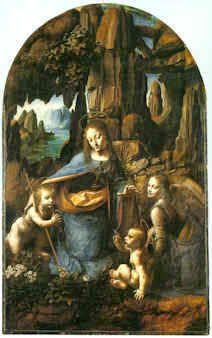


Good Science; Over-Reaching Science; Over-Promoted Science.
On February 10th the Daily Telegraph published a letter from a professor of chemistry at University College London (Robin J. H. Clark) questioning the relationship between art and science in general terms and with regard to a supposed Chagall painting featured on a recent BBC Fake or Fortune television programme. Prof. Clark expressed particular concern over art world failures to heed the testimony of available scientific techniques.
In the late 1980s the UCL chemistry department had developed a non-invasive technique (“Raman microscopy”) for identifying both natural and synthetic pigments within paintings. Because the latter have known dates of invention, their presence in a picture can establish the earliest date at which it could have been produced. This technique is said by Prof. Clark to have been known to Sotheby’s by 1992. The Chagall painting, he pointed out, could have been exposed as a fake at any point in the last 20 years. He further reported that the painting was exposed as a forgery in his UCL laboratory in July last year in the presence of its owners and the presenters of Fake or Fortune:
“I am disappointed that neither of the presenters of Fake or Fortune made this clear. The conclusion that the painting is a forgery is based on our spectroscopic results, which showed that at least two of the key pigments had not been synthesized until the late Thirties, putting the earliest date for the painting at 1938, long after the supposed date of 1909-10.”
Because of the unequivocal nature of those technical findings, Prof. Clark (rightly) observed that the Chagall Committee in Paris, to which the painting was sent, had no option but to confirm the forgery. He also asked how art historians might be encouraged to read science journals so as be informed about “significant developments in science as applied to arts”. In part, his question is fair and urgent. The art market’s notorious governing trade dictum is caveat emptor (buyer beware) – while auctioneers and dealers may take every pain to verify their claims, it is ultimately for buyers to satisfy themselves that attributions and conditions are as described. Auctioneers can only submit works to (possibly disqualifying) technical analysis with owners’ permission. Dealers who buy at auctions almost invariably have works restored but are not required, when selling works on, to disclose which if any tests may have been run.
Support on the extent to which scientific (and also historical and visual) evidence is ignored or manipulated in the interests of “boosting financial rewards in attributing paintings to particular masters” was given in an Observer interview on February 23rd (“Revelealed: the art experts who pass fakes as authentic”) by Professor Martin Kemp, a Leonardo specialist. In the same report by Dalya Alberge, Nicholas Eastaugh, a leading independent scientist (of Art Access and Research), described the present climate as being both without standards and “totally unregulated. It’s a Wild West.”
However, much as we sympathised with Prof. Clark’s impatience with some art world practices, we could not endorse his call for a blanket acceptance of all scientific methods presently being applied to works of art. As we put it in a letter to the Daily Telegraph (published 12 February):
“Professor Robin Clark (letters February 10) calls for developments in science to be applied to art. If sound science is underused by the art trade, more questionable ‘scientific studies’ have been used for many years to offer assurances that picture-cleaners’ solvents have been a safe method of stripping varnishes and repaint from old pictures. As the current issue of the journal of the International Institute for Conservation of Historic and Artistic Works makes clear, the understanding in the art and museum world since the Sixties of how solvents work has been seriously flawed scientifically. Because important intermolecular interactions have been ignored, the theoretical model used cannot predict, as assumed, the actions of solvents on the underlying paints.”
History teaches that the many cumulative “scientific” defences of restorations have best been treated with scepticism. In 1977 Kenneth Clark admitted founding the National Gallery’s conservation science department precisely to bamboozle critics and dupe the public. In later years the Gallery pioneered a new mongrel discipline known as Technical Art History in which curators, conservators and conservation scientists pool expertises so as to arrive at some seemingly “scientifically underpinned” consensus on aesthetic decisions. In reality curators were glossing authority already-ceded to restorers. As the National Gallery restorer Helmut Ruhemann wrote in 1968: “Although the art historians in charge of pictures are officially responsible for the policies regarding cleaning, they naturally form their ideas in the first place from what they are told by their restorers.”
In its guides to conservation the National Gallery presently claims that while its restorations are carried out for aesthetic rather than conservation purposes, and while each restorer imposes a personal aesthetic taste on pictures, it considers all aesthetically various outcomes to be equally valid so long as they have been carried out “safely”. The contention that the (claimed) safety of cleaning methods can underwrite conflicting aesthetic outcomes is a non sequitur. Besides which, no claims have proved more unreliable than those of cleaning solvents’ safety.
The crucial and sometimes wilfully over-looked cultural truth is that there are no properly scientific means of comprehending art’s variously created aesthetic values and relationships. When reiterating this point in our post of 7 February 2014 (“From the Horse’s Mouth ~ Seventy years of worthless ‘science’ and reassurances on the safety of picture cleaning solvents”) we were able to disclose the most recent and most damning evidence of the un-soundness of past scientific endorsements of picture-cleaning solvents.
Notwithstanding these spectacular technical reverses, this month the press has been chocked with uncritical “Good News” accounts of scientific advances in the arts. Most newspapers and the BBC carried claims that scientists had “digitally reconstructed” the original appearance of a Renoir painting in which a former pink background had faded. By coincidence, this claimed miraculous virtual recovery had also been made by “a technique known as Surface-Enhanced Raman Spectroscopy (SERS)” carried out at the Art Institute of Chicago.
The BBC reported that “Northwestern University chemist Prof Richard Van Duyne pioneered SERS. He said the Renoir demonstrated why the Raman technique was fast becoming an invaluable tool for studying artworks: ‘You get tremendous information about the origins of the painting, the techniques of the artist, an understanding of the fading mechanism, and the ability to restore the painting.’” Note that speculative hypotheses are now being presented as sound platforms for restorations. In the art world it is frequently the dogs that don’t bark that matter most. Note that this wonder technique which addresses changes resulting from natural causes would seem to have no powers or potential with regard to the more common and much more seriously deleterious man-made changes made by restorers. Given that both types of injury are easily evident by eye to anyone lifing a picture out of its frame (see Figs. 2 and 3), the silence of “science” on the latter injuries can only seem self-compromising .
In a letter to the Times (February 17) we protested:
“The claim that scientists have recreated the original appearance of a Renoir painting (‘Laser technique shows masterpiece as Renoir intended’, Feb 14) is unfounded. All elements of a picture undergo natural changes over time. To these, further unnatural changes are added by restorers and their invasive paint-penetrating solvents. Compensating for a single faded pigment does not constitute a recovery of a picture’s original appearance. Rather, it offers a further falsification: a single artificially simulated ingredient within a remaining, generally altered and debilitated surviving whole.”
Our letter was accompanied by one from a Professor of Allergy and Clinical Immunology at Imperial College London, making a far-fetched claim that the fact that a synthetic red dye used in paintings had also helped in the discovery of an important white blood cell constituted an unusual “bridging [of] fine art and science”.
While Raman microscopy could certainly disprove the claimed date of the fake Chagall, it seriously misleads the public to present speculative and hypothetical digitally manipulated reconstructions as if literal recoveries of original conditions. On February 22nd the Economist reported an account of another digital re-mastering of real paintings delivered at this year’s meeting of the American Association for the Advancement of Science. The Economist too saw a bridging of the divide between art and science, which it likens to a resolution of the science/art schism of which the chemist and novelist C. P. Snow complained in his famous 1959 lecture “The Two Cultures”. The report also reveals, however, that what was presented as a recovery of the murals’ original conditions was in fact a double hypothetical reconstruction. Not only had Rothko’s colours faded, so too had those of the contemporary photographs of his murals that were to serve as the basis for a digital re-mastering of the actual paintings. Despite the methodologically dubious procedure of digitally re-mastering actual paintings on the back of digitally re-mastered photographs, there was customary breathless admiration for this latest claimed technical miracle:
“In the case of the Holyoke Centre’s Rothkos […e]ach had faded differently, depending on its original colours and how much sunlight it had seen. And various parts of individual paintings had faded at different rates, too. But modern technology allows optical illusions to be finely crafted indeed. The paintings are continuously observed by a high-resolution camera. Its images are compared, pixel by pixel, with the idealised versions provided by the restored photographs. A computer then works out, moment by moment, what mixture of light to shine back to make the faded originals match the vibrant reconstructions—with no messy repainting necessary. For now, the paintings remain under wraps while the museum at which they are stored is renovated. One day soon, though, they will be on display in all their illusory glory.”
There was no discussion of the consequences of viewers’ bodies blocking the projected “correcting” coloured lights. What we are witnessing in this heavily promoted technical bonanza is not a genuinely increased understanding of art by courtesy of scientific advances. If the attempt to increase public understanding of the degree to which even quite modern paintings have suffered alterations since their executions was a real ambition of museum staffs and conservation scientists, it would be imperative for them to discuss (and demonstrate) the largest single source of alterations and adulterations: “restoration” treatments. In the absence of such an agenda, what we see unfolding is a cultually diversionary Big Push by certain professional groups into new and uncontroversial employment pastures where the potential pickings and funding opportunities are immense – there is scarcely an old picture in existence where some pigments have not faded. This virtual remastering show is one that could run and run. But who might fund and who might execute research into all those paintings that suffered far more grievously from the chemical coshes of restorers?
The real problem in the arts is not an insufficiency of technical or scientific assistance. It is deeper and more fundamental. Its root lies within institutional withdrawals from exercising properly critical considerations. The non-appliance of due critical practices is long-standing. There were uncritical responses in the late 1990s when (as we reported in our first post) the National Gallery used a computer-manipulated photograph of an actual skull as the basis for a hypothetical virtual reconstruction of missing parts in Holbein’s “The Ambassadors” which led to the redrawing of Holbein’s skull in defiance (or ignorance) of the perspectival systems of the artist’s times. More recently, the Tate repainted large lost parts of a flood-damaged work on the basis of early colour photographs in the course of a “restoration”. In our uncritical, increasingly “virtual” cultural universe it is more urgent than ever that museum curators should return to acting primarily on sound scholarly appraisals and aesthetically informed insights, and that they should not further devolve their responsibilities to technicians who may or may not be properly alert to matters aesthetic and artistic.
Michael Daley
Comments may be left at: artwatch.uk@gmail.com





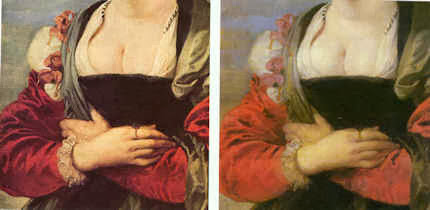
The Sistine Chapel Restorations, Part III: Cutting Michelangelo Down to Size

“Judging by Past Experience, it is Perilous to Suggest Restoration…”
~ Charles Heath Wilson, 1881, “The Life and Works of Michelangelo Buonarroti”. Publisher: John Murray, London.
“I once barged into a correspondence in The Times when the National Gallery was under fire from the ‘anti-cleaners’. I was ticked off very severely by Lord Crawford, the Chairman of the Trustees. I had, mildly I thought, criticised the authorities for ignoring the sincerely held views of the opposition…I was later restored to favour in high places when I made it clear in an article in The Studio that I was convinced that our National Treasures were in the keeping of qualified responsible people.”
T. J. Honeyman, 1971, “Art and Audacity”. Publisher: Collins, London.
It is not widely appreciated how inherently dangerous art restoration practices remain, or how culturally deranging restoration changes can be. At the bottom end of the trade, restorers often advertise their services on a promise to leave pictures “as good as new – or better”. The restoration of Michelangelo’s Sistine Chapel ceiling was – on the accounts of its own restorers and initiators – the biggest, the best, the most scientifically advanced and “radically transforming” top-end restoration ever undertaken. This “Restoration of the Century” left one of the world’s greatest artistic accomplishments so profoundly unlike its former self that enthusiasts could announce the discovery of a “New Michelangelo” who was “very different from the one art experts thought they knew”. At the same time, the chief restorer thrilled in 1982 that the frescoes looked as good as new: “as though they were executed yesterday”. In the midst of this commonplace restorers’ confusion between “recoveries” and “discoveries” (or sometimes, “revelations”), some surprising expressions of support materialised. In 1987, a top-end art historian writing in the magazine Apollo [Endnote 1] announced the demolition of the “Darkness Fallacy and the Sculptural Fallacy” within Michelangelo scholarship, and predicted that the then concurrent restorations of the Sistine and Brancacci chapels would leave both Michelangelo and Masaccio as “less isolated geniuses” who would be “returned to their respective periods” (i.e. confined within designated art historical boxes). In 1991, a newspaper art critic exulted in the displacement of “doomy outpourings of religious angst” by colours as “bright as Opal Fruits” – which colours reflected the workings of a “much more rational mind” [2]. Unsurprisingly, such professional pleasure-taking in chemical transformations that could cut artistic Titans down to size alarmed those who had been happy with the surviving Michelangelo, and an enormous controversy arose. Unsurprisingly, the criticised characterised the criticisers as instances of “the magnitude of the shock to entrenched opinion” that had been unleashed by a triumphant restoration. (As will be seen, the expression of sincerely held citicisms can be harshly punished when substantial vested conservation interests are challenged.)
Behind this interpretive culture war, the effects of the restoration on Michelangelo’s art were material and aesthetic. Those changes are forever. Although bad scholarship can be remedied by good scholarship, the latter cannot undo damage to unique, historic works. What remains to be done, a third of a century after the restoration’s 1980 launch, is a proper, disinterested aesthetically informed analysis of the restoration-induced changes, item by item, figure by figure, photograph by photograph; and, a frank evaluation and acknowledgement of their cultural and art historical consequences. Had this restoration’s profound transformation been accepted without challenge, we would be in a world today where technicians enjoyed unfettered licence to rewrite (or as they sometimes prefer, “to re-present”) history itself. Even tacit endorsements of injurious restorations can damage scholarship and falsify history.
The restoration of Michelangelo’s Sistine Chapel ceiling was well and publicly defended from 1980 until the mid 1990s. At that period, a seismic shift occurred. What follows is an examination from a British perspective of the restoration’s defences up to 1995 (in which year implicit art historical support for the restoration resulted in a seriously misleading exhibition at the National Gallery); and, a further presentation of visual proofs of the restoration’s injurious consequences. We note here how many supporters have admitted entertaining doubts about the restoration’s probity.
A new cleaning method, and the selling of a “New Michelangelo”
In the 1980s, at the height of an international restoration mania, a supposedly “advanced” “scientific” cleaning material was used on Michelangelo’s Sistine Chapel ceiling. It was ferocious in its effects and mechanistic in its application which was expressly designed to thwart personal and allegedly “subjective” and “unscientific”, aesthetic appraisals. The most sophisticated imagery on an immensely important historic work of art was thus subjected to a “treatment” that derived not from the complexities of picture restoration and its necessary acts of discrimination and constant evaluation but, rather, from architectural stone cleaning techniques. This cleaning method altered the ceiling’s centuries old artistic/historic continuity to such a degree that the restorers and their supporters ventured that history would need to be rewritten. The changes, for sure, were dramatic: depictions of figures that had been archetypally and transcendentally alive were brightened, flattened, rendered more abstract, more “on the picture surface” and left with an altogether more modernist and imaginatively impoverished aspect. Contrary to official claims this (demonstrably) was not a liberation or recovery of the ceiling’s original condition and appearance – see, particularly, Figs. 1 and 60.
When Michelangelo’s ceiling was unveiled in 1512 the world was stunned by the grandeur, pictorial audacity and, above all, by figural inventions that had rendered the divine corporeal and vividly alive within our own space and time. Michelangelo had not so much made depictions-on-surfaces as conjured perceived spaces adjacent to the ceiling’s imperfect forms. His optically “sculpted” spaces – which opened vistas beyond the ceiling’s surfaces while simultaneously projecting figures in front of them – had been realised through powers of draughtsmanship and modelling with utter disregard for the “integrity” of the architectural surfaces. Seemingly palpable space was necessary to situate Michelangelo’s monumental programme of over three hundred figures – figures that ran from depicted carved stone sculptures (his architecture-adorning putti), through living, space-occupying young sculptural Adonis’s (his contorted, anxious ignudi) and, more prosaically, through the historical ancestors of Christ, to the divinely gifted Prophets and Sibyls, and finally to God Himself and his celestial supporters. This was immediately acclaimed as a dazzling artistic and illusionistic advance. Its eventual influence was to carry mural painting into the Baroque and beyond. Although artistic fashions and modes of description change constantly, for nearly five centuries this “stupendous” work’s vital relationships endured, as the many copies made throughout its existence testify (see Fig. 1b).
How Doubts became Denials
With the restoration of Michelangelo’s Sistine Chapel ceiling, while some art world players were galvanized into opposition, many others were excited and swept along by the presumptuous magnitude of the transformation. As mentioned, many of the supporters of the restoration have disclosed moments of doubt. We cited in our post of March 4th that the co-director and chief restorer of the ceiling, Gianluigi Colalucci, had said in 1990: “I must confess I harbour a lingering almost subconscious fear that someday someone will come, unexpectedly, with a really intelligent observation that will show all of us to have been blind.” The following year the Sunday Times art critic, Waldemar Januszczak, produced a celebratory book (“Sayonara Michelangelo”) in which he asked in the face of the transition:
“Who among us looking up for the first time at this new, bright, clear Sistine ceiling, perfectly rational, a light-filled work, was not tempted by the doubt: it can’t be so.”
This temptation was throttled by the sheer spectacle of the restoration as an art-changing performance:
“The thin and neat scaffolding bridge moved elegantly along the ceiling like a very slow windscreen wiper. In front of it lay the old Michelangelo, the great tragedian, all basso profundo and crescendo. Behind it the colourful new one, a lighter touch, a more inventive mind, a higher pitch, alto and diminuendo. It was being able to see both of them at once – Beethoven turning into Mozart before your eyes – that made this restoration such a memorable piece of theatre.”
Even the National Gallery’s thoughtful and scholarly (then) curator of Renaissance painting, Nicholas Penny, who recognised (“White Coats v. Bow Ties”, London Review of Books, 11 February 1993) that “The most terrifying thing about the restoration of old paintings and sculpture, as distinct from the editing of texts, is that something might be lost altogether”, swallowed his own moment of anxiety:
“But perhaps one should admit that something is lost however much is gained by any intervention – some possibility of interpretation if not some actual pigment or glaze or polish.” [Emphasis added.] With a seeming acceptance of such material and interpretive losses, the greater gains in the Sistine Chapel were said by Penny to have emerged as follows:
“Study of the ceiling now that it has been cleaned tends to distance Michelangelo from the art of recent centuries – and from the work of artists who were inspired by the ceiling – and reveals a far closer connection with the dazzling colours favoured by artists in his immediate following and also evident in some of the better-preserved 15-century Florentine panel paintings.”
Note the cultural role being served by “restoration” changes: even when their legitimacy is vehemently challenged, restorations facilitate through “study”, new interpretations and a certain re-shuffling of scholarly furniture. Scholars and restorers invariably say that they have duly considered and rejected the criticisms as ill-informed, but the fact remains that eventually all restorations themselves come to be rejected and undone by later restorers. Indeed the alleged need to undo previous restorations is one of the commonest justifications for a restoration. The net consequence of repeated restorations is not a return to an original condition each time, but a daisy chain of altered alterations, with each successive restoration leaving the given work looking unlike its previously “restored” state. With accumulating alterations, works get thinner and thinner. Insofar as such abraded appearances are acknowledged, they are attributed to previous “rubbing”, or other euphemisms. Losses of original material during restorations (as Penny conceded) are to some degree inevitable. This is because while painters work from supporting canvases or panels upwards, restorers work downwards with their solvents and abrasives towards or beyond pictures’ finished surfaces. Collisions are inevitable.
The “New Michelangelo”
The art historical revisionism that advanced with this restoration might have been plausible had changes of colouring been the only changes, and had any of Michelangelo’s contemporaries noted dazzling colours. By any properly visually alert appraisal, however, the changes were less ones of enhanced chromatic power than of debilitating losses to the ceiling’s initially celebrated dramatic modelling and lighting (see Fig. 60). Although Nicholas Penny acknowledged such objections to the received critical consensus, he nonetheless caricatured them:
“Polemics against the restoration appeal repeatedly to the ideas of chiaroscuro and harmony as artistic absolutes.” The implication that critics were in the grip of a fetishized false artistic consciousness was underscored: “It is painful but important to acknowledge that the inspiration one artist draws from another, earlier one is often inseparable from misunderstanding.” It is a common defence against critics to allege some “misunderstanding” of the “facts” because of ingrained or entrenched prejudices but with this restoration the objections stemmed not from misapprehensions or misplaced adherence to ahistorical idée fixes, but from the fact of the concrete, demonstrable and historically verifiable injuries to the painting.
Further Material Evidence of Injury
Having shown many directly comparative pairs of “before” and “after” restoration photographs as proofs of injury – we further present seven single photographs (Figs. 1 to 6 and 48b), each of which alone testifies to the destruction of the final stages of Michelangelo’s painting. To pinpoint the unsoundness of the restoration’s theoretical underpinning, we also show two other works, one drawn (Fig. 41), one painted (Fig. 47) that seem emblematic of serious critical neglect. It will be argued that insufficient respect for the artistic and documentary records (particularly in the form of graphic copies and related paintings) facilitated an initial misdiagnosis of Michelangelo’s painting methods. In addition, we examine the “macro” consequences in terms of changes to the previous relationships between the broad and differentiated zones of the Sistine Chapel’s consecutively decorated surfaces.
Selling the Restoration and Blocking the Critics
In December 1987 two articles that acknowledged the intensity of the controversy were published in Britain. One was a work of journalism by a leading cultural writer with strong interests in science, Brian Appleyard. The other was a full-blown and frankly declared Public Relations Apologia by Kathleen Weil-Garris Brandt, a professor of art history at New York University, a consultant member of the Vatican’s Scientific Advisory Committee on the restoration, and the Vatican’s spokesman on “scholarly and general information” for the public relations firm Arts and Communications Counsellors, which had been retained to handle the crisis.
To take the former first: on 20 December 1987 the Sunday Times magazine carried an article on the restoration – “Lost or Found?”. Its author, Brian Appleyard, acknowledged that he had been “carefully and elaborately briefed” by the co-directors of the restoration, Fabrizio Mancinelli, the curator of the Vatican Museums’ modern paintings, and Gianluigi Colalucci, the head restorer, and by Professor Carlo Pietrangeli, the director of the Vatican Museums, and that the next day he had been “scientifically persuaded” by the Vatican’s chemist, Nazzareno Gabrielli. Nonetheless, Appleyard gave a fair and balanced account, citing the arguments of James Beck, a professor of art history at Columbia University, New York. Even while recognising that “the vast majority of art historians are on the side of the Vatican”, Appleyard concluded “So far the Vatican have been troubled by Beck but have been secure behind the battery of art historians prepared to stand up and oppose him. But his fury and energy are beginning to pay off. More and more awkward questions are beginning to be asked and he warns of more home-grown opposition in Italy.”
An Artist Thwarted
The article itself prompted controversy in Britain by including directly comparative before and after restoration photographs of sections of the frescoes. To this artist’s eyes, those photo-comparisons showed instantly that the “cleaning” was damaging and that the protests were well founded (see Figs. 9 to 11b). Working then as the principal illustrator of the Independent, a new and fashionable newspaper with excellent arts coverage, I asked the arts editor if I might write a short article demonstrating the ways in which the ceiling was being damaged. He declined on grounds that the newspaper’s art critic, Andrew Graham Dixon, had (like Beck) visited the scaffolding, and had been persuaded (like many art historians and critics) that all was fine.
Thus, the first lesson in this controversy was that an artist who had trained for four years in a junior art school, for five years in a fine art college and for three post-graduate years at the Royal Academy Schools – and who afterwards had taught and practised drawing and sculpture for fifteen years – could be unvoiced in a debate about the treatment of a work of art in deference to the views of someone sixteen years younger who had read English at university and art history at the Courtauld Institute (- on which institution’s restorations see “Taking Renoir, Sterling and Francine Clark to the Cleaners”).
An Artist Heeded
When the Independent launched a Sunday edition in 1990, its arts editor invited an article on the Sistine Chapel restoration. In preparation, I contacted James Beck who put me in touch with many key critics. These included, in Italy, Professor Alessandro Conti, Venanzo Crocetti, the sculptor who had worked on the previous restoration of the Sistine ceiling in the 1930s, the restorer Mirella Simonetti; and, in the US, the critic and writer Alexander Eliot and the painter Frank Mason. From the Independent on Sunday I spoke directly to Professor Brandt, Dr Fabrizio Mancinelli, Professor John Shearman, (an advisor to the restoration who viciously attacked Beck on the record and then threatened to sue if I published his grossly defamatory comments), and wrote to Gianluigi Colalucci. The second lesson had thus been that critics of restorations, however prestigious, could find themselves victims of scurrilous attacks from professional peers.
Shooting the Messengers
When surveying the restoration’s then decade long literature, Brandt’s 1987 Apollo article emerged as a seminal document. Its declared purpose had precisely been to defend the “transformation of Michelangelo’s mysterious dark frescoes…into [the] blazing colouristic pyrotechnics that is attracting the most public attention and controversy” (this was despite the fact that Michelangelo had been praised at his own funeral for “the fleeting and sombre colours with which he had formed such rare and lofty shapes”). Most striking of all was Brandt’s assaults on the restoration’s critics, whether they were scholars, restorers, traditionalist artists or fashionably modish artists:
“But, a tiny, heterogeneous and vociferous cadre emerged with the dramatic charge that Vatican conservators are ruining one of the great icons of western civilisation. “Convinced of the urgency of their mission, the critics conducted their campaign in the international press and television and achieved a remarkable degree of public visibility. A letter by a well-meaning group of American master painters of the Pop generation, calling for a halt to the cleaning of the Sistina (as well as the Last Supper) was one index of their success. An interview with one of the American Sistina critics in People Magazine was, however, another… “To the ears of most art historians and conservation experts, however, the critics claims sounded more and more like the wild cries of some ferocious mutant of Chicken Little. Many believe that the critics, like that benighted bird, were misunderstanding insufficient evidence to draw mistaken conclusions to the alarm of the neighbours. Still the issue is a serious one. Are the critics merely opportunists, body-surfing on a wave of publicity they would never otherwise have enjoyed? Or should we be hearing in their polemics a warning that the cleaning of major works of art is another of those matters too important to be left to the experts?” “If the critics’ questions have such detailed answers, what is the continuing public fuss about? Why has the criticism been so remarkably vague, shifting and misinformed? Why have the critics been so reluctant to make the frequent visits to the Sistine Chapel scaffolding…Why does criticism remain invulnerable to the abundant available information. How could such a small group of people, none of whom is – in a professional sense – an expert on Michelangelo and conservation, attract so much publicity and even some well-intentioned adherents? (The original nucleus of nay-sayers consists of only five persons: two painters, one former art critic and two art historians, distributed in Italy and the USA; connexions between them exist but are hard to define.)”
In addition to an insinuation of some underlying conspiracy, Brandt appended an imputation of political motivations that served as platforms for personal opportunism:
“It is easy to see how any hint that the Vatican might be hurting Michelangelo could fuel political fires while providing a chance for professional power play among factions of the intellectual establishment.”
If political motivations combined with personal power play might exist among critics in Italy, Brandt maintained, the situation was different in the United States where:
“The continuing publicity has, of course, also become a phenomenon in itself with a life and fascination of its own. All the more significant that only one American scholar has been tempted to join the public furore. “None of this grandstanding matters much – although one doesn’t like to see an important issue distorted and people misled. I do not believe that a tenacious campaign of ill-informed criticism and personal attacks on the conservators will stop the careful cleaning of the Ceiling.”
Traditional Slurs
At this historical point Brandt’s past abuse of the critics might best be taken to have been self-answering. Her assurance that “the cleaning chemicals do not actually come into contact with the fresco surface” has not worn well and, besides, was at odds with the chief restorer’s earlier admission that if left on a minute too long the chemicals began devouring the fresco surface and Michelangelo’s shading with it. Similarly, her claim that the restoration had been “spurred by the alarming discovery that the glue layers were contracting as they aged , and were pulling flakes of plaster and pigment away from the surface of Michelangelo’s frescoes” proved an impermanent position. As was later reported in “Art Restoration, The Culture, the Business and the Scandal” (James Beck and Michael Daley, 1993), it had been claimed in 1986 (six years into the restoration) that “various checks [had] ascertained that in several places minute flecks of colour were lifting” and that this had “necessitated an immediate restoration.” In 1987 it was said that extensive areas of flaking were progressively worsening and threatening an imminently “uncontrollable situation”. By 1988 Vatican spokesmen were claiming that the weight of encrustations upon the paint surface was causing it to break away from its ground. By 1989 it was said that the glues had “shrunk and puckered” causing “scabs” to fall away “pulling pigment with them”. It was said that this “slow destruction by glue-pox” was “the Vatican’s principle motivation for cleaning the ceiling”. When we asked Brandt in 1990 how big the puckerings were, she replied “Oh! Some are as big as your hand.” Soon after, in 1991, the problem de-escalated: initial investigations were acknowledged, once more, to have encountered “minute desquamations and loss of pigment.”
Brandt’s patronising claim that “the so-called ‘controversy’ is not actually about facts and issues but is a reflection of culture shock” lamely echoed charges made in earlier restoration controversies. During the National Gallery cleaning controversy in London in the late 1940s the critics were said by the art critic, Eric Newton of the Daily Telegraph, to be suffering from the “shocked eye”, a condition which afflicted “the connoisseur and the artist – the visually sensitive man with a quick eye and profound reverence for what he had seen”. Just as at the Sistine Chapel, Newton’s dismissal of the expertise of creative players was made on the claimed authority of restoration “science”. Such generalised appeals to the authority of science often prove to be empty incantation and Newton volunteered no more than “The purely scientific and technical aspects of the process, however are too complex to describe here.”
In 1857 picture cleanings at the Louvre were defended on the grounds that “It is understandable that the romantic amateur loves the rust and the haze of the varnish, for it has become a veil behind which he can see whatever he desires” (Horsin Déon). One critic of the Louvre’s restorations, Edgar Degas, threatened to produce a pamphlet that would be “a bomb”. When Brandt dismissed the Sistine Chapel critics on the grounds that the controversy was “rather unreal since the arguments against cleaning are mainly nostalgically emotional [while] those on the other side are chemical and scientific” she presented her role as being to “dissolve some of the murky argument and preserve a few facts”. As will be seen, artists and art historians can have distinctly differing views as to what constitutes a “fact” and what a blind prejudice.
The Evidence of Restoration Injuries – and the Surprising Reactions To It
When the Independent on Sunday’s picture desk obtained high-quality colour transparencies from the Vatican in 1990 we examined the image of the Erythraean Sybil, part of which had been shown in Appleyard’s Sunday Times article, and encountered among many losses the restoration-mangled foot seen at Figs. 2 and 3. Those losses and losses to a figure on one of the lunettes were first published in the Independent on Sunday of 25 March 1990 (see Figs. 12, 13 and 14) and then later in the Independent of 20 March 1991, where the arguments against the restoration were put by Daley, Beck, Conti, Eliot and the art historian Bruce Boucher, and balanced by three counter arguments.
Of the latter, Ernst Gombrich was harshest on the critics: “No one is infallible, but I have not the slightest doubt that the overall impression and operation is right, and the critics talk absolute nonsense.” The Courtauld Institute-trained editor of The Art Newspaper, Anna Somers Cocks, condescended that some people liked things to look “romantic and old, and can’t cope with the clarity and brilliance of what the Sistine Chapel looks like now it has been cleaned”. The Courtauld Institute-trained Nicholas Penny said “It’s one of the great revelations of our time but the transformation is so absolutely amazing that it is bound to give some people a shock and I am sympathetic to them being shocked”.
Brandt’s 1987 Apollo account had fallen on well-worked ground in Britain where even art world players with strong track records of being critical of restorations had become supportive of this restoration. The Courtauld Institute-trained restorer Sarah Walden, who had implicitly criticised many of her peers and predecessors in her 1985 book “The Ravished Image ~ Or How to Ruin Masterpieces by Restoration”, was one such and she offered this (simplistic) technical distinction in defence of the restoration’s results:
“Unlike easel paintings, frescos are not a film of paint on a surface but impregnate their own support and need no varnish. Given an intact, dry wall, they are spared many of the rigours of restoration, except for the removal of dust and dirt. As the recent cleaning of Raphael’s Galatea in the Farnesina in Rome has shown, and as the present work on Michelangelo’s Sistine Chapel seems to confirm, this is one area where impressive results can be had with far less risk.”
As shown on 28 April 2012, the restorer Leonetto Tintori had discovered on examining the ceiling that it had been covered by what he termed “Michelangelo’s auxilliary techniques” which included not just glue or size painting but also oils. Walden, whose principle critical complaints had been against the “Anglo-Saxon” schools of restoration in Germany, Britain and the US, as opposed to the “Latin” restorations of France and Italy [3], had evidently accepted the restorers’ claims that Michelangelo had simply coloured successive patches of wet and drying plaster at great speed and thereafter accepted whatever disparities and inequalities of value emerged on drying without making any unifying or enriching interventions with glue-based painting a secco on his fresco surfaces when dry, as was customary and as had been noted by his contemporaries. She had further accepted the restorers’ (revisionist and unsupported) claims that the large amounts of glue-based material on Michelangelo’s frescoes had been applied by restorers as a “varnish” to a work which, on her own account, would have required no varnish, and despite the fact that previous Vatican restorers had attributed that very material to Michelangelo. Gombrich, who had played a prominent role in the post-war cleaning controversies at the National Gallery in London – and who had written the Foreword to Walden’s book – was similarly persuaded by the present Vatican restorers’ well disseminated technical account.
Gombrich’s Startling Lapse of Scholarship and Visual Acuity
In 1995 Gombrich presented an exhibition, “Shadows: The Depiction of Cast Shadows in Western Art”, at the National Gallery (London) on the thesis that an avoidance of cast shadows had been “widespread among painters of the High Renaissance”. He did so without reference to the paintings of Michelangelo or Raphael. (When pressed on these omissions he replied “I never meant [the catalogue] to be an encyclopaedia of all cast shadows, though some of my readers seem to assume so.” – Letter to Michael Daley, 10 June 1995.) As will be shown, in a curious fashion, Gombrich’s pictorial amnesia constituted the logical terminus of a more general denial by art historians of the distinctive artistic relationships that had survived on the pre-restoration ceiling, and of the connections between those relationships and the art forms of the period and immediately afterwards. Defending this restoration became an exercise in not-seeing what was and what had been. Gombrich’s position on this restoration was a great disappointment to us given his outstanding earlier contributions.
Gombrich on the Sanctity of Scholarship
In 1978 as the Vatican Museums’ curators, restorers and scientists were moving towards restoring the Sistine Chapel ceiling, Gombrich had discussed one of Michelangelo’s prophets – his Ezekiel – in the context of problems of art connoisseurship and medical practices (and with no reference to colour) [4]. He pointed out that just as with placebos “suggestibility plays a part in our response to works of art”. Demonstrating by a comparison between Jeremiah and Ezekiel that the latter was uncharacteristic of Michelangelo but characteristic of Raphael, he firmly attributed its execution to Raphael (see Fig. 25). Of all the prophets on the ceiling, he contended, this one alone lacked Michelangelo’s profound stylistic traits: “he always negates the picture plane. Jonah being the most famous example of this space-creating and surface-denying imagination, which so aroused the admiration of Renaissance writers.” How could it have been overlooked, Gombrich continued, that the Ezekiel, far from denying the picture plane, asserted it: “Instead of being self-enclosed it impetuously moves to the right, addressing an unseen partner in what looks like a violent argument. It is this implied movement which tears the cohesion to pieces and introduces a shrill note of drama entirely absent from the other creations. The composition is only superficially Michelangelesque…” Further, what the Ezekiel betrayed in its agitated gestures was Raphael’s own great indebtedness to Leonardo: “Indeed it is hardly too much to say that Ezekiel would fit comfortably into the groups of the apostles in the Last Supper of S. Maria delle Grazie.”
This was vintage Gombrich, learned, conceptually adroit, visually acute and boldly re-attributing a Michelangleo to Raphael through Leonardo. Except that here his elegant arguments and persuasive stylistic “evidence” amounted to no more than a plausible contrivance – a conceit that was, he confessed, an art connoisseur’s equivalent of the medical practitioner’s placebo. He hoped that connoisseurs “will not take offence and that the spirits of Michelangelo and Raphael will forgive me this harmless fabrication.” (Was that jest to become a maquette for a far greater and undisclosed prank on those two great artists seventeen years later?)
Gombrich and the Guardians of Memory
Two decades earlier, in a moving 1957 essay “Art and Scholarship”, Gombrich had championed the scholar as “the guardian of memories”. It seemed that he had been stung to do so by the painter Wyndham Lewis who had recently written:
“When I see a writer, a word man, among a number of painters, I shake my head. For I know he would not be there unless he was up to something. And I know that he will do them no good…”
Gombrich’s retort was: “Why should the artist bother about that spoilsport the scholar and his past? The brief answer to this question, I fear, may sound moralistic. Because truth is better than lies.”
Indeed it is – but this leaves his own later omissions in the National Gallery exhibition the more perplexing: How could so great a scholar make so seriously misleading and unfounded a claim in (seeming) defence of such an unsupportable restoration? Spicing this mystery is the fact, as shown below, that Gombrich’s faith in the Sistine ceiling restoration was not absolute and that he, too, like Colalucci, Januszczak and Penny, had once acknowledged a moment of doubt.
Gombrich’s Moment of Doubt
As mentioned, Gombrich was as one with the views of the restorer Sarah Walden on this restoration. Walden was to persist with her endorsement of the restoration until at least 2004 when, in a revised edition of her book (now titled “The Ravished Image ~ An Introduction to the Art of Picture Restoration & Its Risks”), she pressed Gombrich into a swipe at critics of the Sistine ceiling restoration:
“The subject of restoration tends to attract cranks and fanatics, but to suggest that the world’s foremost art historian was one of those would be absurd. He approved for example of the cleaning of the Sistine Chapel, and wrote to me about an Italian who opposed it and was seeking his support: ‘Of course he wants to use [my writings] as ammunition against the cleaning of the Sistine Chapel, but I do think the problems of cleaning are different…I have been up the scaffold…I have no doubt that the team are aware of the many problems…I am even fairly happy about the work on the Sistine ceiling.’” [Walden’s ellipses.]
While Walden tactfully refrained from identifying the Italian critic, by publishing a letter she received from Gombrich in 1987 in the revised book, she revealed an intriguingly confessional remark:
“Last week I was sent a book from Italy violently attacking the ‘cleaning’ of the Sistine ceiling. It may contain some exaggerations but it is still disquieting. Michelangelo e la Pittoria a Fresco, by Alessandro Conti (La Casa Usher, Florence 1986). If you read Italian and have a little time during the next few weeks I’ll gladly lend it to you to look at.”
That unsettling book was later described by Penny in the LRB as “the most sustained polemic against the restoration”. Charles Hope, an authority on Titian and then the Senior Lecturer in Renaissance Studies at the Warburg Institute, London, wrote (in a letter of 1994 to the restorer Helen Glanville – see below) that “The scholar who has done most to draw attention to the relevant texts is of course Conti; and whatever you think of his book (he is not a restorer, by the way), I am sure we can agree that it is obligatory reading for anyone interested in the controversy surrounding the ceiling. Yet […] and so on not only pass over his arguments in silence instead of addressing them, they seem never to cite his book at all…” Gombrich, too, would seem to have suppressed his own disquiet and passed over Conti’s arguments even though he must have appreciated that Conti was a very considerable authority on restoration having taught the History and Techniques of Restoration at the University of Bologna; the History of Modern Art at the state university in Milan; and, the History of Art Criticism at the University of Siena. In his 1988 “History of the Restoration and Conservation of Works of Art” (republished by Butterworth in a 2007 English translation by Helen Glanville) Conti spoke of the alien “material and chromatic robe” with which the Sistine ceiling paintings had been invested “during the present restoration” and identified “the various media” Michelangelo had used on the ceiling as “fresco, lime and secco”. (For Conti’s further comments in that book on Domenico Carnevale’s repairs to Michelangelo’s ceiling, see the caption at Figs. 48a and 48b. That his now very scarce Michelangelo e la Pittoria a Fresco has yet to be published in English might itself be thought something of a scandal.)
The Context of Gombrich’s National Gallery Exhibition
Gombrich’s 1995 exhibition came not just towards the end of his long and distinguished career but at the end of a brief period of intense discussions in Britain on the restorations at the Sistine Chapel and the National Gallery. We had been at pains to show that extreme as the Sistine Chapel restoration was, it was part of a wider radically transforming international assault by restorers acting on historic works of art in the name of their “conservation”. (Between 1990 and 1995, this author alone had published twenty-three times on those subjects – see Fig. 12.) Such discussions greatly accelerated with the publication of the 1993 Beck/Daley book “Art Restoration ~ The Culture, the Business and the Scandal” which, in addition to two chapters on the Sistine Chapel carried a chapter on the National Gallery’s restorations. Responses to the book were various and sometimes startling. They prompted an additional chapter, “The Establishment Counterattacks”, in the revised 1996 American paperback edition. We should acknowledge here that the National Gallery, under its present director, Nicholas Penny, as initially under its previous director, Charles Saumarez Smith, has given ArtWatch UK full and most generously helpful access to all conservation and archival records, and that we have drawn heavily on the compendious material on the Gallery’s conservation practices that is provided in the annual Technical Bulletins. Moreover, since 2012 the Gallery has placed much archival material online.
Responses to “Art Restoration, the Culture, the Business and the Scandal”
After his initially even-handed coverage, Brian Appleyard now characterised Beck in the Independent as being “litigious” – even though he had brought no legal actions but had been sued (unsuccessfully) for criminal slander by an Italian sculpture restorer and had faced a possible prison sentence of three years. Appleyard compared the Beck/Daley book unfavourably before its publication – and before he had read it – with Walden’s book of 1985, specifically dismissing its unseen chapters on the Sistine ceiling on a Waldenesque insistence that “The fact that it was largely pure fresco made the cleaning process straightforward.”
On 18 November 1993 the New York Review of Books carried an essay by Charles Hope, on “Art Restoration ~ The Culture, the Business and the Scandal”. Hope (who was later to become, as Gombrich had been, the director of the Warburg Institute), recalled that “like many other art historians” his initial response to the cleaning had been “entirely favourable”, but which confidence, he now confessed, had been “entirely misplaced”. Viewed in their entirety, the cleaned frescoes create “a decidedly disagreeable impression: the colours are gaudy…the figures look crude and often flat and the architecture seems insubstantial and pedantic.” In short, “Restrained grandeur has been replaced by garish confusion” and it was “difficult to believe that the right procedure was adopted.” Worse followed for the restoration establishment. “Restorers are not always particularly well-informed about the history of art nor especially interested in it”, while, for their part, art historians “seldom have the scientific training to judge the full implication of the courses of action proposed to them.”
Perhaps most disturbing to the Sistine Chapel restoration supporters was Hope’s acknowledgement that when “Talking to friends I find that my unease is widely shared; and it is certainly noticeable that the completion of the restoration has not attracted the kind of acclaim that greeted the unveiling of the lunettes.” After the publication of his review, Hope told Beck in a letter (20 November 1993) “You’ll be cheered to know that several art historians have told me, by letter or in person, how glad they were that I had said what I did.” This greatly amplified a note of caution that had already been present in Nicholas Penny’s observations in the LRB nine months earlier:
“I have met few art historians, even among those who are nervous about the cleaning of paintings, who believe that a mistake was made in cleaning the ceiling. Nevertheless, many art lovers were shaken by what has been published on the subject and some have been no less alarmed by what they have seen in the chapel itself.”
A Restorer’s Response
Temperatures rose after Hope’s review. The Art Newspaper allotted four pages in its May 1994 issue for the counter arguments of Helen Glanville, a Courtauld Institute-trained picture restorer who had read Modern Languages at Oxford. Like Brandt seven years earlier in Apollo, Glanville struck a combative tone and a tendentious note by producing accounts of our “Accusations” against which she provided lawyerish “Defences” written in consultation with the authorities. In 1963 Gombrich had complained “Nobody who criticizes the policy of a great institution expects such criticism to be accepted without further argument. What one has the right to expect, however, is that the answer should concern itself with the substance of the criticism.” In language eerily reminiscent of that used against Beck by Shearman, Glanville challenged not only our character but the judgement of those who had supported us: “The most disturbing aspect is that reviews of the book (including that by Charles Hope in the New York Review of Books of 18 November 1993) appear to indicate that even respected members of the art world accept Daley’s presentation of ‘facts’ at face value”.
Hope’s Riposte
Hope sent a letter to Glanville explaining that he had been “particularly careful not to take Daley at his word”, that he had checked what I had written on Sebastiano was in accordance with the monograph on the artist by Professor Michael Hirst (of the Courtauld Institute, and a member of the Vatican’s Pontifical Commission for the Restoration of the Sistine Chapel ceiling), and also with “the account of the [Sebastiano] restoration in the National Gallery’s Annual Report”. In further reproach, he added “I would have thought it was fairly obvious to anyone familiar with the recent literature that I had done my homework, not least because there are various arguments and texts used in the review which do not figure in the Beck-Daley book at all. [5] In my review I have tried very hard to be fair to both sides…Having read your article I see nothing that ought to be changed; indeed it would be difficult to see what you actually found objectionable in it…Before I began working on the review my scholarly sympathies were entirely on side of the defenders of the recent restoration, and I was hoping indeed expecting, to be persuaded that my unease at the present appearance of the ceiling was unjustified. But the reverse has happened, and not just because Beck and Daley produced such compelling arguments…” Hope then set out with great clarity the scholarly import of the material evidence we had supplied and which he had found persuasive:
“I was disappointed that you did not discuss directly what seemed to me the most important single type of evidence in the whole controversy, the drawing by Clovio of Jonah [see Fig. 1] and the one at Windsor showing the whole ceiling. Both of these, as you will remember, can be securely dated to no later than 1534, and they both show very specific, well-defined areas of shadow also recorded in the engravings of the sixteenth century and later, which have now disappeared. The important thing is that the drawings predate the engravings, that they were manifestly produced independently of one another, yet they are consistent. If they are misleading in the same way, we need to have some explanation of why this is so, because if Michelangelo did paint shadows of the kind they show, and in the places they show, then Beck and Daley would seem to be vindicated.”
Gombrich’s Denial of Historical Realities
Coming so soon after Hope’s generous and substantial support, Gombrich’s claim, as a scholar with an impeccable record as a critic of restorations, that cast shadows had popped out of existence for the duration of the High Renaissance might have seemed like manna to the National Gallery and the Vatican. Did his historical account not implicitly constitute a most authoritative rebuttal of the Beck-Daley, Hope-supported, central claim that the destruction of Michelangelo’s cast shadows had given historically corroborated proof of injury to the Sistine Chapel ceiling? In so doing, did he not also provide express relief to the restorers themselves? If the shadows had never existed during the High Renaissance, as he was claiming, how could they possibly have been harmed in restoration?
In May 1994 The Art Newspaper published my letter of reply to Glanville’s article. It concluded: “this concern [over restorations] is shared by others. The current director of the Prado, Calvo Serrraller, has condemned the Sistine Chapel restoration as a misguided ‘face-lift’. A restorer in St Petersburg complains of the ‘perniciousness of radical British restoration techniques’. A curator of New York’s Metropolitan Museum condemns the ‘strident tones’ produced by ‘the exuberant cleaning of paint surfaces, for which the National Gallery has unfortunately become famous’. It is a pity that the National Gallery staff are not prepared to debate these matters directly. It is a pity that discussion should be necessary at all when, to educated eyes, the evidence of injury contained in before and after cleaning photographs is so unmissable.” It would seem, (on Gombrich’s recollection – “In the shadow of the masters”, interview, The Art Newspaper, May 1995) that that very month, the National Gallery’s director, Neil MacGregor, approached Gombrich to ask whether he would do an exhibition in the “The Artist’s Eye” series (in which artists assembled and discussed selections of paintings made from within the Gallery’s collection).
Mr MacGregor’s Choice
Gombrich submitted five or six proposals from which, he said, MacGregor “selected shadows”. Thus the National Gallery had obtained an exhibition that purported to explain why the masters of the High Renaissance had opted to “show us a shadowless world”. If the content was helpful to the Gallery, the fact of Gombrich’s participation might have been a greater boon still. As a critic of the Gallery’s restorations during the 1950s and 1960s he had been a dangerous foe. Before becoming the National Gallery’s director, MacGregor, as editor of the Burlington Magazine, had himself been a partisan of restorations and was well aware of Gombrich’s standing in these disputes. In a Burlington editorial in January 1985, MacGregor had written:
“Cleaning controversies are probably the liveliest, and they are certainly the hardiest, of the art world’s perennial topics of discussion. Of course, thefts and exports make bigger headlines, but they lack conversational staying power, just as new record prices slip faster and faster from the memory. But debates on cleaning run and run, this Magazine having been the forum for one of the most celebrated jousts in the early 1960s.”
MacGregor then drew a distinction that marked a crucial advance that picture restorers had made by the 1980s: “Then the key question was how, or even whether, to clean. Now it is more likely to focus on what can be learnt through cleaning about the picture itself.” This rebranding of art restoration, despite all of its inherent risks, as an aid to scholarship had seemed a spectacular professional coup. By the late 1980s museum restorers had forged a common professional alliance with curators in which “discoveries” made in the course of a restoration could be presented to the world through professional journals, museum press releases, and newspaper/television interviews. The National Gallery laid claim for having pioneered the new hybrid discipline known as Technical Art History, in which curators, restorers and scientists pool efforts so as to fly in tight professional formations. In reality, museums and galleries had set themselves a trap – and Gombrich had chosen the worst possible moment to flip sides in the Great Restoration Battles: to talk about what has been learned/discovered requires the production of material, visual evidence and such evidence becomes fair game for examination.
Gombrich’s Case Against the National Gallery’s Restoration Methods
In 1950 Gombrich had drawn attention in a letter to the Burlington Magazine, to a passage in Pliny which described wondrous effects achieved by the legendary painter Apelles when he finished off his pictures with a thinly spread dark coating or “varnish”. How could we be sure, Gombrich asked, that no Renaissance masters had ever emulated the great painter of antiquity by applying similarly toned varnishes to their own works? He received no reply from the National Gallery. Ten years later, he put the question again in his book “Art and Illusion”, this time provoking Helmut Ruhemann, the Gallery’s pioneering exponent of “Total Cleaning”, into a categorical insistence that “there is no evidence for anything so inherently improbable as that a great old master should cover his whole picture with a ‘toning down layer.'”
Gombrich returned to the fray in 1962 in a Burlington Magazine article (“Dark varnishes – Variations on a Theme from Pliny”) contending that even a single instance of tinted overall varnish would undermine the philosophy of the Gallery’s intrusive restorers who presumed to discern and recover originally “intended” effects among the complex, variously degraded, many times altered material layers of old paintings. Gombrich had cited Pliny’s remarkable technically eloquent account of Apelles’ method: “He used to give his pictures when finished a dark coating so thinly spread that, by reflecting, it enhanced the brilliance of the colour while, at the same time, it afforded protection from dust and dirt and was not itself visible except at close quarters. One main purpose was to prevent the brilliance of the colours from offending the eye, since it gave the impression as if the beholder were seeing them through a window of talc, so that he gave from a distance an imperceptible touch of severity to excessively rich colours.” To the National Gallery the suggestion that colour might be suppressed in any degree by an artist was an affronting heresy, and the idea that a dark toning layer might simultaneously render colours individually more brilliant while collectively more unified was an oxymoron.
The Gallery’s then head of conservation science, Joyce Plesters, responded with a long, witheringly dismissive rebuttal in the Burlington (“Dark Varnishes – Some Further Comments”). Professor Gombrich, she insisted, lacked “technical knowledge” and his scholarship was incomplete and misinterpreted. The entire documented history technical history of art – much of which she appeared to quote – showed that “no convincing case” could be made for a single artist ever having emulated Apelles’ tinted varnish. The passage from Pliny, she sniffed, was but a matter of “academic rather than practical importance” – a charge that was echoed by the director, Philip Hendy, in the Gallery’s Annual Report where he disparaged technically ignorant “university art historians”. Plesters grandly offered to “sift” and “throw light” upon any further historical material that Gombrich or others might care to present in future directly to the National Gallery. Once again, a moment of high political danger for the Gallery’s restorers and curators passed: if no evidence existed of artists having used glazes and varnishes in the manner alleged by critics, how could restorers possibly be damaging them?
The controversy slowly subsided into isolated protests such as that of the painter Pietro Annigoni who painted “MURDERERS” onto the doors of the National Gallery, one night in 1970, in protest against what he had described in a 1956 letter to the Times as “atrocious results [that] reveal an incredible absence of sensibility”. But by 1977 it was “game-over”, so to speak. That year the National Gallery felt confident enough to launch its Technical Bulletin in which restoration methods would be described and illustrated. In it, Plesters mused complacently that “one or two readers may recall the furore when the cleaning of discoloured varnishes from paintings…began to find critics”. (On Plesters’ own technical incompetence, see our post of 27 January 2011.) In the same year a former director of the Gallery, Kenneth Clark, pronounced picture cleaning “a battle won” and claimed responsibility for the victory by having installed a “scientific department with all the latest apparatus” at the National Gallery. He had done so, he said, not because he believed in the “application of science to picture cleaning”, but rather because “until quite recently the cleaning of pictures used to arouse extraordinary public indignation, and it was therefore advisable to have in the background what purported to be scientific evidence to ‘prove’ that every precaution had been taken.”
Gombrich’s Vindication
Joyce Plesters died in October 1996. Earlier that year the National Gallery’s Technical Bulletin carried reports of the cleaning of two paintings by Leonardo’s follower Giampietrino. One, his Salome, had suffered the usual weakening of modelling and shading. The other, his Christ carrying his Cross (Fig. 45) had not. Intriguingly, the latter was said to enjoy both “intensity of colour” and a “restrained overall effect” – the very paradoxical effect the Gallery had dismissed as inherently improbable. Even more remarkably, Giampietrino had first built up an “illusion of relief” with “dark translucent glazes”, and then – just like Apelles – had deliberately “restricted his own range of values” with “a final extremely thin overall toning layer consisting of warm dark pigments and black [!] in a medium essentially of walnut oil with a little resin”. The “varnish” was thus virtually identical as a material to the painting itself – which may explain why it had survived for so long. Many, more soluble, resin varnishes with warm dark pigments had been judged to be earlier restorers’ attempt to impart a deceiving “old masters’ glow” after a harsh cleaning…and removed as alien disfigurements.
Conspicuously, the Technical Bulletin reports made no reference to the Burlington Magazine’s celebrated joust of the early 1960s. Had the Gallery privately informed its recently honoured guest exhibitor of his belated vindication, we wondered? It had not. When we informed Gombrich of this technical corroboration, he replied:
“Many thanks for your letter. I happen to have a birthday these days (87, alas!) and I could hardly have a nicer present than the information you sent me. I don’t ever see the N. G. Technical Bulletin and would have missed their final conversion to an obvious truth! Better late, than never. There is more joy in heaven (or Briardale gardens)…”
We published an account of the National Gallery’s remarkable discovery, and of Gombrich’s response to it, in the November 1998 Art Review (“The Unvarnished Truth”). Three years later in a prefatory remark for the revised 2004 edition of Walden’s book “The Ravished Image”, Gombrich announced: “It is now clear that the position I took forty nine years ago in this matter has been vindicated”. As, indeed, it had been, but curiously, Gombrich declined to mention the fact that an exact analogue of Apelles’ reported practice had been discovered on the work of an associate of Leonardo’s within the conservation studios of the Gallery which had originally dismissed his claims but recently honoured him with an “autograph” exhibition. Instead, he attributed his vindication to research reported five years later in a Burlington Magazine article of January 2001 on work conducted in the conservation studios of the Getty Museum. The article, “‘Amber Varnish’ and Orazio Gentileschi’s ‘Lot and His Daughters'”, by Mark Leonard, Narayan Khandekar and Dawson W. Carr, was certainly an important document. It reported that underneath a thick recent, disfiguring but easily soluble varnish, an older thinner much tougher (but still soluble) varnish “remained directly on the paint surface in many areas.” Examinations of paint samples established that “in some areas at least”, this varnish layer had been applied “very early in the life of the painting”, if not originally.
It had been found that in areas where sections of this early, possibly original varnish had been removed in earlier cleanings, the artistic consequences had been devastating: “One particularly prominent loss was in the neck of the daughter at the left. The older varnish remained intact throughout the face, yet at the line of the chin it had been broken through, and removed throughout the rest of the neck. To the naked eye, it looked as if the final layer of modelling in the neck had been ripped from the surface. Although the preparatory flesh tones were still intact, the carefully nuanced sculptural solidity found throughout the rest of the face was missing.” Although no one noticed it, this last remark echoed and corroborated Annigoni’s Times complaint of 1956 that restorers at the National Gallery pronounce “miracles” when “brilliant colours begin to appear“. Unfortunately, he continued, “what they have found are nothing but the preparative tones, sometimes even of the first sketch, on which the artist has worked carefully, giving the best that is in him, in preparation for the execution of the finished work.”
Welcome as such recent confirmations of longstanding claims by artist and art historian critics of restorations are, it should be noted to how great an extent they are arising after the horse had bolted. The National Gallery has yet to disown any of its post-war restorations – in which period it has restored and often re-restored almost its entire collection and often to seriously deleterious effects (see Figs. 55 to 59b by way of example). As the unwisdom of stripping off old varnishes finally begins to gain acceptance in restoration and curatorial circles, the fact remains that had artists’ testimony been heeded, not only would the ponderous and hugely expensive particle accelerators and other “diagnostic” apparatuses of modern museum conservation departments not have been needed, but that much of our visual cultural patrimony could far sooner have been spared mistreatment. Even before Gombrich’s first 1950 letter to the Burlington, in 1946, a painter, Laura Knight, had explained the intrinsic dangers of picture cleaning with perfectly calm “hands-on” knowledge and clarity in a letter to the Times (27 November):
“With the exception of direct painting, a comparatively modern method, a painter builds his pigment onto canvas or panel – always with the final effect in view. The actual surface of a picture is the picture as it leaves the artist’s hand. The varnish which finally covers the work for protection to a varying extent amalgamates with the paint underneath. Therefore drastic cleaning – the removal of the covering varnish – is bound to remove also this surface painting and should never be undertaken.”
Although Gombrich might well once again have been feeling that “There is more joy in heaven…” this early or original Getty Museum Varnish had not corroborated his Apelles’ thesis to the same degree as the National Gallery’s research on the Giampietrino. There, the surviving original “varnish” layer was not simply naturally discoloured but had been deliberately loaded with “warm dark pigments and black”.
Had Gombrich learned of his own vindication on this point a decade sooner, he might perhaps have been less censorious of those who claimed that Michelangelo, too, had toned down his own colours with black pigment on the Sistine Chapel ceiling. He might even have been less easily persuaded that Michelangelo had confined himself to painting into wet plaster with waterbound pigments. For that matter, even as late as 1993, had Gombrich heeded (as had done his successor at the Warburg Institute, Charles Hope), the hard evidence we presented in “Art Restoration” that the most massively extensive applications of original dark toning layers had occurred on the greatest masterpiece of the High Renaissance – Michelangelo’s Sistine Chapel ceiling – he might have enjoyed his sense of vindication sooner [6]. He might also then have appreciated that the very technical proof of the antiquity of the discoloured layer on the Orazio Gentileschi painting (the fact that this layer had not run into pre-existing age cracks) had been observed more than a century earlier on the surface of Michelangelo’s Sistine ceiling; that the ceiling’s controversially removed a secco passages had, in fact, precisely passed the Getty Cracks Test. As Charles Heath Wilson had discovered and reported when examining the ceiling within touching distance: “There can be no doubt that nearly all of this work is contemporary, and in one part only was there evidence of a later and incapable hand. The size colour has cracked as the plaster has cracked, but apart from this appearance of age, the retouchings have all the characteristics of original work.” Where Brandt had reported in her influential Apollo article that while the restorers had been on the lookout for “the famous secchi”… “they were surprised not find a secco passages”, Wilson had found it without any difficulty (and without any hi-tech apparatus) because: “Retouches in size-colour are easily recognised. Pure fresco has a metallic lustre, but the retouches are opaque. They are also necessarily painted differently from the fresco, have a sketchy appearance, with hard edges, or are hatched [see Fig. 34] where an attempt is made to graduate them.”
Perhaps, even after twenty further years of campaigning, we might need to re-emphasize that earlier testimony of Wilson’s: the size colour had cracked as the plaster had cracked. The glue/size had not run into any pre-existing cracks. That is to say, the size colour had been applied before the plaster had cracked. The plaster is known to have cracked before any restorers went near the ceiling. Ergo, the size colour could only have been applied when the ceiling was new – and therefore Michelangelo alone could have been the author of the secco painting that lay so clearly to view on the dry surface of his frescoes. This hard technical proof cross-links with the even earlier artistic corroboration of Michelangelo’s authorship of the shading and the cast shadows that was found in Clovio’s beautiful hand-drawn sketch of the Jonah shown at Fig. 1. Moreover, had Gombrich heeded our 1993 account, he would also have appreciated that Wilson had, a century earlier, precisely confirmed his Apelles’ dark toning thesis, insofar as Michelangelo’s extensive secco paintwork had been observed to have “consisted of a finely ground black, mixed with a size”.
By accepting Wilson’s firsthand testimony, Gombrich would further have appreciated, pace Mrs Walden, that Michelangelo had put this secco work to the following extensive artistic ends:
“The shadows of the draperies have been boldly and solidly retouched with this size colour, as well as the shadows on the backgrounds. This is the case not only in the groups of the Prophets and Sibyls, but also in the ancestors of Christ in the lunettes and the ornamental portions are retouched in the same way. The hair of the heads and the beards of many of the figures are finished in size colour, whilst the shadows are also thus strengthened, other parts are glazed with the same material, and even portions of the fresco are passed over with the size, without any admixture of colour, precisely as the force of watercolour drawings is increased with washes of gum…These retouchings, as usual with all the masters of the art at the time, constituted the finishing process or as Condivi expresses it, alluding to it in the history of these frescoes, ‘l’ultima mano’. They were evidently all done at the same time and therefore when the scaffold was in place.” And not only! He would have seen an anticipation of the Getty Museum Optical Identification of Aesthetic Injuries Method. That is, Wilson had testified precisely that the faces of the Prophets Daniel and Jeremiah had “undoubtedly been injured by rude hands, suggesting that glazing has been partially or entirely swept away”. Specifically: “The face of Jeremiah seems colourless and painted in black and white only: that the face of Daniel is blotched with brown marks.”
Gombrich had thus been magnificently vindicated twice over on his Apelles Thesis: once on the testimony of a close follower of Leonardo, and once on the testimony of the mighty Michelangelo. He had very graciously accepted news from us of the (lesser) confirmation from within the National Gallery. How sad it is that he had left himself unable to lay rightful claim to the vastly more substantial example of Michelangelo’s Sistine Chapel ceiling paintings. How sad, too, that in defending his error of judgement on Michelangelo, he should have obliged himself to unperson the artistic legacy of the twin giants Michelangelo and Raphael in order to mount an incoherent untenable shabby little exhibition at the National Gallery.
CODA:
Sad as this all is, even now, it is not yet the end of the tragedy. Art historians and their (reversible) tribulations aside, how terrifying it remains that the consequence of the destruction of the precious historic/artistic material that comprised the finishing stages of Michelangelo’s own paintings (and which had protected the fresco surfaces for hundreds of years) is that the remaining now stripped-bare surfaces have been left prey to a persisting polluted atmospheric stew for which no solution has been found by the Vatican’s technical and scientific wizards after two decades of assurances – and twenty-six years after Prof. Brandt disclosed in Apollo that “I have urged repeatedly that problems of climate and pollution control in the Sistine Chapel be given higher priority.” In our post of 21 January, “Setting the Scene, Packing Them In” we cited reports that as many as 20,000 visitors a day were being run through the Chapel. Already, we are outdated. More recent reports put the daily total as high as 30,000 – and report a new pestilence: pickpockets operating within the Pope’s private chapel.
Michael Daley
ENDNOTES:
1. “The Sistine ceiling and the Critics”, David Ekserdjian, December 1987. 2. Wldemar Januszczak, “Sayonara Michelangelo”, 1991. Publisher: Bloomsbury, London. 3. The force of this distinction masked certain inconsistencies. For example, even in Britain during the early post-war period when national schools or tendencies were most pronounced, two highly successful German restorers represented polar opposites in picture restoration’s “ideological” wars. While Helmut Ruhemann lead the controversial school of “Total Cleaning” from within the National Gallery, Johannes Hell championed the philosophy of gradualist and minimalist restorations in which an overall appraisal of the aesthetic consequences of cleaning was maintained at all times. Hell, whose work was admired by members of the Royal Academy, including its painter-president, Gerald Kelly, did so from a successful career within the private sector but his disciples were to gain influential positions in the US museum world. Today, the linkage of competing restoration philosophies to national practices has lost almost all force. All museums – like the Louvre, like the Getty – now sport increasingly powerful science departments and engage nationally and internationally in the kind of professional collaborations between restorers, scientists and curators that operate under the new umbrella discipline know as Technical Art History – and there is scarcely a Technical Art Historian today who would subscribe to a “Total Cleaning” philosophy. Virtually to a person, restorers nowadays declare themselves to be minimalists. 4. Originally published under the title “Rhétorique de l’attribution (Reductio ad absurdum)” in Revue de l’Art, 42, October 1978. Republished as “The rhetoric of attribution – a cautionary tale” in Reflections on the history of art, 1987. (We are indebted to Charles Hope for locating the sources of this vividly recalled but utterly misplaced text.) 5. Charles Hope wrote to Helen Glanville: “The Fichard passage, for example, was not mentioned by them, but by Mancinelli, and I had to consult to Repertorium für Kunstwissenschaft for 1891 to discover the full context; and it was Conti who drew attention to Michelangelo’s purchase of lake in 1508…” In the third James Beck Memorial Lecture, in London, June 2011, Hope discussed the Sistine Chapel ceiling restoration in the context of the National Gallery’s post-war restoration policies. He warned how misunderstandings of key art historical terms such as sfumato and colorito had carried grave and irreversible consequences for much art “as it did in the case of the Sistine ceiling”. Hope’s lecture has been published in full in the ArtWatch UK members’ Journal No. 28. (For membership subscription details, contact Helen Hulson, Membership and Events Secretary, ArtWatch UK, at: hahulson@googlemail.com) 6. …or, even sooner still, had he read Alexander Eliot’s essay “The Sistine Cleanup: Agony or Ecstasy” in the March 1987 Harvard Magazine. In an interview with Einav Zamir on the Artwatch International website (“Evidence of the Eyes”), Eliot recalls: “Frank Mason said ‘We’ve got to protest and stop the cleaning’ to which I responded ‘You can’t buck city hall, let alone the Vatican.’ Then Frank said, ‘Yes, but think of how awful you’ll feel if you don’t try,’ and so he recruited me. I then wrote a piece for Harvard Magazine on the subject, which Jim Beck told me helped persuade him to join us. At that point, the Vatican became noticeably upset.” For more of Eliot and Mason’s views on the Sistine Chapel ceiling restoration, see A Light in the Dark: The Art & Life of Frank Mason and “Divine Light”.
Comments may be left at: artwatch.uk@gmail.com

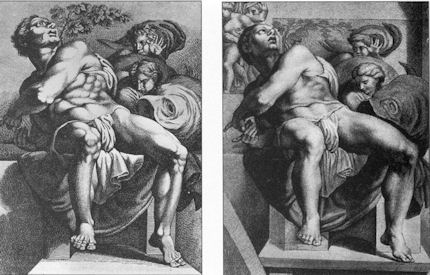
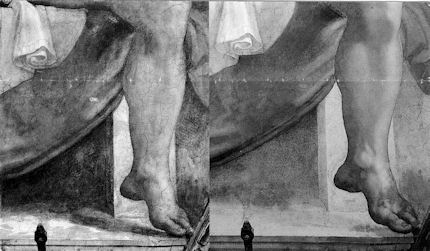
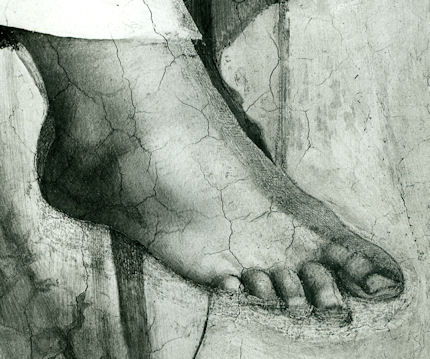


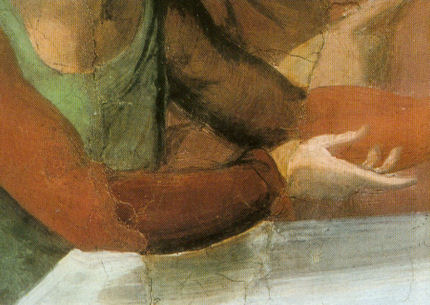

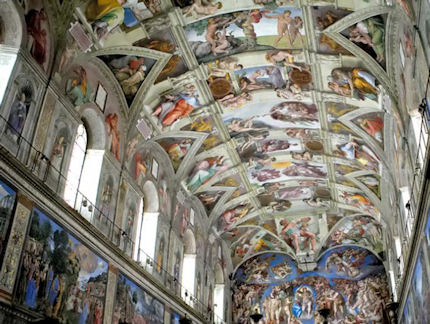


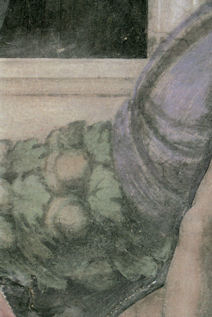
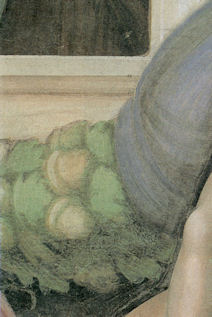

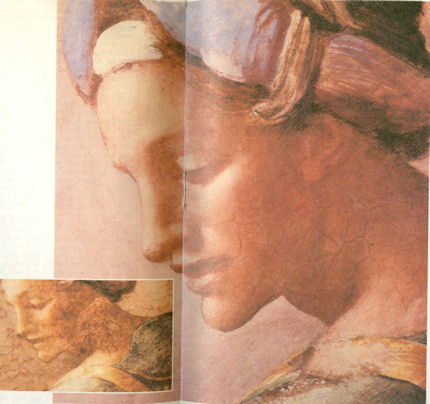


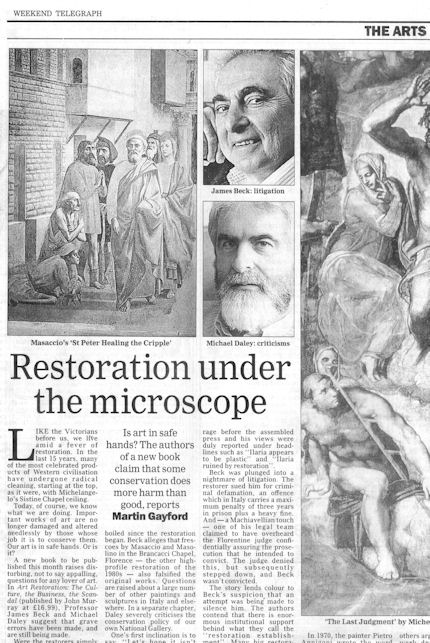


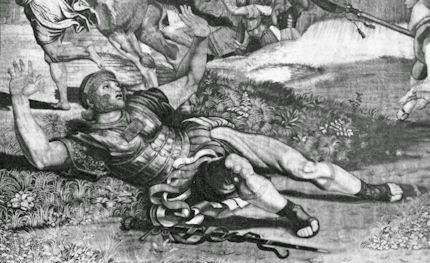

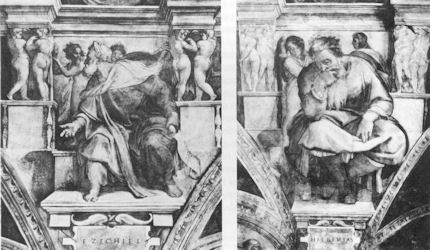


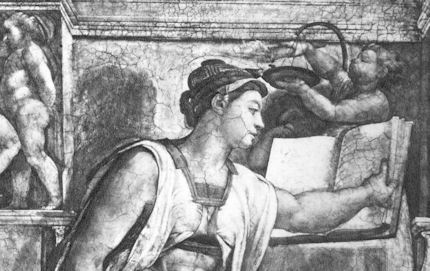


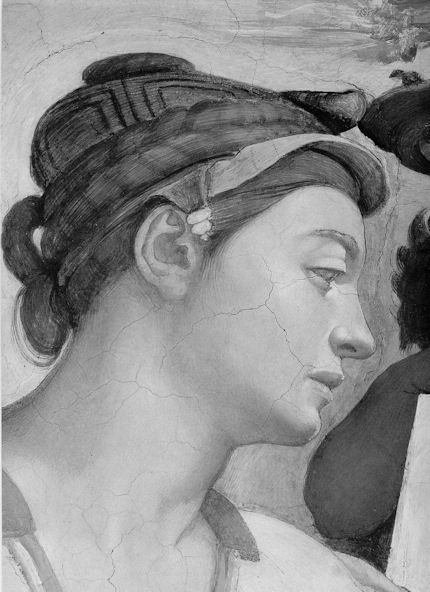


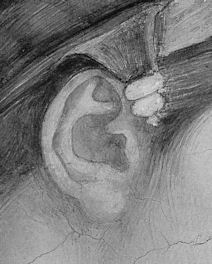
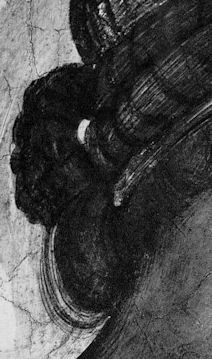




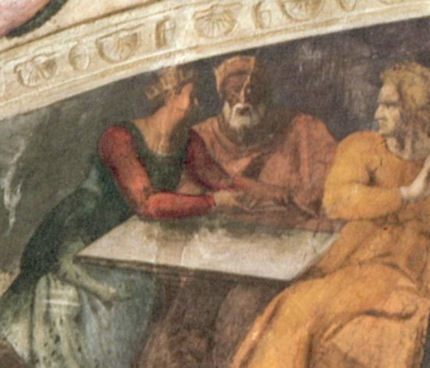
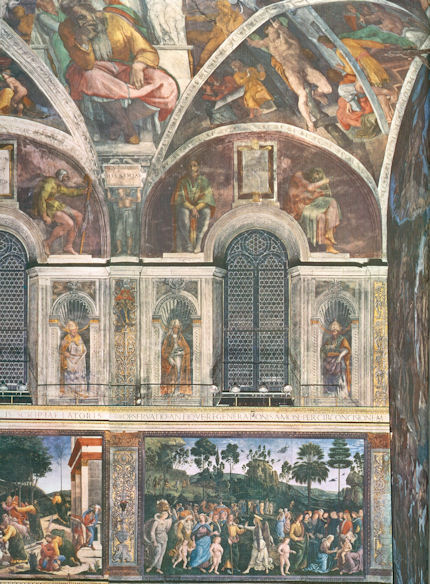
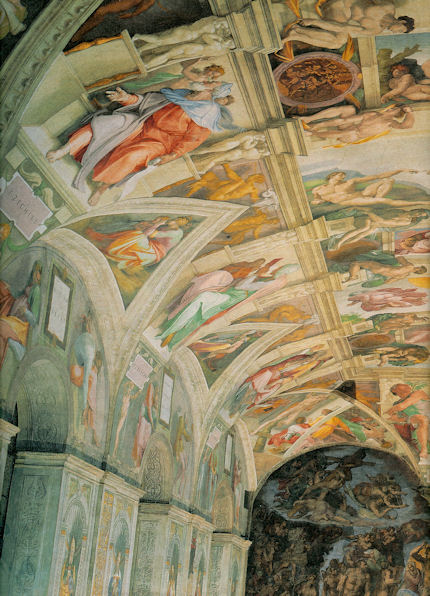
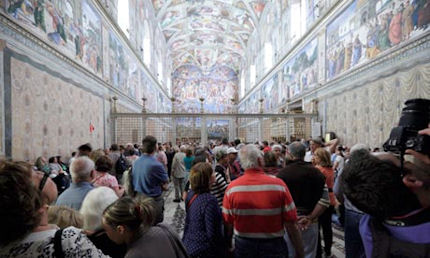


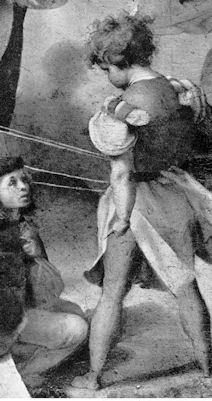

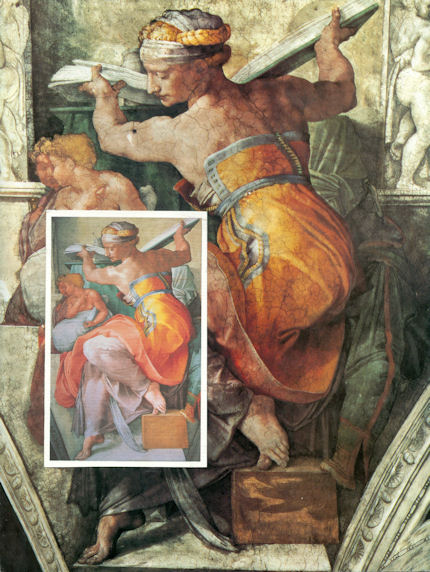
The Sistine Chapel Restorations: Part I ~ Setting the Scene, Packing Them In
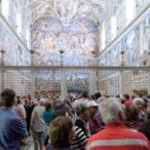
The Vatican authorities are in conservation crisis today because they stripped the Sistine Chapel frescoes bare in the 1980s and 1990s. They did so against material and historical evidence that Michelangelo had finished off his frescoes with additional glue or size-based a secco painting (see right and our posts of 1 April 2011 and 12 November 2012). That original, autograph material was removed in full knowledge that the stripped-down bare fresco surfaces would thereafter be attacked by atmospheric pollution unless given some other protective covering (see Appendix below). An attempt to coat the frescoes with synthetic resin (Paraloid B72) was abandoned leaving some surfaces clogged and the rest unprotected. The authorities then promised to install hi-tech paraphernalia that would somehow prevent the polluting atmosphere from making contact with the Chapel’s painted walls and ceiling (see caption at Fig. 4). As was shown in our previous post, that cockamamie promise was not delivered. Today, in a chapel increasingly over-crowded with paying visitors (see Fig. 1), these stripped-down frescoes stand in greater peril than ever.
Ironically, the “cleaning” of the ceiling, which arguably constitutes the greatest single restoration calamity of the 20th century, occurred at a time when picture restorers had skilfully rebranded themselves as safe, scientifically validated “conservators” of all that is valuable – even though Kenneth Clark had recently admitted to having founded the National Gallery’s science department in the late 1930s in order to dupe the public and wrong-foot restoration critics. A grandly titled “Laboratory for Scientific Research” had been created at the Vatican in 1922 on the “latest ideas” but during the 1980s Italian restorers admitted that running technical “tests” before restorations was professional “window-dressing” because it was always known in advance which materials were to be used.
Some restorers sincerely believed in the scientific hocus pocus that supposedly had trumped anachronistic and unacceptably “subjective” aesthetic responses. The appointed chief restorer of Michelangelo’s frescoes, Gianluigi Colalucci, was one such, insisting that: “Emotional and subjective considerations must not be permitted to intrude upon science”. At that time the Vatican’s curatorial and administrative authorities may not have sufficiently appreciated the extent to which every restoration of a great work of art is an accident waiting to happen: a collision of sublimity and incomprehension made tangible. In 1993, at the beginning of the fourth chapter of the JamesBeck/Michael Daley book “Art Restoration: The Culture, the Business and the Scandal”, we asked:
“If authentic painting by Michelangelo has been lost in the course of a scientific restoration, many questions need to be answered. Did a blunder occur because of or in spite of the use of a scientific approach? Has too great a dependence on scientific data undermined crucial powers of aesthetic discernment and judgement? Is the scientific method of restorers rigorous or slipshod? Is the scientific status of modern conservation legitimate or bogus? Do restorers always follow their own ground rules?”
In the last twenty years it has become clearer that the claimed scientific underpinnings of picture restoration methods were spurious and that an appreciation of the workings of art and its internal relationships is not to be gained through some analysis of material components in a laboratory, however highfalutin and expensive the “investigative” or “diagnostic” apparatus may be. Beyond its conceptually simplistic and aesthetically impoverished terms of reference, the very reporting of “scientific” conservation methods has lacked both critical rigour and methodological consistency. In practice conservation science has provided a flag of convenience under which fundamental artistic questions can be evaded while ever-more ambitiously grandiose, lavishly funded and spectacularly transforming projects are launched. The authorities at the Vatican seemed quite oblivious of the ease with which even the most modest restorations can escalate into dangerous and irreversible treatments.
In 1964 Dr Deoclecio Redig de Campos, the Vatican museums’ curator and director of restorations, launched a cautious cleaning of the 15th century frescoes by Perugino, Botticelli, Ghirlandio, Rosselli and Signoreli on the lower parts of the Sistine Chapel’s north and south walls. After 15 years, that programme led to the cleaning of two minor 16th century frescoes by Matteo da Lecce and van den Broecke on the east wall. By that date, direction had passed to Dr Fabrizio Mancinelli, the new curator (and soon to be, with Colalucci, the co-director of the Nippon Television Corporation-sponsored restoration of all of Michelangelo’s Sistine Chapel frescoes). As we reported in “Art Restoration”, Mancinelli decided that “Redig de Campos’s cautious policy of removing only part of the layer of grime and foreign substances…was not appropriate in this situation.”
What Mancinelli deemed appropriate was that the minor frescoes should be cleaned with the new aggressive cleaning compound AB 57, even though this would obliterate original painting applied a secco by the artists onto their frescoes when dry. Curiously, Mancinelli’s justification for this removal of authentic and historical material was primarily aesthetic. That is, he held that a cautious cleaning and repairing of the damaged original secco paints would give only “disappointing results” compared with what might be attained by what he termed “a more radical cleaning”. We should be absolutely clear: “radical” was a euphemism for stripping the paintings down to their bare fresco surfaces in order to introduce heightened (but inauthentic) colours. Although the programme was to prove unethical by restorers’ own professional codes, Mancinelli persuaded the authorities that the visual “gains” to be had by trading original material for chemically brightened colours on those two minor works would outweigh even a directly consequential need to “return to the side walls and [do] a more thorough job there too.” (Just as the slowest ship determines the speed of a convoy, so in decorated chapels the most brightly scrubbed surface sets the overall level of cleaning. Michelangelo’s fate was sealed.)
While restoring the east wall works in 1979, a single test of AB57 was made on one of Michelangelo’s lunettes (see Fig. 8 and, for the consequences, Figs. 4-7). Professor Carlo Pietrangeli, the director of the Vatican Museums, said in 1982 “the results were so encouraging that it was decided to take on the whole ceiling. By the summer of 1980 the work had begun.” As Pietrangeli told Patricia Corbett in the May 1982 Connoisseur, once AB57 was shown to deliver chromatically transformed frescoes, “No one was able to resist the temptation”. In 1987 Dr Walter Persegati, the Vatican Museums secretary and treasurer, said in the Bible Review “These tests brought forward such colours that we were both scared and excited…It was decided that the procedure developed for the cleaning of the van den Broeck and Matteo da Lecce was applicable to Michelangelo’s frescoes. Therefore, we decided we had to do it.”
Note that because it had been decided that it could be done, it was “therefore” also decided that it should be done. In Part II we investigate the means, the methods and the artistic consequences of that novel application of a new cleaning agent to the very old, very precious decorated surfaces of the Sistine Chapel. In doing so we also show why the Vatican’s curators were right to be scared.
Michael Daley
APPENDIX
“A major purpose of the conference was to underline a basic truth: the conservation of any work of art is doomed to failure unless equal emphasis is given to its past and its future vicissitudes…Scientists and historians worry that conservators can be too ready to intervene, too impatient of prior tests, and insufficiently heedful of future dangers.” ~ Kathleen Weil Garris Brandt, Professor of Fine Arts, at New York University’s Institute of Fine Arts, and spokeswoman for the Vatican on the restoration of Michelangelo’s Sistine Chapel frescoes, reporting the proceedings of the “London symposium on the conservation of wall-paintings” in the November 1987 Burlington Magazine.
“There is therefore much concern about the future of the frescoes, given that no protective layer has been applied in this campaign (the controversial use of paraloid was abandoned at an early stage of the cleaning of the lunettes). The Vatican has decided to seal the windows and introduce an air-conditioning and filtration system. Doubts were expressed at the conference. Could the threat from faulty air-conditioning be worse than the threat from atmospheric pollution and mass tourism? ” ~ Caroline Elam, editor of the Burlington Magazine, reviewing the 1990 symposium on the Sistine ceiling restoration held in Rome to give preliminary consideration to the cleaning of Michelangelo’s “Last Judgement”.
“A ‘drunken herd’ of ‘unruly’ tourists is damaging Michelangelo’s famous Sistine Chapel paintings, one of Italy’s leading arts figures claimed as the pope prepared to mark the 500th anniversary of the iconic frescoes’ creation. Some 5 million people visit the chapel every year – sometimes as many as 20,000 in a single day — and an increasing number of experts are now arguing that mass tourism is damaging the paintings. Despite a major, 14-year-long restoration project in the 1990s, they claim that the breath, sweat, dust and pollution brought in by visitors dramatically changes the Chapel’s humidity and temperature – factors to which frescoes are particularly sensitive…” ~ Claudio Lavanga, NBC News, 31 October 2012.
Comments may be left at: artwatch.uk@gmail.com
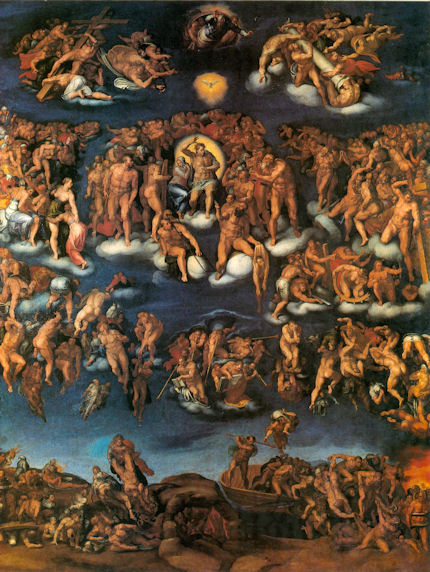
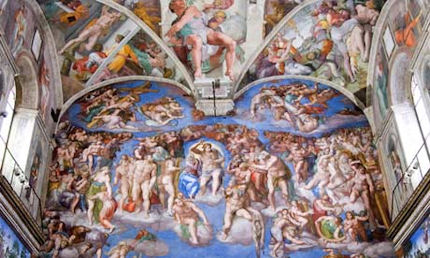


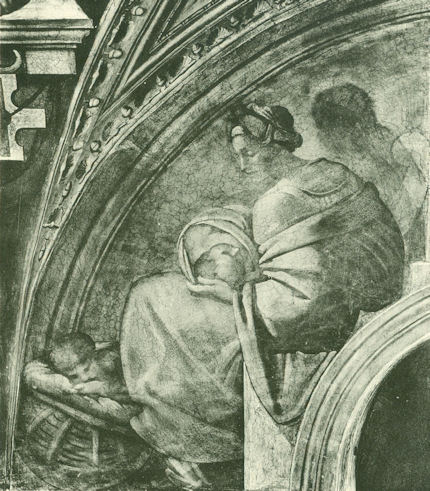

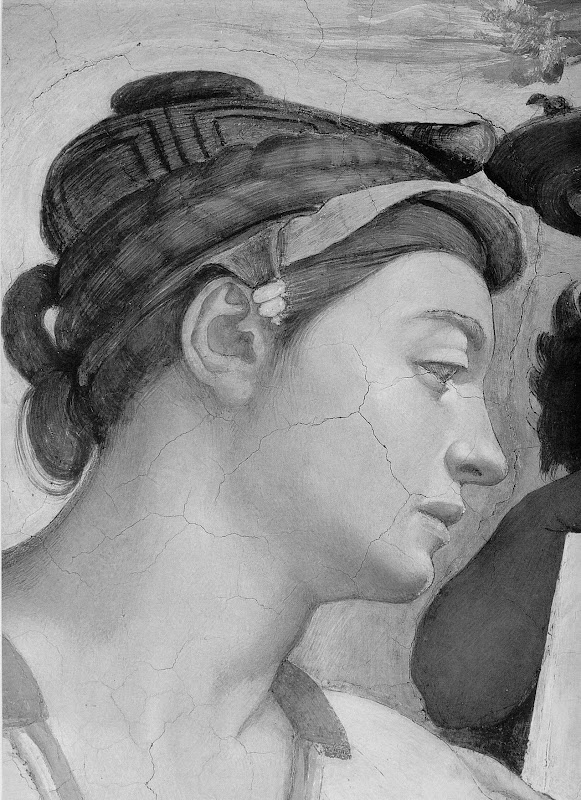
Could the Louvre’s “Virgin and St. Anne” provide the proof that the (London) National Gallery’s “Virgin of the Rocks” is not by Leonardo da Vinci?
When the National Gallery’s restored “Virgin of the Rocks” was pronounced an entirely autograph Leonardo we were left reeling with incredulity. Picture restorers rarely decline opportunities to claim “discoveries” but could they really be claiming an ability to make a picture an autograph Leonardo simply by thinning its varnish? During the media frenzy of the National Gallery’s £1.5bn Leonardo blockbuster, its chief restorer, Larry Keith, was asked if a distinctive Leonardo brushstroke had emerged. “No”, he said, proof of authenticity lay in the picture’s internal relationships. Given that those relationships differ markedly from the ones present in the Louvre’s unquestionably autograph “Virgin of the Rocks”, what accounted for the discrepancies? The then curator, Luke Syson, replied that Leonardo’s style had, in the London copy, become abstracted, less naturalistic and more “metaphysical”. This seemed fanciful: had not all of Leonardo’s pictures carried a beguiling air of the metaphysical – and had this quality not derived from the artist’s preternaturally intense engagement with natural phenomena and the mysterious powers which operate through them? Had a new corroborating body of drawn studies emerged? The Gallery admits that not only is there no identifiable Leonardo brushwork but that the picture itself is “manifestly uneven in finish and execution” and that there has been “a good deal of agreement that Leonardo himself painted little or none of it”. When we asked if any securely autograph Leonardo paintings shared these newly claimed characteristics, Syson said that they were also found in the “Last Supper”, when only 20% of that large, fragmented, degraded, many-times restored, de-restored and re-restored mural survives – and when its recent restorers “discovered” that it had originally been choc-full of tiny naturalistic details (curtain hooks, slices of lemon, reflections on glassware, tablecloth patterns and so forth). Above all, the National Gallery’s latest upgrade flew in the face of – and seemingly sought to circumnavigate – a landmark 1996 article by a geologist (and now art historian), Ann Pizzorusso, who has shown that while the rock configurations in the Louvre version were entirely consistent with precise formations found in nature and in Leonardo’s own studies, those seen in the London version were found in neither. (See Pizzorusso, “Leonardo’s Geology: The Authenticity of the Virgin of the Rocks”, The MIT Press, Vol. 29, No. 3, and “Leonardo’s Geology: The Authenticity of the Virgin of the Rocks”, in Leonardo Magazine, Vol. 29. No. 3, 1996, pp. 197-200.) Here, Pizzorusso presents further elegant demonstrations of the London picture’s non-autograph status that are manifest in the (recently restored) late Leonardo masterpiece, “The Virgin and Child with St Anne”.
Ann Pizzorusso writes:
London’s National Gallery recently announced that its version of the “Virgin of the Rocks”, previously attributed to various artists who worked in Milan, was now, after being cleaned, solely the work of Leonardo da Vinci. The National Gallery supports its claims by stating that the work represents a change in style and that the geology in the picture is rendered in a more abstract, monumental style (see Appendix A).
While art historians have long discounted the National Gallery’s version as one by Leonardo, the Gallery has now discounted centuries of scholarship with their new interpretation and subsequent attribution of the painting to Leonardo. What is most ironic and troubling about the National Gallery’s position is that there are reams of contractual documents which still exist today documenting a 25 years long lawsuit concerning the two versions of the painting and which show, unequivocally, that Leonardo did not paint the version in the National Gallery. Prof. Charles Hope, a former director of the Warburg Institute, London, and an expert in notarial Latin states that there is no doubt that Leonardo painted the first version and not the second (New York Review, 9 February 2012).
While we may be able to forgive the National Gallery for not being up on notarial Latin, there is no excuse for their proposal that Leonardo changed his style. In the decades in which I have studied Leonardo from all aspects (we must remember, Leonardo did not consider himself primarily a painter) one thing stands out in all his works—a fidelity to nature and a lifelong effort to depict natural objects as realistically as possible.
The father of Leonardo studies, Carlo Pedretti, in his book analyzing Leonardo’s nature drawings, “Leonardo da Vinci Nature Studies from the Royal Library at Windsor Castle” (with a forward written by Kenneth Clark, a former director of the National Gallery in London), devotes the entire volume to discussing Leonardo’s preoccupation with natural objects and his fanaticism in attempting to depict them as realistically as possible. This passion was imparted to his students, Francesco Melzi, Cesare da Sesto, Giovanni Boltraffio and Marco d’Oggiono. So much so that a drawing of a Tree (RL 12417), long thought to be by Leonardo, was later attributed to Cesare da Sesto and a view of Amboise (RL 12727) to Francesco Melzi. In analyzing the works of Leonardo’s students one can see that they have followed Leonardo’s technique and depicted natural objects as realistically as possible. They had obviously heard quite a bit of ranting by Leonardo about “Botticelli’s bad landscapes” (see Appendix B).
Another reason why Leonardo’s approach is reflected in his art is that he was born in the transitional era of the late Middle Ages, an age still filled with superstition and fear, especially about such things as mountains, natural catastrophes and death. He grew up leading the way into the Renaissance, faced all these fears, and debunked them. He travelled extensively in the Alps outside of Milan taking note of nature and geology. He noted landslides and torrential flooding with its associated damage (see Figs. 3 & 4), he dissected corpses to provide the most accurate depiction of human anatomy we have ever had until relatively recent times. His work as engineer, geologist, botanist and astronomer cannot be disconnected from his work as an artist (see Figs. 8 & 9). To understand Leonardo, one must understand him completely. And to understand him completely is not difficult. He has written everything down. He was faithful to nature. If one applies just that one rule to Leonardo da Vinci, looking at his work from a scientific standpoint, the answer is crystal clear: fidelity to nature is a Leonardo trademark that can be used to determine the authenticity of his work.
Now that we have seen that the National Gallery has preferred not to acknowledge the work of many esteemed Leonardo scholars, maybe looking at the recently cleaned “Virgin and Child with St. Anne” in the Louvre will change its mind (see Figs. 1, 7, 10, 11, 14, 17, & 21). The “Virgin and Child with St. Anne”, dated to about 1510, came later than the National Gallery version of the “Virgin of the Rocks”. We do not know how much later, as the National Gallery has now dated the initiation of its version of the “Virgin of the Rocks” as 1491/2-9 and its completion to 1506-08. Professor Hope, in his review of the notarial documents regarding the lawsuit states that the National Gallery version of the “Virgin of the Rocks” could not have been painted before 1508.
If we use the 17 year time period (1491-1508) which the National Gallery cites for its “Virgin of the Rocks”, it would mean Leonardo was painting the “Last Supper” (1492-7/8), completing the Burlington Cartoon (1499-1500 or 1506-08) and the “Virgin of the Rocks” at the same time. On page 96 of Kenneth Clark’s book entitled “Leonardo da Vinci” he indicates that Leonardo was exceptionally busy. Apart from the first “Virgin of the Rocks” his time was taken up with work for the court. He was the court limner and also painted two portraits of the Duke’s mistresses Cecilia Gallerani and Lucrezia Crivelli. With these portraits, we would be up to five major works in progress by Leonardo if we include the National Gallery’s “Virgin of the Rocks”.
This being said, all of these works being done at nearly the same time gives us the perfect opportunity to appraise, determine and evaluate the stylistic traits of the artist at that period of his career. In looking at the Burlington Cartoon and the “Virgin and St. Anne”, both are rich with geologic detail and accuracy. Leonardo has risen to new heights in his portrayal of landscape elements. His talent and passion are vividly displayed in the Burlington Cartoon and he reaches a level of sophistication, subtlety and accuracy in rendering the geology in the “Virgin and St. Anne” which had never been seen before (see Appendix C).
The St. Anne is a geologic tour-de-force. In fact, Leonardo experimented extensively on developing paints and a technique for depicting the pebbles of agate, chalcedony and marble at the feet of the Virgin and St. Anne (see in particular, Figs. 1 & 21). Leonardo writes in his notebooks about his efforts and how satisfied he was to have developed an approach to rendering the pebbles in such a realistic fashion. In fact the entire painting is one geologic treat after another. He had spent years in the Alps so he knew the landscape and geology exactly. With his newly developed technique for painting marbleized pebbles he was delighted (- see Appendix D).
Using a date of 1510 for the “Virgin and St. Anne” and a date of 1483-86 for the “Virgin of the Rocks”, both in the Louvre, we have proof that Leonardo did not change his style, and that, if anything, he became more fanatical in his quest for geologic accuracy, developing new paints and techniques for natural depiction and driving his students to deliver the most accurate depiction of nature in their own works.
So we must ask the question “How and why could Leonardo have changed his style to produce a work so lacking in geological and botanical accuracy as the ‘Virgin of the Rocks’ in the National Gallery in London?” There is no evidence Leonardo changed his style and now, with the recently cleaned “Virgin and St. Anne”, we have that proof. We also know that his students were inculcated with his passion for accurate depiction of natural objects so we must also exclude his students as authors of the National Gallery work.
It would be best for the National Gallery to reopen the case for the attribution of the work to Leonardo. Hundreds of years of scholarship by Leonardo critics as well as the words and the works by Leonardo himself should not be discounted. The National Gallery does a disservice to those who have worked so hard to come up with incontrovertible evidence regarding the attribution of this work and most of all the National Gallery does a disservice to Leonardo himself.
Ann Pizzorusso
Appendix A
The National Gallery’s claimed shift within Leonardo’s oeuvre
“We know that Leonardo’s painting technique gave priority to the figures. The Virgin is designed first, as she is in so many of his drawings, and the landscape seems to flow from her. Since Leonardo saw the painter’s acts of creation as analogous to God’s, his generation of the landscape in the Virgin of the Rocks and the absolute, unalterable perfection of the Madonna at the center could be understood as precisely connected with the doctrine of the Immaculate Conception. But the appearance of the Virgin and her companions, and of the plants and rocks, are different, in the two versions: the theological meaning of his stylistic choices has shifted slightly. In the Louvre picture Leonardo relies on entirely naturalistic tactics to give the picture its spiritual flavor: the sinless beauty of the Virgin becomes the same kind of truth as the natural beauty of the irises nearby. But in the London Virgin of the Rocks, the Virgin and Christ are supernatural, the world around rendered notably less naturalistically, the rocks are straightened to become great columns; the flowers appear to be ideal composites of the leaves and petals of real plants. Tackling the theme for a second time, Leonardo chose to show the viewer not just a vision of the Virgin Mary, but Gods’ perfect ideas for everything around her. What we are shown here is an ideal world made before the physical creation of our own imperfect cosmos, before the need for humankind’s salvation.”
The National Gallery catalogue, “Leonardo da Vinci, Painter at the Court of Milan”, page 174.
Appendix B
Leonardo on Botticelli’s bad landscapes
“He is not universal who does not love equally all the elements in painting, as when one who does not like landscapes holds them to be a subject for cursory and straightforward investigation-just as our Botticelli said such study was of no use because by merely throwing a sponge soaked in a variety of colours at a wall there would be left on the wall a stain in which could be seen a beautiful landscape.”
Leonardo da Vinci, from: “Treatise on Painting”, the chapter on Criteria and Judgments, the subsection “How a painter is not worthy of praise unless he is universal”.
Appendix C
Walter Pater
“Saint Anne–that delicate place, where the wind passes like the hand of some fine etcher over the surface, and the untorn shells are lying thick upon the sand, and the tops of the rocks, to which the waves never rise, are green with grass, grown fine as hair. It is the landscape, not of dreams or of fancy, but of places far withdrawn, and hours selected from a thousand with a miracle of finesse. Through Leonardo’s strange veil of sight things reach him so; in no ordinary night or day, but as in faint light of eclipse, or in some brief interval of falling rain at daybreak, or through deep water.”
Walter Horatio Pater, “The Renaissance, Studies in Art and Poetry”, The Echo Library 2006, page 54.
Appendix D
Carlo Pedretti
“The movement of the fifteenth century was twofold; partly the Renaissance, partly also the coming of what is called the ‘modern spirit’, with its realism, its appeal to experience. It comprehended a return to antiquity, and a return to nature. Raphael represents the return to antiquity, and Leonardo the return to nature. In this return to nature, he was seeking to satisfy a boundless curiosity by her perpetual surprises, a microscopic sense of finish by her finesse, or delicacy of operation, that subtilitas naturae which Bacon notices. So we find him often in intimate relations with men of science – with Fra Luca Paccioli the mathematician, and the anatomist Marc Antonio della Torre. His observations and experiments fill thirteen volumes of manuscript; and those who can judge describe him as anticipating long before, by rapid intuition, the later ideas of science. He explained the obscure light of the un-illuminated part of the moon, knew that the sea had once covered the mountains which contain shells, and of the gathering of the equatorial waters above the polar.
“Notebooks and sheets of about 1508 contain a number of notes on ‘mistioni’ (mixtures), a plastic material of his own invention with which he aimed at imitating the colour and design of semi-precious stones. He describes his production process and how, once the objects were thus produced, he spent much time finishing them with his own hand to a smooth and glossy surface…At the same time he was much taken by anatomical studies, so that when he described the production process of his ‘mistioni’ he came to specify the effect that was to be achieved: ‘…then you will dress it with peels of various colours, which will look like the mesentery of an animal’.
“In 1502, Francesco Malatesta wrote Isabella d’Este that Leonardo had looked at many of the Medici gems and objets d’art made of stone. Leonardo praised ‘the one of amythyst or jasper as Leonardo baptized it, because of the admirable variety of its colours’”.
Carlo Pedretti, Leonardo, A study in Chronology and Style, London, 1974, pages 132-137.
Ann Pizzorusso
For an in-depth comparison of the two versions of the Virgin of the Rocks see:
Comments may be left at: artwatch.uk@gmail.com


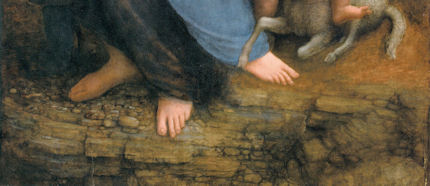


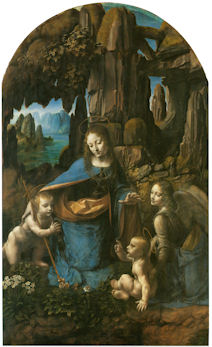


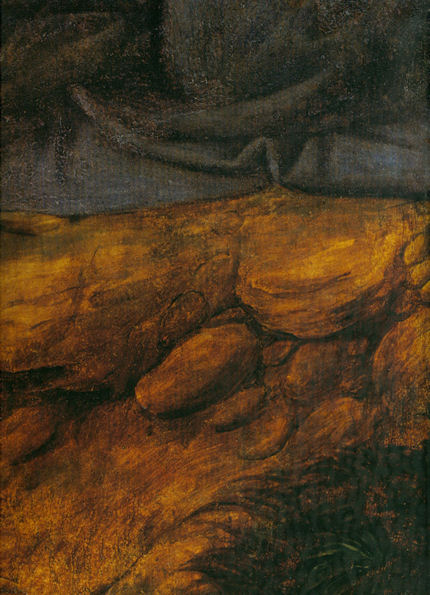


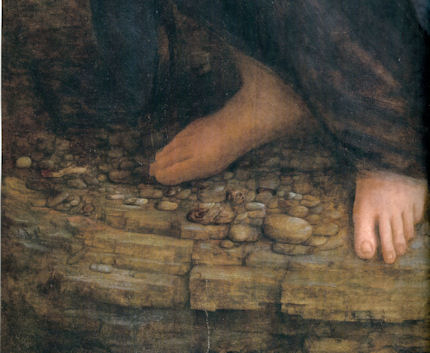
Rocking the Louvre: the Bergeon Langle Disclosures on a Leonardo da Vinci restoration

ArtWatch has been haunted for two decades by a nearly-but-not-made restoration disclosure. In the 1993 Beck/Daley account of the Nippon TV sponsored Sistine Chapel restoration (Art Restoration: The Culture, the Business and the Scandal), we reported that in the late 1980s Leonetto Tintori, the restorer of Masaccio’s “Trinity” in the Santa Maria Novella, Florence, and a member of the international committee that investigated the controversial cleaning, had “urged the Sistine team privately to preserve what he termed ‘Michelangelo’s auxiliary techniques’ which in his view included oil painting as well as glue-based secco” (p. 111). What we had not been able to say was that Tintori (who died in 2000, aged 92) had prepared a dissenting minority report expressly opposing the radical and experimental cleaning method.
Shortly before the press conference called to announce the committee’s findings, Tintori was persuaded by a (now-deceased) member of the Vatican not to go public with his views. He was assured that his judgement had been accepted and that what remained on the Sistine Chapel ceiling of Michelangelo’s finishing auxiliary secco painting would be protected during the cleaning. With a catastrophically embarrassing professional schism averted, the restoration continued and the rest of what Tintori judged to be Michelangelo’s own auxiliary and finishing stages of painting was eliminated. Without knowledge of Tintori’s highly expert dissenting professional testimony, the public was assured that despite intense and widespread opposition the cleaning had received unanimous expert endorsement. Critics of the restoration were left prey to disparagement and even vilification.
On January 4th, we noted that in the widely reported schism that emerged at the Louvre with the resignations of Ségolène Bergeon Langle, the former director of conservation for the Louvre and France’s national museums, and, and Jean-Pierre Cuzin, the former director of paintings at the Louvre, from the Louvre’s international advisory committee on the restoration of Leonardo’s “Virgin and Child with St. Anne”, it had been recognised that the resulting crisis of confidence was of a magnitude not seen since the Sistine Chapel controversy. Restoration advisory committees are not imposed on museums and customarily they serve as political/professional fig leaves. In the wake of the Louvre committee resignations, embarrassed and perhaps panicky members of the museum’s staff offered self-contradictory and unfounded assurances (see below). In January, the Louvre’s head of painting, Vincent Pomarède reportedly claimed that “The recent cleaning was absolutely necessary for both conservation and aesthetical reasons.” This assurance proved unfounded on both grounds. Pomarède added that no member of the committee “has ever said that the cleaning was not prudent and had gone too far technically.” One has now done so – publicly – and left museum restorations under an unprecedented spotlight.
During an earlier cleaning controversy at the Louvre, Edgar Degas threatened to produce an anti-restoration pamphlet that would be what he termed a “bomb” – but he never did so, so far as we know. Now, as Dalya Alberge reports in the Guardian, the French Le Journal des Arts yesterday published an interview with Ségolène Bergeon Langle of truly momentous if not incendiary consequence (see below). We learn that her resignation came after no fewer than twelve letters requesting information on the restoration’s course went unanswered; that it was made in specific and pointed protest against the use of retouching pigments whose safety had not been proven; and, that the Louvre’s public claims of some pressing conservation need to remove the varnish were false, having been made despite it being known within the museum that any potential threat to the paint came not from the varnish but from a single faulty board in the picture’s panel which was reacting to the museum’s insufficiently stable environmental conditions. Perhaps most disturbingly serious for art lovers are Bergeon Langle’s disclosures that along with old (but nonetheless still protective) varnishes, original material of Leonardo’s was removed – against her advice – from the painting; and, aesthetically, that it is confirmed that the modelling of the Virgin’s face was weakened (see Figs. 1 and 2; and, for weakening to the modelling of St. Anne’s face, Figs. 12 and 13).
That the Louvre authorities would not inform even so distinguished a member of its own advisory committee might suggest either that the restorers had not known in advance what they would be doing to the painting; or, they feared that disclosure of their intentions would provoke opposition within the advisory committee. Either way, this was clearly an unacceptable (if not improper) way for a museum to execute irreversible alterations to one of Leonardo’s most advanced sophisticated, complex and problematic works. To Bergeon Langle’s now public “insider” criticisms, additional detailed material to highlight further Louvre procedural shortcomings and misrepresentations to the press and to the public will shortly be presented by Michel Favre-Felix, the president of the Association Internationale pour le Respect de l’Intégrité du Patrimoine Artistique (ARIPA). Favre-Felix is also to call formally for the establishment of a national scientific ethics committee that would be independent of museums and their restoration teams and be charged with re-examining the conservation file on the challenged St. Anne restoration.
A second member of Louvre’s advisory committee, Jacques Franck, the world authority on Leonardo’s painting technique, has said to the Guardian that a restoration likely to generate such disapproval from leading figures should never have been undertaken in the first place and, given that Ségolène Bergeon Langle is unquestionably France’s highest authority on restoration matters, her alarmed protest is therefore one that should mean a lot to both Leonardo scholars and art lovers the world over.
Unfortunately, the restoration-induced changes on the St Anne are not unprecedented. It is Art’s general tragedy that while scholars have quietly enlarged the oeuvre of Leonardo over the last century and a half, restorers have repeatedly swabbed and scritched away at the surviving fabric of those precious works – sometimes to an astounding degree, as with the “Last Supper” in Milan. With the National Gallery’s substitute version of the “Virgin of the Rocks” we have seen how the distinctive Leonardesque expression on the angel’s mouth was altered (without any acknowledgement) despite the fact that a distinguished scholar and former director of the Gallery, Kenneth Clark, had seen the angel’s face as being “the one part of our Virgin of the Rocks where the evidence of Leonardo’s hand seems undeniable, not only in the full, simple modelling, but in the drawing of the hair”. It is a matter of note that four of the most enthusiastically supportive members of the Louvre advisory committee were drawn from the curators and restorers who were directly responsible for the London and Milan Leonardo restorations.
Of Leonardo’s accepted earlier paintings, in 1939 Kenneth Clark lavished especial praise on the treatment of modelling found on two portrait heads – and in his enthusiasm, he awarded the palm of best preservation to both of them. The “Ginevra Benci”, then in the Liechtenstein Collection but now in the National Gallery of Art, Washington, was judged “the best preserved of all Leonardo’s early pictures”; one that “shows most clearly his intentions at this period”; and, one where “within the light oval of the face there is very little shadow, and the modelling is suggested by delicate gradations of tone, especially in the reflected lights.” Clark thrilled to the great refinement of execution: “We see a similar treatment of form in Desiderio’s low reliefs, controlled by the same sensibility to minute variations of surface. There are passages, such as the modelling of the eyelids, which Leonardo never surpassed in delicacy, and here for once he seems to have had none of that distaste for the medium which we can deduce from his later paintings, no less than from contemporary descriptions of his practice.” Ever aesthetically alert and deft, Clark saw all of these ultra-refined technical devices as being entirely “subordinate to the feeling of individual character with which Leonardo had been able to charge his portrait, so that this pale young woman has become one of the most memorable personalities of the Renaissance.” (We are grateful to Carroll Janis for drawing attention to this passage.)
Clark’s alertness to the physical/aesthetic characteristics of Leonardo’s hand was to the fore in his reflections on the “Portrait of a Musician” at the Ambrosiana in Milan. In the “subtle luminous modelling” of its head and its “delicate observation of light as it passes across the convex forms”, this work could only be “by Leonardo’s own hand alone and unaided” and it was “very similar to that of the angel in the Virgin of the Rocks”. As it stood before 1939, this too was “perhaps the best preserved of Leonardo’s paintings”, and in it we were then able to “learn something of his actual use of pigment, elsewhere obscured by dirty varnish, and we see that it was less smooth and ‘licked’ than that of his followers.”
Ironically, Clark, with his pathological aversion to “dirty” varnish (which is to say, old varnish on an old painting on an old support), was more responsible than anyone for the subsequent museum restoration/stripping mania. Looking around today’s museums, it is hard not to conclude that Clark might have been more careful in his wishes. Bergeon Langle’s warning against the modern addiction to penetrative imaging systems is particularly apt and timely: the hyper-active restoration changes (see right) made to the modelling and to the expression of those precious living Renaissance faces have cumulatively thinned and abraded pictures surfaces and material components and thereby remorselessly pushed great paintings into sad resemblances of their own infra-red under-states (see particularly, Figs. 4-11 and 19 & 20). Technical curiosity kills more than cats. In the case of Leonardo it has contrived to pull that artist back from his own increasingly lush highly-wrought subtly atmospheric shading towards the brilliant but thinner decorous linearity of Botticelli, when any comparison of the “Mona Lisa’s” hands with those of Leonardo’s “Annunciation” would have warned precisely against such perverse and regressive adulterations.
The interview given to Le Journal des Arts of 27 April, by Ségolène Bergeon Langle read as follows:
Why resign from the Louvre’s scientific advisory committee for the St Anne? “In January 2011 the committee had agreed on a gentle cleaning of late varnishes and the removal of the stains on the Virgin’s cloak. Yet, between July and October 2011 a more pronounced cleaning was done and presented as ‘necessary’, which I objected to. I was then faced with people who would oppose my position, which is technical and not based on aesthetics. My 12 letters [to the Louvre] asking for precisions on some aspects of the cleaning process and on the materials to be used for retouching, remained unanswered. I had to resign (on December 20th, 2011) to be heard just on one specific point: the Gamblin retouching pigments were not to be used since their innocuousness is not proven. Right from the beginning, false ideas have been put forth, like calling ‘repaints’ original retouches by Leonardo in the work’s early stages, or to attribute flaking in the paint layer to the ‘contracting varnish’, a [consequence that was] actually due to the sawing up of the wood [panel]…”
What do you think of the work done? “In my opinion, the precautionary principle hasn’t been respected. We must face the fact that the Virgin’s face is less modelled now. The cleaning should never have gone so far. However, I was happy that the grove [of trees] be preserved and, also, the ground’s material constituents that some ‘felt’ not original (though between January and April 2011 a brown-greenish section of the ground, located below St Anne’s elbow had been removed already). Besides, another matter of much controversy, the whitened layer on Christ Child’s body, has mistakenly been understood as a late varnish [that has] gone mouldy. I’m inclined to believe it was an irreversibly altered [original] glaze and, therefore, I have recommended that it be preserved, but nobody would hear me.”
The current Leonardo exhibition implies that his other paintings in the Louvre should be cleaned also. How do you feel about that? “Just not to do it, by all means! The original flesh paint in the St John-the-Baptist, being rich in oil, displays a significant network of drying cracks and might be fragile in the event of cleaning. For sure, scientific methods are essential but they need sound interpretation and wisdom dually… To date, there is too much boldness originating mistakes and an alarming fascination for infra-red investigation whereby are revealed under-layers that were never meant to be seen.”
Michael Daley
Comments may be left at: artwatch.uk@gmail.com
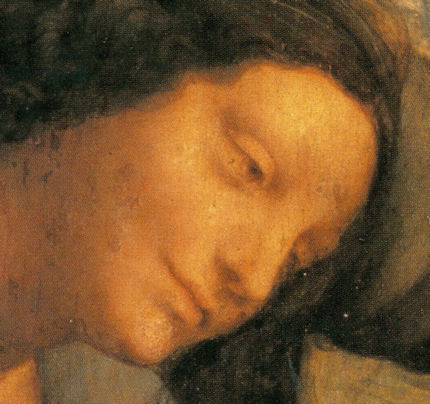


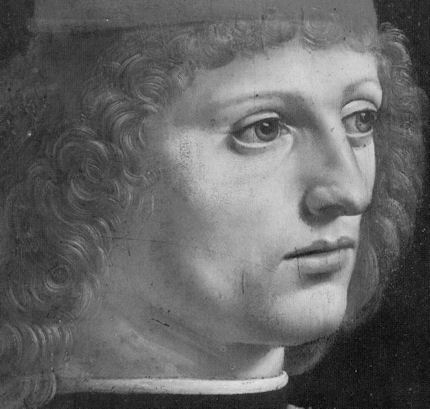


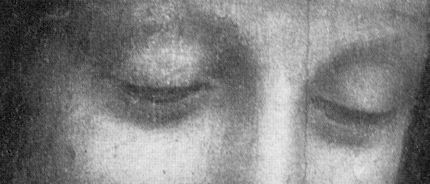

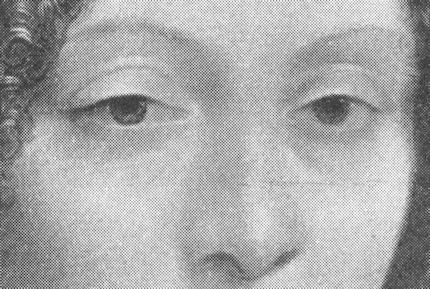





The Perpetual Restoration of Leonardo’s ‘Last Supper’ – Part 1: The Law of Diminishing Returns
The restoration of Leonardo’s “Last Supper” (1977 -1999) was defended last month at the National Gallery symposium on the artist’s methods and influence, by Pietro Marani, the Leonardo scholar who co-directed the restoration from 1993 onwards. When we pointed out that while the previous restoration had been praised for recovering all of Leonardo’s authentic paintwork, the last restoration had in fact introduced vast areas of new painting, Marani held that restorers and curators may impose their own generation’s values and interpretations. Appeals to the authority of one generation cuts little ice given how happy each proves to be to undo and redo its predecessor’s work – and, besides, given that on past form we are already half way along to the next generation’s “Last Supper” restoration, the one presently being defended is already approaching its own “sell-by date”.
In its early days, the last restoration was presented as a near miraculous liberation of the original and entirely unadulterated handiwork of Leonardo da Vinci, when that claim, far from being a novel one of its day, was, as mentioned, a re-run. In 1958, John Canaday, the art editor and art critic of the New York Times, reported how, following the war-time bombing of the refectory housing the mural in Milan:
“When the sandbags were removed…the ‘Last Supper’ was in such pitiful condition that historians were ready to list it as a war casualty. But since then the picture has been gone over as definitively as the combination of exhaustive scholarship and high technical skill make it possible to preserve once and for all whatever is discoverable of the original work. The results are better than anyone expected, although the painting still suggests a ghost at best or, at worst, an embalmed relic…”
Taking their cues from restorers, commentators often dismiss past treatments and celebrate more recent scientifically under-pinned “definitive”, “once and for all” and “miraculous” ones. (Just this week, a Rubens – his “Cain Slaying Abel” – that has been restored at the Courtauld Gallery with funding by the Bank of America, is said in a press release to have stabilized the painting for nothing less than “the next one hundred years”.) The “Last Supper” rescue operation took place in two stages in 1947-49 and 1952-54. In the first, the restorer Mauro Pelliccioli (see Fig. 1) supervised by a former Superintendent of Fine Arts in Milan, Fernanda Wittgens, anchored the disintegrating paint with shellac. As Wittgens’ wrote in the Christmas 1954 issue of Art News, “This was not ordinary shellac, of course, but an absolutely colourless one recently produced in England by a chemical process that removes all wax.” With this shellac, Wittgens went on, Pelliccioli performed his wonders:
“…it produced the greatest miracle of the entire restoration. The reattachment of the painted surface was achieved to perfection, and the colours acquired a new consistency as though they had been actually rejuvenated by the shellac that made them adhere to the wall…Mauro Pelliccioli, by doing away with all glues soluble in water, had permanently eliminated the danger of mould: he had at last hit upon a tremendously strong, transparent adhesive impervious to humidity.”
When the shellac was settled, Pelliccioli began scraping off the repaints of earlier restorers. Bernard Berenson visited the scaffold and later reported how, with no more than a penknife, a razor and a drop of turpentine, Pelliccioli had “touched bottom” by removing the “multiple restorations of centuries” and allowing the paint of Leonardo, “deteriorated by the centuries but no longer deturpated by incompetent hands” to be seen once more. In his diary note on October 21st 1953 Berenson said that Pellicciolli had known precisely “where to scrape” – a point echoed and amplified in H. H. Pars’ 1957 “Pictures in Peril”:
“Pelliccioli was able to distinguish those parts of the painting where nothing of the original painting was left, and those parts where overpainting and restoration concealed Leonardo’s own brilliant colours. Step by step these were revealed in the now firmly-fixed painting until we are now able to see Leonardo’s ‘Last Supper’ in better preservation than for many generations, deteriorated through the centuries it is true, but no longer marked and deformed by incompetent hands.”
Thus, to everyone’s satisfaction, the work had been physically rescued and what authentic Leonardo paintwork could be exposed to view had been liberated. Earlier restorers’ repainting was left in place only where it covered bare wall. Just twenty-one years later in 1975, Pinin Brambilla Barcilon, a former student of Pelliccioli’s, reported that fragments of paint were falling off the mural. Two years later, following tests, she began re-securing those parts of the paintwork that were becoming detached. Her minimal and straightforwardly necessary conservation measure was to mushroom, in parallel with the restorations of Michelangelo’s Sistine Chapel ceiling frescoes, which began in 1980, and Masaccio’s Brancacci Chapel frescoes, which began in 1981, into one the most protracted radically ambitious, corporately-funded and controversial restorations of modern times.
It can now be seen that 1977 marked the high water mark of confidence in the recuperative powers of restorers and in the legitimacy of their increasingly bold and experimental methods. In the previous decade, heroic actions in wake of the floods in Florence had carried restorers to unprecedentedly high levels of public respect (even when they opted to strip frescoes from walls). In Britain, following a spuriously engineered triumph with the restoration of Titian’s “Bacchus and Ariadne” at the National Gallery, criticism had been declared dead by the victors. The National Gallery launched its Technical Bulletin in 1977 and in it, the Gallery’s head of conservation science, Joyce Plesters, mused complacently: “one or two readers may recall the furore when the cleaning of discoloured varnishes from paintings…began to find critics”. In the same year, Kenneth (Lord) Clark published his two volumes memoir “Another Part of the Wood” and “The Other Half” in which he pronounced picture cleaning “a battle won” and claimed credit for having taken the first steps, as director of the National Gallery (1934-1945), by installing a “scientific department with all the latest apparatus”. He had done so not because he believed in the “application of science to the problems of cleaning”, but because “until quite recently the cleaning of pictures used to arouse extraordinary public indignation and it was therefore advisable to have in the background what purported to be scientific evidence to ‘prove’ that every precaution had been taken.”
Duping the public in such manner occurred in Italy. In 1981, a year after the start of the Sistine Chapel ceiling restoration in Rome, the restoration of the Brancacci Chapel commenced. Speaking of the prior tests made in connection with that restoration, the author Ken Shulman cites an Italian art historian (“Anatomy of a Restoration”, p. 156), who had said:
“Let’s be honest and admit what all restoration directors will say in private. At the beginning of any restoration, you order as many tests as you can imagine, fully aware that only about five per cent of them will be of any use during the restoration. The rest of the analyses are merely window dressing.”
With Leonardo’s “Last Supper”, amidst all the preliminary testing, no-one seemed concerned by the fly that was present in the ointment of Pelliccioli’s celebrated reductive, purist restoration: his liberation of Leonardo’s paintwork had come at a cost in terms of artistic legibility. A law of diminishing returns had been set in motion that would (as we will see in Part 2) produce panic and confusion among the restorers and their supervisors.
Michael Daley
Comments may be left at: artwatch.uk@gmail.com


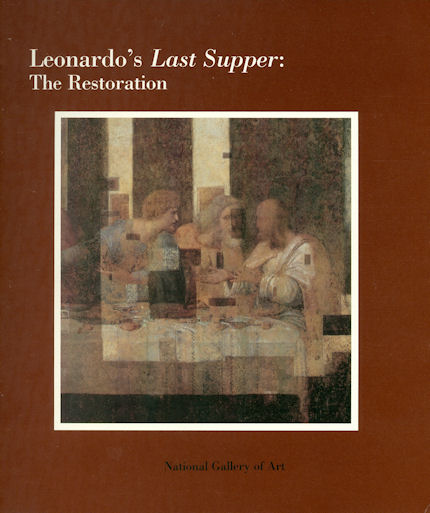

What Price a Smile? The Louvre Leonardo Mouths that are Now at Risk

There is an air of confusion, and even a whiff of crisis, in today’s international art restoration community. At the National Gallery’s CHARISMA symposium on Leonardo’s technical practices and influence (January 13-14), many fascinating and highly informative demonstrations were made of non-invasive imaging techniques. A ground-breaking paper by Ana González Mozo revealed how the Prado’s copy of the Mona Lisa had faithfully tracked Leonardo’s own revisions on the original work. Imagine – a copy not so much of the finished masterpiece but of its very genesis. The proceedings, happily, are to be published. Unfortunately, at this richly rewarding and even-handedly conducted event, two critically serious weaknesses emerged during the proceedings and discussions that seemed linked and together to constitute a wider international art conservation faultline.
That is, firstly, there are manifest deficiencies of understanding on the crucial relationship between the discoveries that are being made through advances of technical analysis, and the original painterly/artistic means by which the art-objects-under-investigation were produced by artists in the first place. This single shortcoming carries profound cultural and professional consequences and is, we believe, a root cause of many of the controversies which arise in the field. Secondly, and concerning these controversies, a number of speakers (particularly Italian speakers, as it happens) used their papers to dismiss critics of their (sometimes long-past) restorations. Such combative unrepentance suggests how hard the task remains to establish some proper and effective systems and habits of disinterested critical appraisal in what is becoming an alarmingly expanionist and self-authorising and validating field. Much might be gained if restorer/conservationists themselves would devote more energies to those fruitful knowledge-advancing studies that leave vulnerable and uniquely precious historical works of art intact and free from what too often seem injudicious or debilitating interventions.
For some speakers, “virtual” indications of changes within pictures, seemed to be taken in themselves as invitations to swabs-on interventions. Certainly it seemed tactless and provocative when, at a time of great disputation, a Louvre curator, Vincent Delieuvin, ended a talk on non-invasive examinations of the museum’s Leonardo “Virgin of the Rocks” with the bald declaration “Restoration of the painting is possible”. Possible? No doubt it is politically so today at the Louvre, but desirable even under the present controversial circumstances? And what exactly has made this hitherto untreatable picture (see caption at Figs. 2 and 3) treatable? Must every restored masterpiece immediately trigger another? Will curators and their restorers never allow decent intervals for the fumes to evaporate and for their handiwork to be evaluated with due attention and consideration after the inevitable PR media barrages that nowadays accompany all major restorations? For that matter, is no one in authority concerned by the general and wider risks that are being incurred in the current Leonardo binge in which the oeuvre itself is being speculatively “grown” even as its most secure works are being recast by today’s more adventurous generation of technicians?
Concerning the Louvre fracas, Didier Rykner, surprised and disappointed us in his Art Tribune post of January 7th by disparaging the international debate on the restoration of Leonardo’s “The Virgin and Child with Saint Anne”, that followed a Guardian report. Headed “A follow-up to the Debate…” that somewhat churlish post afforded a proxy defence of the Louvre’s current policy. Of the momentous resignations of Sègoléne Bergeon Langle, the former director for conservation at the Louvre and France’s national museums, and Jean-Pierre Cuzin, a former director of paintings at the Louvre, from the Louvre’s own international advisory committee, Rykner complains that the restoration has sparked a debate “when in fact nothing new has happened since since the month of October (see our article in French).” One thing that is new is that everyone now knows (thanks to the diligence and reach of the international press) what very few previously appreciated: a profound schism exists over picture restoration methods at one of the world’s greatest museums – in truth, the world’s greatest single museum – and, that the restoration of a major work of the world’s most famous artist is the centre of that dispute.
Rykner characterised the “Virgin and Child with St Anne” restoration as one in which only “three points had to be solved”, when, far from being some problem-solving exercise, this is a debate about the very nature and legitimacy of actions that might be made on an immensely complex, unfinished, ancient and precious masterpiece. Restorations never take place in antiseptic clinical spaces. They always reflect philosophies, interests and professional inclinations or dis-inclinations towards radical interventions. Conflicts in this arena are far from trivial and it is desirable that they should not take place in the dark.
There is great irony in the present situation. For many years after the Second World War, the Louvre occupied the virtuous conceptually elegant and restrained end of the restoration spectrum. And it did so in explicit opposition to the brutal simplistic campaign of “total cleaning” launched at the National Gallery by the restorer Helmut Ruhemann, who insisted that “important paintings should be thoroughly cleaned before we theorise about them”. Ruhemann’s influence at the National Gallery was under-written by the long-serving post-war director Philip Hendy, who wrote in the catalogue to the didactic 1947 exhibition of pictures cleaned (in secret) during the war: “The purpose of this exhibition is not only to do justice to the cleaned pictures, but, by extending the knowledge of their condition, to bring about a higher standard of criticism in this all-important subject.” By 1958 Bernard Berenson had been persuaded that “the recent restorations of pictures in the National Gallery are defended by most English people against the almost universal disapproval of continental craftsmen and critics.”
Berenson was right about the continental opposition but, perhaps being overly-reliant on the reports of Kenneth Clark (who had launched the National Gallery’s cleaning blitzkrieg in the late 1930s when he had hired “the brilliant Ruhemann”), he had quite missed the scale and the ferocity of opposition within England. In 1947 Hendy had made the self-defeating claim that: “There would not in all probability have been so much criticism of the appearance of the pictures cleaned since the war began if the public had been kept waiting until the cleaned pictures could be shown as they are shown [all together] now. Instead, they had to be scattered among the dirty pictures upon walls which there had been neither time no labour even to brush down after six years of increasing exposure to the elements.” If Hendy could not see the force of a widespread preference for “dirty” over “cleaned” pictures, by 1977 his predessor director, Kenneth Clark had quite forgotten the controversy the returned pictures had provoked: “A cleaned picture often looks very bright when first it is finished, but it loses its shine after a year or two, and I was fortunate in that the pictures I brought back for the reopening of the Gallery, all of which had been cleaned, had had time to ‘settle down’. No one complained about them.”
For a concrete example of the war-time consequences of Ruhemann-esque preludes to theorising, see Figs. 9 and 10. For a discussion of the role of the German restorer, Johan Hell, whose highly restrained work in Britain earned much support among artists and private patrons, see this author in the June, July/August and September 2006 issues of the Jackdaw. Hell’s great influence in Britain (he restored the collection of the Dulwich Picture Gallery to acclaim) was carried to the United States, albeit in dilute form, by his sometime student, John Brealey. In 1951, René Huyghe, the Louvre’s chief curator of paintings and drawings advised restorers and curators “If there is the slightest doubt, stop; for in this matter it is inadmissible to make a mistake. Excessive prudence leaves the future open without compromising it. But mistakes made by presumption are irreparable.” In the Sunday Times (15 January 2012) Bergeon Langle said “We prefer the most moderate cleaning possible. But my views weren’t taken into consideration.”
Not heeded, perhaps, but widely noted nonetheless. The debate that has been opened by the two Louvre resignations shows no sign of abating. In a recent article Bergeon Langle has further explained: “I deemed that the restoration was not being carried out in line with what I imagined was necessary for this Louvre painting. That is my firm belief.” We now learn through such increasingly frequent press reports and the assorted leaks and briefings on this schismatic dispute within the museum’s twenty members strong advisory committee, that the Louvre’s present curators, with the encouragement of certain English and Italian curator and conservator members of that committee, are resolved to pursue more radical, less precautionary treatments. What makes this dispute-among-experts so alarming is that evidence of the consequences of the shift from caution and physical restraint within the Louvre already exists – we don’t have to read the book (and the official accounts, should they ever be made available), we can simply look at the pictures: as previously shown, restorers at the museum may now change and then re-change the expressions on old master faces without even being required to record their adulterations in the museum’s dossiers. This, by any standards is an already extraordinary and indefensible position.
News of the Louvre resignations comes just seven months after the shocking disclosure of its cosmetic facial exercises and at the point where the cleaning of the “St. Anne” is completed and the perilous stage of retouching begins. It so happens that the expression of St. Anne’s mouth is interrupted by a panel join (see Fig. 1) which might provide another temptation for a little cosmetic surgery with the retouching brushes. We were not reassured when the Louvre’s present head of painting, Vincent Pomarede said recently that the retouchings would be “reversible”. “So what?”, we would ask. As shown right (Fig. 5), the Louvre recently made two egregious errors on a single Veronese face. That the second falsification – which is still in place – is theoretically as removable as the one it superseded does not mitigate the presently persisting offence and lapse of curatorial vigilance. The two members of the Louvre advisory committee from the National Gallery who have been enthusiastic supporters of the current restoration (the then curator Luke Syson, who has moved to the Metropolitan Museum, New York, and the head of conservation, Larry Keith), happen themselves to have been responsible on their own patch for another incomprehensible, initially unacknowledged (- even in the Gallery’s own Technical Bulletin report) but again “reversible” alteration to a (Leonardo) mouth – see Figs. 6, 7 and 8.
One of the more monumentally controversial restorations defended at the National Gallery symposium was that of Leonardo’s “Last Supper” by Pinin Brambilla Barcilon. Sponsored by the Olivetti corporation, the restoration had been directed by the distinguished Leonardo scholar Pietro Marani, who is a member of the Louvre’s “St. Anne” advisory committee, and like Syson and Keith an enthusiastic supporter of the present restoration. When we pointed out at the conference that the previous restoration of the “Last Supper” in the 1950s had been praised at the time by Bernard Berenson as an ultimate recovery of all the surviving authentic Leonardo paintwork, Pietro Marani countered by claiming a right for each generation’s restorers and curators to impose their own values and interpretations on historic works of art. The consequences for Leonardo’s “Last Supper” of the claimed (“Buggins’ Turn”?) right to undo and redo every great work of art, will be examined in our next post.
Michael Daley
Comments may be left at: artwatch.uk@gmail.com

It seems to be being claimed now that scientific tests have shown that the painting can safely be restored. Given a) the extremely cracked and irregular surface; and, b) the extraordinary subtlety of the modelling that attaches to the individual fragments of the paint but works artistically across them and despite their physical and optical disruptions, it is hard to imagine what assurances “scientific analyses” might offer in support of taking the sheer risk of working upon such a painting with solvents which are notoriously invasive and pentrating and love nothing better than a good crack through which to advance themselves. Would a restorer attempt to clean each item of paintwork individually or work across several at a time while attempting to preserve the immeasurably subtle artistic relationships that would be out of sight underneath the solvent-laden and abrasive swab?
“Put on the carnations with silk brushes, and while they are fresh you can make the shadows as vaporous as you will. The carnations should be painted with white, lake, and massicot; the shadow should be of black and matoric (massicot), with a little lake and black. When the picture has been sketched in lightly, let it dry and then retouch it with lake soaked in gum-water, and this should have been left some time in gum-water, because it is thus better, and will not have any lustre when it is used…”
The scholar of Leonardo’s painting techniques, Jacques Franck, has adduced that the “vaporous” subtlety of expression encountered here could only have been produced by minute touches of brushwork applied in multiple glaze layers, and has warned that with such a blur of superimposed micro-layers of vulnerable glazes, one could not be sure that the solvent used, even in the course of a very gentle cleaning, would not cause inevitable damage, whether in the ultra delicate zone of the mouth or elsewhere. As it is, any gum-bound pinks have long since faded or perished at restorers’ hands, along with the Mona Lisa’s eyebrows – which have survived on the Prado’s copy.
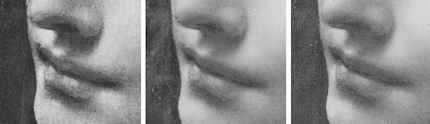


In between the two photographs (the post-cleanings photographs are grey-scale conversions from the large colour plate in the 1990 edition) this painting was restored twice by the Gallery, in 1940 and in 1981-82. It was said of the first cleaning that it had been undertaken because the picture was “much disfigured by dark spots and discoloured varnish”.
The second cleaning was undertaken because “The picture is still blistering. There are numerous old small retouchings, obvious repairs along the cracks and a large hole in the green robe lower left…[and because there was a] discoloured layer of old varnish with some blanching.”
The treatment report after the second restoration read: “The discoloured varnish and retouchings were removed with propan-2-ol and white spirit leaving a thick greyish layer of surface dirt and varnish remnants which was removed with a potassium oleate soap. The blisters were laid with gelatine and the painting restored with pigments in Paraloid B-72 and varnished with Ketone-N.”
It should be said that we are greatly indebted to the National Gallery for making its conservation records and photographs available to us. In this particular case, in setting out the post, we queried our own scanned post-cleaning photographs and re-scanned them as a precaution. The second scan was identical to the first. Thus, in so far as the (Gallery’s own published) photographs are reliable, the viewer may fairly make here an appraisal of the artistic cost (in terms of lost tonal differences; lost modelling of forms; lost details – as in curls of hair, for example) that was paid for the removal of the disfigurement represented by spots of darkened retouching. Moreover, such trade-offs, which are surprisingly common in museum restorations, are rarely strictly necessary – or necessary at all. Jean-Pierre Cuzin, the former director of paintings at the Louvre who resigned from the St Anne advisory committee, was of the opinion that the discoloured touches on the St Anne could simply have been repainted. (The varnish had been thinned, replenished and regenerated on a number of occasions since the war.) Such retouching practices are common: aside from its two major cleanings and restorations, this Pontormo had simply been retouched in 1955 – and again in 1979, just two years before its second cleaning.
Perhaps the last word should be given to Sègoléne Bergeon Langle who has recently commented: “As a general rule, I prefer old works to be cleaned only very lightly. You can never retrieve the original colours, what you get instead is the current state of the painting materials. Leaving a slight veil over the work makes it more harmonious.”
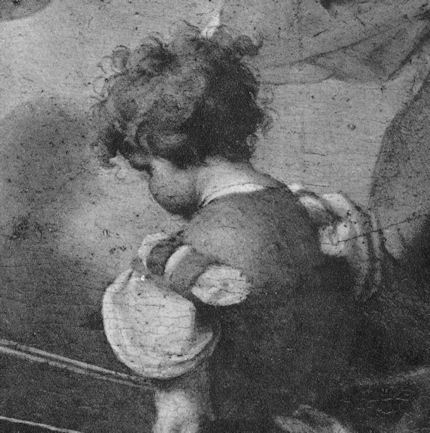
The National Gallery’s £1.5 billion Leonardo Restoration

Two decades after recognising that art restoration “discoveries” and “revelations” had become very big business, we encounter a blockbuster exhibition that required a Government indemnity of £1.5 billion and was specifically launched as a vehicle to celebrate a restoration that had yet to take place: “We started thinking about this five years ago, when we were beginning to plan the restoration of ‘The Virgin of the Rocks’, so an exhibition to celebrate that project seemed like the right thing to do.” So said Luke Syson, the curator of the National Gallery’s “Leonardo da Vinci: Painter of the Court of Milan” exhibition, in a BBC interview.
Museum restorations never take place in vacuums. If you build an exhibition on the proposed restoration of a very famous artist’s work you set certain narrative expectations in motion; create pressures and hopes of big, dramatic results. When the “Virgin of the Rocks” was put back on display after its restoration – and pronounced an entirely autograph Leonardo, even though the restorer had not removed all of his predecessor’s varnish – I was pleased to discuss the then forthcoming Leonardo exhibition with Luke Syson who said that its scholarly focus would be an analysis of the influence that a new type of Leonardo painting had had on his followers. Namely, that during the 15 or so years long gestation of the National Gallery’s version of the “Virgin of the Rocks” which was delivered unfinished in 1508, and the contemporaneous (1492-98) “Last Supper” in Milan, Leonardo’s painting style had become distinctly abstracted, less naturalistic and more metaphysical in character. When I expressed scepticism that this thesis might rest secure on two such different works as the “Virgin of the Rocks”, with its uncertain condition and status (the Gallery admits the picture is “manifestly uneven in finish and execution” and that there has been “a good deal of agreement that Leonardo himself painted little or none of it”), and the degraded, fragmented, many-times restored “Last Supper”, Syson disclosed that the Royal Academy’s full-size copy of the latter by Giampietrino was being borrowed. At this, I asked if the Gallery’s own Giampietrino “Christ carrying his Cross” (which had recently been relegated to the reserve collection – on Syson’s instruction, I learned) would also be included in the exhibition. It would not. This was disappointing – and a lost opportunity to right an ancient wrong.
The “Christ carrying his Cross” had been discussed by Larry Keith, the Gallery’s new head of conservation who has restored the “Virgin of the Rocks”, and Ashok Roy, the Gallery’s head of science, in the Gallery’s 1996 Technical Bulletin under the title “Giampietrino, Boltraffio, and the Influence of Leonardo”. This followed the restoration of two Giampietrinos (his “Christ” and his “Salome”) and Boltraffio’s “Virgin and Child”. A remarkable technical discovery had been made on “Christ carrying his Cross” the ramifications of which seemed not fully to have been appreciated. Keith and Roy did acknowledge that Giampietrino’s Leonardo borrowings were “not restricted to matters of composition alone, but also include other aspects of painting technique”; they granted that the “strong chiaroscuro and dark backgrounds of Giampietrino’s small format panels are clearly an attempt to emulate the more striking pictorial effects that Leonardo had introduced to Milan”; they explicitly acknowledged that Giampietrino’s painting technique was much influenced by Leonardo’s, and that this could be “seen in the sfumato and relief of the National Gallery Christ carrying his Cross” – which painting was “clearly derived from Leonardesque prototypes” and for which “A silver-point study of Christ carrying his Cross by Leonardo [was] clearly the compositional source…” And yet, despite all of this, they seemed at pains to cast Giampietrino as a pronouncedly lesser follower of Leonardo than Boltraffio.
While excluded from the forthcoming show, Giampietrino’s “Christ” has at least been liberated from the reserve collection, making it possible for the picture and its condition to be studied before visiting the Leonardo blockbuster. Not only is it as closely related to Leonardo’s imagery and methods as has been acknowledged, it is arguably the best preserved Renaissance picture in the National Gallery. Its good condition is a byproduct of what the Gallery describes as “an unusual pigmented glaze layer”. After carefully building and modelling his forms with successive layers of paint and glazes to “an illusion of relief”, Giampietrino covered the whole painting with a single “final extremely thin overall toning layer consisting of warm dark pigments and black”. This had had remarkable aesthetic and physical consequences. The layer was contemporary with the painting and, being composed of walnut oil with a little varnish, resistant to the usual varnish stripping solvents. The use of walnut oil further relates this picture to the “Virgin of the Rocks” where that oil had been used throughout.
During the picture cleaning controversies at the National Gallery after the Second World War, the possibility that just such toning overall finishes might exist on old paintings was advanced by Ernst Gombrich. In a letter to the Burlington Magazine in 1950 and in his 1960 book “Art and Illusion”, he cited a famous report by Pliny which described the overall dark veiling finishes that Apelles had applied to his paintings to wondrous effect, and asked “is it conceivable that such famous testimonies would never have induced a master of the sixteenth or seventeenth centuries to emulate Apelles and apply a darkening varnish to achieve a more subtle tonal unity?” He then reflected “I do not think it is even claimed that our ‘safe’ cleaning methods could detect such a varnish, let alone that they could preserve it.” This provoked the National Gallery’s restorer Helmut Ruhemann (who had cleaned Leonardo’s “Virgin of the Rocks” in 1948-9 to unfortunate effect – see right) into a vehement dogmatic dismissal: “there is no evidence for anything so inherently improbable as that a great old master should cover his whole picture with a ‘toning down layer’.”
That Leonardo was a learned man and a reader of Pliny is acknowledged by both Syson and Keith in the present exhibition catalogue. In his 1962 Burlington Magazine article (“Dark Varnishes: Variations on a Theme from Pliny”), Gombrich repeated what Pliny had said of Apelles:
“He used to give his pictures when finished a dark coating so thinly spread that, by reflecting, it enhanced the brilliance of the colour while, at the same time, it afforded protection from dust and dirt and was not itself visible except at close quarters. One main purpose was to prevent the brilliance of the colours from offending the eye, since it gave the impression as if the beholder were seeing them through a window of talc, so that he gave from a distance an imperceptible touch of severity to excessively rich colours.”
How could the connection between Apelles’ final “dark coating so thinly spread” and Giampietrino’s “final, extremely thin overall toning layer [with] warm dark pigments and black” have passed without comment? The cleaning controversy of the 1960s had hardly faded from memory: as recently as 1985 it had been described by a subsequent director of the National Gallery, Neil MacGregor, as “one of the most celebrated jousts” in the Burlington Magazine. In the current National Gallery Technical Bulletin, (Vol. 32) Larry Keith, Ashok Roy, Rachel Morrison and Peter Schade, say of the restoration of the “Virgin of the Rocks” that while its practical intent was “primarily aesthetic” it also served to provide an example of the gallery’s interdisciplinary approach: “Whenever possible, major restorations are intended as the hub of a wide range of research activity that sees curators, scientists and restorers working together – increasingly alongside colleagues from other institutions”. Our criticsms of the Gallery’s customary use of restorations as effective “laboratory test cases” for conducting multidisciplinary research with an input from curators are longstanding, but what makes this unusual and pronounced “non-singing” of such a very important finding all the more perplexing is the fact that this discovery may be the tip of a scholarly iceberg. Tucked in footnote 24 of the 1996 Keith/Roy account is a disclosure that such overall toning layers are “quite rare in Italian painting of the period” and that they “may be confined to Milanese technique”. Did this mean that other instances had been found at the Gallery? Or even, given the Milanese locus, that Leonardo himself might have been the instigator or a user of such applications? (Kenneth Clark had earlier attributed disparities of finish in the “Virgin of the Rocks” precisely to damaged glazes – see right.)
When Larry Keith writes in the current catalogue that Leonardo exploited oil paint in the “Virgin of the Rocks” for its “subtle transitions and distinctions within the deepest tones, all of which were carefully orchestrated within a system of unified lighting”, he might as appropriately be describing the well-preserved effects of Giampietrino’s “Christ” as those in the “Virgin of the Rocks” where, despite the picture’s acknowledged “inconsistencies” of finish, Leonardo is said to have created a “new and remarkable unified coherence…by a carefully considered manipulation of lighting, colour and tonal values”.
Whatever the merits of Giampietrino as an artist, no Renaissance work in the Gallery shows a more tightly and subtly controlled overall development of forms, tones, colours, and expressively purposive lighting, than his “Christ”. It was unjust if not perverse when Keith/Roy, gave the laurel to Boltraffio, in part as “an artist capable of a more subtle understanding of Leonardo” but also as one who had been working in Leonardo’s studio “by 1491”, as opposed to Giampietrino of whom “it is not certain how much direct contact [he] would have had with Leonardo’s actual painting methods, and it would be misleading to assume that the imitation of Leonardo’s effects required direct reproduction of his techniques.” Under what circumstances and on whose authority other than Leonardo’s, might someone have made a full sized, exactly matching, oil-painted copy of the “Last Supper”? Besides which, in the current catalogue, Minna Moore Ede, when describing Giampietrino’s copy of Leonardo’s “Last Supper” as being with its “great clarity and three-dimensionality” the most faithful and accurate record of all, discloses that Giampietrino, just like Boltraffio, is now understood to have been a live-in apprentice who joined Leonardo’s workshop in the mid 1490s.
In the Technical Bulletin Keith/Roy saw “differences of palette” between the “more highly saturated local colour” of Giampietrino’s copy of Leonardo’s “Last Supper” and a “pictorial unity produced by a tightly controlled, restricted range of tone and value” in the work itself. That reading has been dropped: Keith now sees (Leonardo exhibition catalogue entry, p. 70) that the “Last Supper” was, as Giampietrino’s copy had testified, executed in a “higher-keyed, lighter palette” than that of the London “Virgin of the Rocks”.
Even if Giampietrino’s work had been “essentially imitative, showing more of an attempted simulation of the painted appearance of Leonardo’s works than an understanding of his ideas”, as opposed to Boltraffio’s “more sophisticated” grasp, it might for that very reason leave him the more reliable guide to the original appearances of Leonardo’s paintings than Boltraffio in his more ambitious attempts to think and compose in the manner of his master and superior. In their 1996 account, Keith and Roy undermine their own slur that Giampietrino’s overall toning layer attempted a spurious impression of a Leonardesque suppressed colourism by explaining how, in his “Christ”, Giampietrino had covered his white gesso ground with “a stiffly brushed, rather opaque imprimiture of a light brownish grey”, while for his “deep red” draperies he had first applied “an unusual strongly coloured dense red-brown underpaint consisting of vermilion, red earth and black, with an increased proportion of black used under the shadow of the folds.” Those passages of painting were further reinforced with “dark red glazes”. Taken together, it was precisely admitted that (- and quite remarkably Apelles-like), “The overall effect is restrained in spite of the intensity of colour and creates a more naturalistic effect.”
The late-discovered existence of Giampietrino’s dark toning layer constituted a repudiation of the Gallery’s former head of science, Joyce Plesters, who (in the Burlington Magazine in 1962 – “Dark Varnishes – Some Further Comments”) had parodied the very idea as a “crude device of indiscriminately deadening all the colours by the application of an overall yellow, brown, or blackish varnish”. In 1996 Plesters was then still alive (as was a long-serving trustee of the National Gallery, Denis Mahon, who had joined her in attacks on Gombrich in the 1962 Burlington Magazine – “Miscellanea for the Cleaning Controversy” ). In 1996 I asked Gombrich if the Gallery had informed him of its discovery of an overall toning layer of “warm dark pigments and black in a medium essentially of walnut oil, with a little resin”. He said not but that he was pleased to learn of the Gallery’s “final conversion to an obvious truth”. We published our first account of this episode thirteen years ago (“The Unvarnished Truth”, Art Review, November 1998). Could it be that a continuing institutional desire to spare the posthumous blushes of departed Gallery players who bungled in spectacular fashion is permanently to blight an interesting artist’s reputation, retard the gallery’s own (in many respects admirable and generously shared) scholarship and thwart full recognition of the achievements of one of the most distinguished art historians to have made home in this country?
Michael Daley
Comments may be left at: artwatch.uk@gmail.com

Above, Fig. 1: “Christ carrying his Cross” by Giampietrino. NG 3097, c.1510-30. Poplar, 60 x 47 cm.



“There is no longer any doubt that our Virgin of the Rocks is a second version of the subject, undertaken by Leonardo some twenty years after the picture in the Louvre…”
On the faces of the Virgin and the angel (Figs. 7 & 8 below), he reflected:
“It is uncertain how much of this replica he painted with his own hand, and this head of the Virgin is the most difficult part of the problem. It is too heavy and lifeless for Leonardo and the actual type is un-Leonardesque; yet it seems to be painted in exactly the same technique as the angel’s head in the same picture…”
Of the angel, he wrote:
“This is the one part of our Virgin of the Rocks where the evidence of Leonardo’s hand seems undeniable, not only in the full, simple modelling, but in the drawing of the hair. The curls round the shoulder have exactly the same movement as Leonardo’s drawings of swirling water.”
Even so, he added:
“Beautiful though it is, this angel lacks the enchantment of the lighter, more Gothic angel in the Paris version. It embodies the result of Leonardo’s later researches in which ideal beauty and classic regularity of chiaroscuro were combined, with a certain loss in freshness, but with an expressive power which almost hypnotised his contemporaries.”
In the 1990 re-issue, this note was added to Clark’s comments on the heads:
“As a result of the cleaning of the altarpiece in 1949 the differences between the heads are rather less apparent.”
It would be nice to take this as an official confession of a restoration injury within the Gallery (Clark had concluded that “A pupil did the main work of drawing and modelling, and before his paint was dry Leonardo put in the finishing touches. Most of these have been removed from the Virgin’s face but remain in the angel’s, where perhaps they were always more numerous.”) Consider, then, this account from a privileged art critic who was, so to speak, embedded in the Gallery’s conservation department during the recent, blockbuster-launching restoration, the Guardian’s Jonathan Jones:
“For a long time, the National has believed its Leonardo to be mostly the work of assistants, with only the basic design and some perfect parts – above all, that angel – recognisable as his handiwork. What a difference a cleaning can make. In its official statement yesterday, the gallery was naturally cautious (‘it now seems possible that Leonardo painted all the picture himself’); but talking to me over several weeks in the workshop, in front of the painting, the National’s experts made it clear they believe this to be a pure and unsullied painting by Leonardo’s own hand. ‘We now have a picture which I believe is entirely by Leonardo,’ said Luke Syson, curator of Italian Renaissance paintings and the man who has spearheaded this restoration. If he is right, this is a Leonardo to rank alongside The Last Supper and the Mona Lisa.”
Yes, if he is right – but what counts as “right” in matters of attribution? And in what sense do we “now have” a different picture? The restorer has claimed not to have removed all of his predecessor’s varnish, so nothing can have been seen that was not visisible in 1948-9. During this last restoration Syson claimed that “every age invents its own Leonardo.” Such art critical relativism might be taken as an innocuous socio-cultural observation were it not tied to the work of restorers who claim individual interpretive “rights”. The Gallery’s handbook “Conservation of Paintings” acknowledges that pictures are now “changed primarily for aesthetic reasons” (p. 53) and (p. 45) that restorations are carried out on the “aesthetic objectives of those responsible for the cleaning”. Moreover, (p. 53) although the “different aesthetic decisions” taken by individual restorers produce results that “may look very different”, all of such different outcomes are “equally valid”, provided they have been carried out “safely”.
In matters of aesthetic and artistic integrity, the “safety” or otherwise of the cleaning materials is a red herring – if pictures end up looking different, they are different, and these differences are material and irreversible. It is therefore vital that there be the fullest possible disclosure of the changes that are made – especially those made with the retouching brush.


Lucian Freud’s blast against picture restorers, and a fellow painter’s note of appreciation

In his book “Man with a Blue Scarf: On Sitting for a Portrait by Lucian Freud”, Martin Gayford reports that Neil MacGregor, when director of the National Gallery, “often met Lucian Freud wandering around there in the evening, and learned a lot from him because he sees as an artist. This is quite different from the angle of an art historian.” Unfortunately, there is one lesson that Mr MacGregor might appear not to have learnt from Lucian Freud.
Few of the artists who enjoy the privilege of being able to visit the National Gallery after hours, alone or with a few friends, have attacked the gallery’s picture restorers publicly, but it so happens that the late Lucian Freud was one who bit the hand that indulged him. We can thank Martin Gayford for putting Freud’s condemnation of the National Gallery’s and other restorers on the record in his account of a visit they made to an El Greco exhibition at the gallery in February 2004:
“It is a slightly eerie experience being almost alone in this place that is usually so packed. LF is struck by the great sense of reality of certain works – the St Louis from Paris, the boy with a lighted coal from Edinburgh, the wonderful portrait from Boston (but not its horrible frame). But overall, he is disappointed. He is particularly upset by the slick, glossy, over-cleaned, over-bright appearance of many of the works (including, sadly, St Martin). ‘I have never seen so many completely fucked-up pictures. Sometimes I feel I could almost name the Winsor and Newton white the restorer has used.’ LF is highly conscious of a painting’s physical constitution. He is already thinking, he says, about how his own works will age through time, and wishes restorers would allow ‘old things to look old’. He was utterly infuriated, years ago, by the effect of restoration on Piero di Cosimo’s Satyr Mourning over a Nymph (c.1495), in the National Gallery, which was previously a painting – with reclining nude, tender mourning faun and attendant dogs – he loved.”
This condemnation is notable for two reasons. First, Freud was demonstrably right (see below and right). Second, as a great modern painter, he gives the lie to the common restorers’ slur that their artist/critics mistake dirt and old varnish for original paint and are romantic traditionalists who cannot adjust their prejudices to the “reality” that old master paintings, when properly scrubbed, are just like modernist paintings – i.e. brighter, cleaner, thinner and flatter. Freud, on any reckoning, was no such creature: although working entirely and un-apologetically as a figurative painter, his means were (in the tense we must now sadly use) both personal and products of no age other than our our own. They were radical and fully cognisant of the wherefores of modernist picture-making – being, as John Wonnacott so perceptively and elegantly describes below, a kind of locally applied “analytic” cubism. And Martin Gayford quotes Freud’s own precise warning that an “excessive reverence for the art of the past would be, I imagine, completely crippling.”
Anyone who possesses a particular couple of books can gauge the error of the National Gallery’s picture cleanings and “restorations”. In 1938 the gallery’s then director, Kenneth Clark, published a fine book of black and white photographs of details from pictures in the gallery (“One Hundred DETAILS from Pictures in the National Gallery”). Those photographs were of very high quality and had been taken for scientific rather than aesthetic purposes. In 1990, the gallery re-published Clark’s book but, this time, with recent colour photographs. In a foreword to the new edition, Neil Macgregor wrote that in 1938 the National Gallery’s pictures were “among the dirtiest in the world”. (There is surely a study to be made of the almost pathological disposition of those commentators who equate evidence of aged materials in pictures with dirt.) MacGregor acknowledges that while Clark complains in some of his commentaries of pleasure lost as a result of the interposition of “discoloured varnish or […] clumsy retouchings”, he remained fearful of “what might be found if the golden veils of dirt and varnish were ever to be removed.” Clark had good reason to be fearful: his then recent cleaning of Velazquez’s full length portrait of Philip IV of Spain (the “Silver Philip”) had – rightly – unleashed a firestorm of criticism and controversy.
Mr MacGregor acknowledges that following the wholesale cleanings that took place at the gallery after the Second World War, many pictures were now “different in critical respects” from the paintings about which Clark had written. It might be tempting to take the phrase “different in critical respects” as a MacGregor-esque euphemism for Freud’s “completely fucked-up”, given that he acknowledged that readers possessing both editions of the book “will decide how much is gain, how much loss” as a result of those cleanings. Alas, from that point onwards, Mr MacGregor seems to have lashed himself to the mast of the Good Ship Conservation and kept private any reservations that he might have had about picture restorations.
Clark’s book paired photographs of similar subjects taken from pictures by different artists and eras. The two details published of the Piero di Cosimo of which Freud lamented, his “A Mythological Subject” (or “Satyr Mourning over a Nymph”), were paired with pictures of Rubens, in the case of Piero’s faun, and Hogarth (a cat from his “The Graham Children”), in the case of Piero’s portrayal of a dog. Clark appended this note on the latter:
“Hogarth enjoyed painting this cat so much that the Graham children look hollow and lifeless beside her. She is the embodiment of cockney vitality, alert and adventurous – a sort of Nell Gwynne among cats. Her vulgarity would hardly be noticeable, were she not confronted by the noble silhouette of Piero’s hound who regards her with the gravity of an antique philosopher. The novelist Paul Bourget, when asked what the English critic Walter Pater looked like, replied: ‘Il ressemblait à un amant de Circe transformé en dogue.’”
To appreciate the changes wrought on that hound and a nearby pelican, see Figs. 1 to 6, right. The colour photographs published in the 1990 edition are here shown in greyscale so that like may be compared with like for the purposes of easier and more revealing comparisons.
Michael Daley
A Reflection on the painting of Lucian Freud by the painter John Wonnacott:
I am told that on the blogosphere, I am yet again misquoted as saying that Lucian Freud couldn’t “compose” a picture for toffee. I am no more interested than was Lucian in rearranging objects to make art. What I actually said to the late Bruce Bernard over a bibulous Soho lunch for the Sunday Times colour supplement some twenty years ago was that Lucian couldn’t “design” a painting for toffee. We were talking only of his great late nudes. By contrast, an early head like the John Minton could hang next to Van der Weyden, with its delicate surface and clarity of design. When Bill Coldstream, Lucian’s contemporary and equal, made a paint mark in response to appearance it was related immediately to every other mark on the surface, leading the eye from edge to edge of the picture; that is, drawing as design. Lucian’s brush marks were related directly only to others within the particular object of his scrutiny. As Bruce Bernard went on to quote me: no one else could paint so intensely and so powerfully within the figure.
Never the less I was wrong.
Lucian, as Martin Gayford records in his book the “Man with a Blue Scarf”, always worked standing up so that he could dart backwards and forwards from his easel to subject particular objects to closer observation. In the grandest of the late images, different areas of the painting would be created from different viewpoints, different angles, different distances. These areas seem to crash in to each other, along surface fault lines that I at least find visually exhilarating. Whether this is design or anti-design matters not, it is brilliant and original.
I have been asked to compare Lucian Freud’s approach to painting a Royal Portrait with my own. When I was commissioned to paint the Royal Family I virtually lived in the Palace for a year, trundling my easels and materials, Spencer-like, from the “artist studio” right round to the White Stateroom where Lavery had made his equally large 1913 painting, of George V and family. I drew and redrew the room as the central subject of my design, only occasionally meeting my Royal sitters, about seven hours with each, on different sittings, allowing their figures to grow from and into my design. In Martin’s book we see Lucian standing some two metres from the Queen with a tiny canvas on a simple radial easel. He had the courage to deal with even so eminent a figure just as he dealt with every other human being: to quote his own words, “zoologically”.
Asked what his Royal sitter had thought of John Wonnacott, I regret to pass on the disappointingly minimal – – – – “scruffy”!
John Wonnacott’s magnificent portrait group of the Royal Family is in the collection of the National Portrait Gallery, where, since the arrival from the Tate of Sandy Nairne, as director, it has been consigned to the reserve collection. It can, however, be viewed on request.
Comments may be left at: artwatch.uk@gmail.com


Why is the Metropolitan Museum of Art afraid of public disclosures on its picture restorers’ cleaning materials?
Many museums have mastered the art of presenting their picture restorations as miraculous recoveries that preclude any need for examination or criticism. A few days after our post on secrecy and unaccountability at the Metropolitan Museum of Art, a Public Relations officer at the museum, in the presence of Artwatch International’s executive director, James Keul, asked television crew members who had just interviewed Michael Gallagher, the Met’s head of picture conservation, not to broadcast his comments on cleaning solvents, any mention of which would “open the doors for critics”.
There are strong – but not good – reasons why a museum might wish to avoid discussions on the materials that restorers use. In hope of prising the Met’s doors, we re-visit the museum’s secret 1971 cleaning of Velazquez’s great portrait Juan de Pareja at Wildenstein and Company. We do so in the light of four documents: an untitled, undated Met booklet; a special conservation issue of the Met’s Bulletin (winter 1993/94); and two accounts given by the Met’s then director, Thomas Hoving, in his books of 1993 (Making the Mummies Dance) and 1996 (False Impressions). None of these identifies the solvents and varnishes used on what had been one of the world’s best preserved Velazquezes.
Restorations take place within general cultures and within local/institutional cultures. Healthy cultures require debate and transparency. Unfortunately the richly-funded, impregnably protected Met sometimes seems to take itself as the summation of Culture. When, in 1971, the museum snatched Juan de Pareja from the impoverished and enfeebled British (who had owned it for centuries), institutional pride was fit to burst. The Met booklet carried entries from the President of the Board, Douglas Dillon; the Director, Thomas Hoving; the Vice-Director and Curator in Chief, Theodore Rousseau; the Curator in Charge, European Paintings, Everett Fahy; and the “Conservator”, Hubert von Sonnenburg. Before the sale, Hoving, Rousseau, Sonnenburg and Fahy had flown to London, Madrid, and Rome – a sort of “boy-gang” playing at spreading rumours like “the disinformation section of the KGB”, as Hoving, (who later claimed to have discussed with Wildenstein’s how to “manipulate the art press and crank up the rumor mill” in a general strategy of “dissimulation and misleading rumors”), put it.
When bought, the picture was not paraded to the Met but “sneaked” into Wildenstein and Company “for secrecy”, partly because funds had been committed without the Board’s knowledge but also because, as Hoving put it, the Board had to remain longer in the dark as “total secrecy” would still be needed to “prepare our public relations stance” and “have the time to clean it.” The deceiving of the public was absolute: for a short period before the restoration, the picture was exhibited to New Yorkers as Wildenstein’s own property. Ignoring back-room machinations, the crucial question is: Why should a miraculously well-preserved, three and a quarter century old unlined canvas, have immediately been subjected to the traumas of a rushed restoration before the Board and the city might learn of the acquisition?
Hoving deferred to Sonnenburg on matters of connoisseurship and artistic technique, and had abnegated all responsibility for deciding whether or not to buy the picture: “back in New York with Chairman Dillon, Rousseau and I were on pins and needles awaiting Sonnenburg’s word. Would it be yes, or forget it? ” When Hoving, Sonnenburg, Rousseau and Fahy assembled before the painting in London, the Met’s conservation oracle suavely predicted a new and different picture that would be liberated dramatically from within a yellowed varnish tomb. Hoving sold those predictions of an even greater artistic glory to the Met’s big-wigs, some of whom had personally pledged hundreds of thousands of dollars. Velazquez’s mixed-race assistant with “dark-brown flesh” would emerge with “rosy” flesh tones and a nice clean “grey” doublet. Thus were the museum’s key players guaranteed a dramatic restoration result that would “present” as a further triumph of their collective perspicacity – and also, by eliminating any trace of Radnor family restorations (restorations that had been posited but nowhere established by Sonnenburg), expunge all historical and aesthetic continuities and make the picture entirely their own.
In such possessive and chauvinistic contexts, admitting the possibility of errors, aesthetic losses, or regrets, becomes unthinkable. This restoration would be – must be – beyond appraisal, reflection, debate or criticism. But given that no artist, writer or musician is above evaluation and criticism, why should a technician, acting on what was by common agreement the finest creative work of one of the world’s greatest artists, have been so indulged? And for that matter, why should every Met restorer be allowed to “touch base” on whatever he takes to be a picture’s bedrock “original” surface? How original can a repeatedly solvent-invaded, swab-abraded surface be?
Sonnenburg, working under intense pressure to complete before any political or journalistic exposure of the secrecy, on a script of his own writing, proved himself right to Hoving’s satisfaction: “the most astounding feature of the work was that there was hardly any color in the picture.” Purging the picture of extraneous “varnishes,” or what Hoving called “gunk” transformed the picture, but at what cost? Looking at the booklet’s now historically precious fold-out spread of three identically sized and printed full colour plates that recorded the restoration in progress (see previous post), it would seem that the original “varnished” state was indeed more, and more variously, colourful.
Sonnenburg’s high reputation as a moderate, risk-avoiding restorer stood on his having spent several years as an apprentice to the most famously cautious, slow-working and aesthetically alert restorer, Johan Hell. In Britain, Hell’s restorations were greatly preferred by artists to those of his fellow German émigré Helmut Ruhemann, who established the National Gallery’s highly controversial in-house restoration department after the Second World War. The President of the Royal Academy, Sir Gerald Kelly, entrusted his own grandest works to Hell’s varnishing technique.
By hiring Sonnenburg in the 1960s, the Met put cultural distance between its earlier troubled restorations and those then raging at the National Gallery, but it did so without anyone fully comprehending Hell’s philosophy or method. For a time, Sonneburg was succeeded at the Met by the British restorer John Brealey who had also studied with Hell. Brealey’s disastrous restoration of Velazquez’s Las Meninas at the Prado (see right) shows him to have been no proper student of Hell’s (– a judgement endorsed to us by Dr Hell’s late widow, Kate). The Met booklet sequence makes clear that, on the great Juan de Pareja, Sonneburg proceeded in outright violation of his declared master’s precepts and practices. By swiftly stripping the picture from one side to the other, instead of first establishing the antiquity of the “varnish” and only then, perhaps, proceeding to clean gradually and equally overall, Sonneburg embraced the practices of Ruhemann and repudiated those of his master (- to whose work we shall return in future posts).
The cover photograph of the Met booklet shows the face in detail. A close-up reveals a system of open and exposed cracking that is more visually disruptive than was ever recorded before or after the restoration (see above right). We do not know how – or with what solvents – the painting had been cleaned before that point. There is no indication of when the photograph was taken. We do not know what steps were taken to minimise the visual disruption of those cracks afterwards. We do know – as Sonnenburg must have – that Hell would never have arrived at that point in a restoration; would never have stripped a picture of all varnish, even into its cracks, for fear of letting his solvents invade the paintwork and attack the exposed paint/ground interface.
There may be irony in the fact that the heavy restoration doors now being slammed at the Met have, for five years past, been generously and most helpfully opened to us at the National Gallery in London.
Michael Daley
Comments may be left at: artwatch.uk@gmail.com